

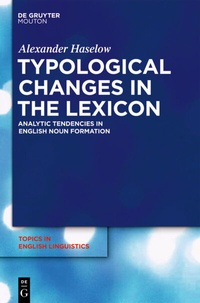
Typological Changes in the Lexicon
Description

This is the first study of the typological change of English from a synthetic towards an analytic language that focuses exclusively on the lexical domain of the language. It presents an innovative approach to linguistic typology by focusing on the different encoding techniques used in the lexicon, providing a theoretical framework for the description of structural types (synthetic, analytic) and encoding techniques (fusional, isolating, agglutinative, incorporating) found in the lexicon of a language.
It is argued that, in the case of English, the change from syntheticity to analyticity did not only affect its inflectional system and the encoding of grammatical information, but also the derivational component. Based on a cognitive approach to derivation, the book provides empirical evidence for a considerable decline in the use of synthetic structures and a trend towards higher degrees of analyticity in a specific lexical domain of English, the formation of nouns by means of derivation. The full extent of this change surfaced during the transition from Old English to early Middle English, but it was later partly reversed though influence from French. The typological shift was thus the result of a global structural reorganization of the language that resulted in a fundamental change of the structure of words.
The book also presents a comprehensive account of the historical development of nominal derivation from the beginnings of Old English until the end of the early Middle English period. Based on empirical data from written sources the study documents the frequency of use of all Germanic-based derivational morphemes for nominalizations over different subperiods and discusses their origin as well as important changes of their semantic and morphological properties.
More details
Other editions
Additional editions
Person
Content
- Intro
- Acknowledgements
- Contents
- Abbreviations
- 1. Introduction
- 1.Preliminaries
- 2.The goals of the present study
- 3.The structure of the present study
- 4.Studies on the development of English derivational morphology
- 4.1.General accounts
- 4.2.Studies on quantitative changes in the use of prefixes and suffixes
- 5.The typological change of English word-formation
- 6.Two scenarios
- 2.Syntheticity and analyticity in the lexicon
- 1.Introduction
- 2.Overview of past studies of morphological typology
- 2.1.Morphological typology and derivation
- 2.2.General remarks
- 3.Language change and morphological typology
- 3.1.Sapir's concept of 'drift'
- 3.2.Dixon's typological clock
- 3.3.Typological changes in IE languages
- 4.The structural types of encoding lexical information
- 4.1.Analytic encoding techniques
- 4.2.Synthetic encoding techniques: Agglutination and fusion
- 5.The status of zero-derivation: synthetic or analytic?
- 6.A typological profile of Old English
- 7.Conclusion
- 3.The framework: Suffixation and conceptual categories
- 1.Introduction
- 2.Grammatical vs. semantic analysis of derivatives
- 3.Semantic description of suffixes
- 4.The approach taken in the present study
- 4.1.Word-formation rules from a cognitive perspective
- 4.2.Schemas
- 4.3.Conceptual categories
- 4.4.The role of suffixes in a schema-based approach
- 4.5.Advantages of the schema-based approach
- 5.The five conceptual categories
- 5.1.Person
- 5.2.Object
- 5.3.Location
- 5.4.Action
- 5.5.Abstract
- 6.Major shortcomings of the schema-based approach
- 7.Summary
- 4.The corpus & methodology
- 1.Introduction
- 2.Linguistic variation
- 3.Selection of the texts
- 4.Methodology: Identifying nominal derivatives in the texts
- 5.Documentation of the results
- 6.Other criteria guiding the empirical analysis
- 6.1.Compounds with complex determinatum
- 6.2.The dividing line between suffixoids and suffixes
- 6.3.Zero-derivation
- 7.Productivity in word-formation
- 5.Category 1: Person
- 1.Introduction
- 2.Person-noun suffixes in OE and early ME: The data
- 2.1.-D
- 2.2.-EL
- 2.3.-EN
- 2.4.-END
- 2.5.-ERE
- 2.6.-ING
- 2.7.-LING
- 2.8.-OR
- 2.9.-Ø (zero-derivation)
- 2.10.-ESTRE
- 3.Summary
- 6.Category 2: Object
- 1.Introduction
- 2.Object-noun suffixes in OE and early ME: The data
- 2.1.-D
- 2.2.-DOM
- 2.3.-EL
- 2.4.-EN
- 2.5.-UNG
- 2.6.-Ø (zero-derivation)
- 2.7.Minor Formations
- 3.Summary
- 7.Category 3: Location
- 1 Introduction
- 2.Location-noun suffixes in OE and early ME: The data
- 2.1.-ÆRN
- 2.2.-D
- 2.3.-DOM
- 2.4.-EL
- 2.5.-EN
- 2.6.-UNG
- 2.7.-Ø (zero-derivation)
- 2.8.Minor formations
- 3.Summary
- 8.Category 4: Action
- 1.Introduction
- 2.Action-noun Suffixes in OE and early ME: The Data
- 2.1.-D
- 2.2.-EN
- 2.3.-LAC
- 2.4.-NESS
- 2.5.-UNG
- 2.6.-Ø (zero-derivation)
- 2.7.Minor Processes
- 3.Summary
- 9.Category 5: Abstract
- 1.Introduction
- 2.Abstract-noun suffixes in OE and early ME: The data
- 2.1.-D
- 2.2.-DOM
- 2.3.-EN
- 2.4.-HAD
- 2.5.-LAC
- 2.6.-NESS
- 2.7.-RÆDEN
- 2.8.-SCIPE
- 2.9.-UNG
- 2.10.-Ø (zero-derivation)
- 2.11.Minor Processes
- 3.Summary
- 10.The development of Old English noun suffixes
- 1.Introduction
- 2.Statistical analysis
- 3.Overview of the empirical data
- 3.1.Person: From nine suffixes to four
- 3.2.Object: Loss of morphological marking
- 3.3.Location: Loss of all suffixes
- 3.4.Action: From six suffixes to two
- 3.5.Abstract: From ten suffixes to eight
- 3.6.Summary suffixation
- 4.The overall frequency of nominal derivatives
- 5.Asymmetries in Old English and early Middle English derivation
- 6.The frequency of noun suffixes from a formal perspective
- 7.Conclusion
- 11.The typological change of English word-formation
- 1.Introduction
- 2.Derivation in Old English
- 3.The foundation of the PDE system of nominal derivation
- 4.The loss of categories
- 5.The change of the status of the base form
- 5.1.Root-based morphology
- 5.2.Stem-based morphology
- 5.3.Word-based morphology
- 5.4.The development towards isolated morpheme boundaries
- 6.Language contact and the re-introduction of stem-based morphology
- 7.Summary
- 12.Derivation and inflection: A typological perspective
- 1.Introduction
- 2.The classical distinction between inflection and derivation
- 3.The inflection - derivation continuum
- 4.Inflection, derivation and the loss of morphological markers
- 5.The loss of bound morphemes in derivation and inflection
- 5.1.Asymmetry in the number of morphemes in inflection and derivation
- 5.2.The survival of seven derivational suffixes 260 6. Summary
- 13.Noun formation after the early ME period
- 1.Introduction
- 2.The impact of French on English derivation
- 3.A typology of noun suffixes added to the inventory of English derivational morphology
- 4.The structural consequences of lexical borrowing
- 5.Summary
- 14.Conclusion
- 1.The point of departure
- 2.The results
- 3.The reasons for the typological change of English
- 4.Final remarks
- Notes
- References
- Subject index
