

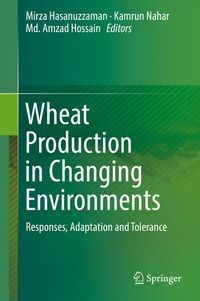
Wheat Production in Changing Environments
Description

This book presents recent advances in global wheat crop research, including the effects of abiotic stresses like high and low temperatures, drought, hypoxia, salinity, heavy metals, nutrient deficiency, and toxicity on wheat production. It also highlights various approaches to alleviate the damaging effects of abiotic stress on wheat as well as advanced approaches to develop abiotic-stress-tolerant wheat crops.
Wheat is probably one of the world's most important cereals; it is a staple food in more than 40 countries, and because of its adaptability is cultivated in almost every region. Global wheat production has more than doubled in the last 50 years due to higher yields. However, despite their high yield potential, modern wheat cultivars are often subject to crop loss due to the abiotic stresses. As such, plant breeders have long aimed to improvetolerance in order to maintain yield.
Written by 85 experts, and offering the latest insights into wheat responses and tolerance to various abiotic stresses, it is a valuable tool for agronomists, plant breeders, plant physiologists and students in the field of plant science and agriculture. It is the first book to comprehensively cover past and current abiotic stress problems and tolerance mechanisms.
More details
Other editions
Additional editions
Persons
Dr. Mirza Hasanuzzaman is a Professor of Agronomy at Sher-e-Bangla Agricultural University in Dhaka, Bangladesh. His current work is focused on the physiological and molecular mechanisms of environmental stress tolerance. Dr. Hasanuzzaman has published over 80 articles in peer-reviewed journals, edited six books and written 30 book chapters on various aspects of plant physiology, plant stress tolerance, and crop production. He serves as an editor and reviewer for more than 50 peer-reviewed international journals and was a recipient of the 'Publons Peer Review Award 2017 and 2018'. In addition, he was selected for the World Academy of Science Young Scientist Award (2014).
Dr. Kamrun Nahar is an Associate Professor at the Department of Agricultural Botany, Sher-e-Bangla Agricultural University, Dhaka, Bangladesh. An expert on plant stress physiology, she serves as an editor and reviewer for numerous international journals, and is an active memberof 20 professional societies.
Dr. Mohammad Amzad Hossain is a Professor at the Subtropical Field Science Center, University of the Ryukyus, Okinawa, Japan. An expert on tropical plant cultivation science, agronomy, organic farming, and weed science, he received the Weed Science Society of Japan Award for Prominent Achievements and the Okinawa Research Encouragement Award (Natural Science) in 2005 and 2014, respectively.