

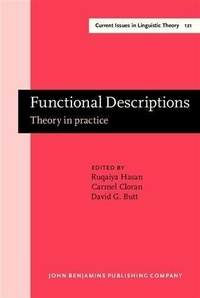
Functional Descriptions
Theory in practice
1st Edition
Published on 28. June 1996
XXXVI, 381 pages
978-90-272-7630-8 (ISBN)
Description

This volume focuses on the relation between theory and description by examining aspects of transitivity in different languages. Transitivity - or case grammar, to use the popular term - has always occupied a centre-stage position in linguistics, not least because of its supposedly privileged relation to states of affairs in the real world. Using a systemic functional perspective, the ten papers in this volume make a contribution to this scholarship by focusing on the transitivity patterns in language as the expression of the experiential metafunction. Through a study of different languages - English, Dutch, German, Finnish, Chinese and Pitjantjatjara - the contributors provide functional descriptions of the various categories of process, their participants and circumstances, including phenomena such as di-transitivity, causativity, the get-passive, etc. With the relation between theories and descriptions running through the ten chapters of this volume as sometimes an overt and sometimes a covert theme, the chapters point to the nature of the linguistic fact which is linked ineluctably on the one hand to the nature of the theory and on the other to the speakers' experience of the world in which they live.
The majority of papers included in the volume derive from the 19th International Systemic Functional Congress at Macquarie University.
The majority of papers included in the volume derive from the 19th International Systemic Functional Congress at Macquarie University.
More details
Other editions
Additional editions
Book
06/1996
John Benjamins Publishing Co
€137.80
Shipment within 10-15 days
Persons
Content
- FUNCTIONAL DESCRIPTIONS THEORY IN PRACTICE
- Editorial page
- Title page
- Copyright page
- Acknowledgments
- Table of Contents
- About the Authors
- Theories, Maps and Descriptions: An Introduction
- 1. Function and description
- 2. Functional descriptions: some fundamental concepts
- 3. Universal descriptions: Vision without perspective?
- 4. About the chapters in this volume
- 5 Conclusion
- References:
- 1. On Grammar and Grammatics
- 1. The problem
- 2. Grammar and grammatics
- 3. Defining grammar
- 4. The emergence of grammar through time
- 5. Grammar in semiotic function
- 6. Grammar as theory
- 7. How big is a grammar?
- 8. How does your grammar grow?
- 9. Grammar as multiple perspectives
- 10. Indeterminacy in grammar
- 11. Some matching features
- 12. Paradigmatic orientation and delicacy
- 13. A note on delicacy
- 14. A note on the corpus
- 15. Trinocular vision
- 16. Indeterminacy in grammatics
- 17. A note on realisation and instantiation
- 18. Realisation and instantiation: some specific analogies
- 19. Centricity
- 20. A final note on grammatics
- References
- 2. On the Idea of Theory-Neutral Descriptions
- 1. New challenges to linguistic description
- 2. The disjunction between theory and description
- 3. Construing theory-description as a semiotic resource
- 4. The construction of theoretical meaning
- 5. Meeting new descriptive challenges
- 6. Conclusion
- Notes
- References
- 3. Ditransitivity and Possession
- 1. Introduction: ditransitivity and dative alternation
- 2. Relational transitivity
- 3. The eight-cell ditrans paradigm of the verb attribute
- 4. A general semantico-grammatical model of ditransitivity
- 5. Conclusion
- Notes
- Data Sources
- References
- 4. So Grammarians Haven't the Faintest Idea: Reconciling Lexis-oriented and Grammar-oriented Approaches to Language
- 1. Introduction
- 2. Lexis, delicacy, dependency and rank
- 3. The place of lexis in the lexicogrammar
- 4. A worked example
- 5. Conclusion
- Notes
- References
- 5. The Semantics of Get-Passives
- 1. Introduction
- 2. Criteria for the classification of get-passives
- 3. Semantic features of get-passives
- Notes
- Abbreviations:
- Data Sources:
- References
- 6. Causation in Dutch and French: Interpersonal aspects
- 1. Introduction
- 2. Causative constructions in Dutch and French
- 3. The semantics of causation
- 4. Realising the causative situation
- 5. Analytic causatives: an interpersonal interpretation
- 6. Conclusion
- Notes
- References
- 7. Process Types in Finnish: Implicate Order, Covert Categories, and Prototypes
- 1. Introduction
- 2. Issues to be discussed
- 3. Implicate order, covert categories, and prototypes
- 4. Experientially defined clause types in Finnish
- 5. Concluding remarks
- Notes
- Abbreviations
- References
- 8. The 'Complement' in Chinese Grammar: A Functional Reinterpretation
- 1. Introduction
- 2. The scope of the term 'complement'
- 3. The postverb: class features
- 4. The 'postverb': functional features
- 5. Experiential functions: the system of Phase
- 6. Textual functions in Chinese: a reinterpretation of 'complement'
- 7. Conclusion
- Notes
- Abbreviations
- Transcription
- References
- 9. Pitjantjatjara Processes: An Australian Experiential Grammar
- 1. Introduction
- 2. Material processes
- 3. Mental processes: perception and reaction
- 4. Verbal processes: saying
- 5. Behavioural processes
- 6. Relational processes: being and having
- 7. Topological perspective on process types
- 8. Conclusion: comparing grammars in a post-colonial context
- Notes
- Abbreviations
- References
- 10. Metalinguistic diversity: the Case from Case
- 1. Metalinguistic relativity
- 2. Metalinguistic diversity
- 3. Issues
- 4. Metalinguistic diversity
- Notes
- References
- Index
