

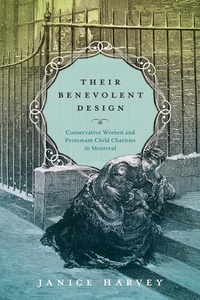
Their Benevolent Design
Conservative Women and Protestant Child Charities in Montreal
1st Edition
Published on 12. March 2024
418 pages
978-0-2280-2028-8 (ISBN)
Description

Throughout the nineteenth century poor relief in Quebec was private and sectarian. In Montreal bourgeois Protestant women responded by establishing institutional charities for destitute women and children.
Their Benevolent Design delves into the inner workings of two of these charities (the Protestant Orphan Asylum and the Montreal Ladies' Benevolent Society), sheds light on little-known aspects of the community's response to social inequality, and examines the impact of liberalism on changing attitudes to poverty and charity. Seeing charity as a class duty, elite women structured their benevolent design around the protection, religious salvation, and social regulation of poor children. Janice Harvey explores how these philanthropists overcame the constraints of social conventions for women in polite society, how charity directors devised and implemented institutional aid, and how that aid was used by families and experienced by children. Following the development of the charities through the end of the nineteenth century and into the early twentieth, the book explores the conflict that arose between these institutions and other social services, including those that advocated for foster care and so-called scientific charity. The 1920s marked a major social shift in how child poverty was understood and managed in Protestant Montreal.
Despite the gendered obstacles facing women in charity organization, Their Benevolent Design celebrates the remarkable ingenuity and independence of a group of Canadian women in shaping social aid and improving the grim realities of child poverty.
Their Benevolent Design delves into the inner workings of two of these charities (the Protestant Orphan Asylum and the Montreal Ladies' Benevolent Society), sheds light on little-known aspects of the community's response to social inequality, and examines the impact of liberalism on changing attitudes to poverty and charity. Seeing charity as a class duty, elite women structured their benevolent design around the protection, religious salvation, and social regulation of poor children. Janice Harvey explores how these philanthropists overcame the constraints of social conventions for women in polite society, how charity directors devised and implemented institutional aid, and how that aid was used by families and experienced by children. Following the development of the charities through the end of the nineteenth century and into the early twentieth, the book explores the conflict that arose between these institutions and other social services, including those that advocated for foster care and so-called scientific charity. The 1920s marked a major social shift in how child poverty was understood and managed in Protestant Montreal.
Despite the gendered obstacles facing women in charity organization, Their Benevolent Design celebrates the remarkable ingenuity and independence of a group of Canadian women in shaping social aid and improving the grim realities of child poverty.
Reviews / Votes
"The subject of institutionalized 'care' for children is not only historically important: it is an issue of our times. Their Benevolent Design is excellent social history that documents the activities and institutional apparatus of poverty relief at a key moment in Montreal's history. Harvey examines two important private charities founded and led by women, convincingly arguing that they provided essential (but not unproblematic) services for the city's desperate women and children, that they were sites of gender and class identity formation, and that they were a means by which elite conservative women shaped Montreal history." Tamara Myers, University of British Columbia and author of Youth Squad: Policing Children in the Twentieth Century "Harvey has devoted her career to providing this narrative with crucial nuance, particularly regarding how, for whom, and why charity was administered in nineteenth-century Montreal. Their Benevolent Design is a magisterial and highly engaging account that explores human agency with empathy and insight." Canadian Historical ReviewMore details
Series
Language
English
Place of publication
Montreal, QC
Canada
Target group
College/higher education
Edition type
Digital original
Illustrations
22 photos, 6 diagrams, 9 tables
22 photos, 6 diagrams, 9 tables
File size
13,54 MB
ISBN-13
978-0-2280-2028-8 (9780228020288)
Copyright in bibliographic data and cover images is held by Nielsen Book Services Limited or by the publishers or by their respective licensors: all rights reserved.
Schweitzer Classification
Other editions
Additional editions
Book
03/2024
McGill-Queen's University Press
€130.73
Article not available at the moment
Book
03/2024
McGill-Queen's University Press
€47.00
Shipment within 15-20 days
Person
Janice Harvey is a retired professor, now scholar in residence at Dawson College and a member of the Centre d'histoire des regulations sociales in Montreal.
Content
- Their Benevolent Design: Conservative Women and Protestant Child Charities in Montreal
- Cover
- Half Title Page
- Series Page
- Title Page
- Copyright
- Dedication
- Contents
- Tables and Figures
- Acknowledgments
- Abbreviations
- Introduction
- 1 A Poor Relief Network for Montreal's Protestant Poor
- "A MIXED SOCIAL ECONOMY"
- STATE SUPPORT FOR PRIVATE RELIEF INITIATIVES
- THE PRIVATE RELIEF NETWORK
- PROTESTANT CHURCHES
- PROTESTANT NATIONAL SOCIETIES
- PROTESTANT PRIVATE CHARITIES
- RESIDENTIAL CHARITIES FOR CHILDREN
- WOMEN
- THE ELDERLY
- THE MONTREAL PROTESTANT HOUSE OF INDUSTRY AND REFUGE (1863-1953)
- THE HOMELESS
- ANCILLARY INSTITUTIONS
- "EXTERNAL" SERVICES
- 2 "Endeavours to Do Good": The Protestant Orphan Asylum and the Ladies' Benevolent Society
- THE CHARITABLE ELITE
- CHARITABLE SUPPORT
- BENEVOLENT WOMEN'S SOCIETIES
- WOMEN'S CULTURE AND ITS IMPACT ON CHARITY WORK
- 3 Charity Management and Work
- ORGANIZATIONAL STRUCTURE
- MANAGEMENT WORK
- ATTENDANCE AT MONTHLY COMMITTEE MEETINGS
- SUBCOMMITTEES
- VISITING THE INSTITUTION
- FUND-RAISING
- THE COLLECTION
- ENTERTAINMENT EVENTS
- "MANAGER" TYPES
- RELATIONS WITH THE STAFF
- THE MATRON/SUPERINTENDENT
- THE TEACHER
- OTHER STAFF
- 4 Admissions: The Children and Their Families
- THE CHILD RECIPIENTS: GENERAL CHARACTERISTICS
- PARENTS AND KIN
- FAMILY SITUATION: POVERTY, ILLNESS, DEATH, AND LIFE CYCLE
- CHANGING ADMISSION POLICIES AND NEW SERVICES
- EPIDEMICS AND SPECIAL ANNEXES
- THE LADIES' BENEVOLENT SOCIETY AS A BOARDING FACILITY
- THE LADIES' BENEVOLENT SOCIETY AS AN INDUSTRIAL SCHOOL
- THE PROTESTANT ORPHANS' HOME "WITH CONVALESCENT WARDS"
- THE TWENTIETH CENTURY
- 5 In the Institutional Home
- THE HOME
- CONDITIONS IN THE INSTITUTIONS
- HEALTH
- DIET
- SCHOOL
- WORK
- PLAY
- A HOME?
- 6 Returning Home and Other Placement Policies
- RETURNING HOME AND PARENTAL RIGHTS
- ADOPTION
- APPRENTICESHIP
- APPRENTICESHIP OCCUPATION AND LOCALITY
- PROBLEMS AND ABUSE CASES
- POST-APPRENTICESHIP
- TO SERVICE
- THE TWENTIETH CENTURY
- 7 "Women's Social Sphere"
- PUBLIC APPEARANCES
- GENDERED SPECIAL QUALITIES
- THE REJECTION OF PLACING OUT
- OPPOSITION TO "SCIENTIFIC CHARITY"
- COOPERATION AMONG THE FEMALE CHARITIES
- Conclusion
- Epilogue
- Appendix: Protestant Charities in Nineteenth-Century Montreal, by Date of Establishment
- Notes
- Bibliography
- Index
