

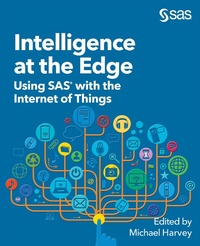
Intelligence at the Edge
Description

The world that we live in is more connected than ever before. The Internet of Things (IoT) consists of mechanical and electronic devices connected to one another and to software through the internet. Businesses can use the IoT to quickly make intelligent decisions based on massive amounts of data gathered in real time from these connected devices. IoT increases productivity, lowers operating costs, and provides insights into how businesses can serve existing markets and expand into new ones.
Intelligence at the Edge: Using SAS with the Internet of Things is for anyone who wants to learn more about the rapidly changing field of IoT. Current practitioners explain how to apply SAS software and analytics to derive business value from the Internet of Things. The cornerstone of this endeavor is SAS Event Stream Processing, which enables you to process and analyze continuously flowing events in real time. With step-by-step guidance and real-world scenarios, you will learn how to apply analytics to streaming data. Each chapter explores a different aspect of IoT, including the analytics life cycle, monitoring, deployment, geofencing, machine learning, artificial intelligence, condition-based maintenance, computer vision, and edge devices.
More details
Other editions
Additional editions

Content
- Intro
- Contents
- Preface
- About the Internet of Things
- About This Book
- We Want to Hear from You
- About the Author
- Chapter 1: Using SAS Event Stream Processing to Process Real World Events
- Introduction
- How Does SAS Event Stream Processing Work?
- What is a SAS Event Stream Processing Model?
- Processing Events in Derived Windows
- Examples of Event Transformations
- Streaming Analytics
- Addressing Big Data and the Internet of Things
- Conclusion
- About the Contributors
- Chapter 2: Linking Real-World Data to SAS Event Stream Processing Through Connectors and Adapters
- Introduction
- Publishers and Subscribers
- Writing Your Own Connector
- Orchestrating Connectors
- Alternative Client Transports for Adapters
- Connectors and Adapters Available with SAS Event Stream
- Processing
- Example: Using a File and Socket Connector and a WebSocket
- Connector
- Conclusion
- About the Contributor
- Chapter 3: Applying Analytics to Streaming Data
- Introduction
- The Multi-Phase Analytics Life Cycle
- Online and Offline Models
- Online Versus Offline Model Deployment
- Potential for Model Application
- Stability Monitoring
- Support Vector Data Description
- Application of Offline Models on Streaming Data
- Subspace Tracking
- Conclusion
- References
- About the Contributors
- Chapter 4: Administering SAS Event Stream Processing Environments with SAS Event Stream Manager
- Introduction
- Monitoring Your SAS Event Stream Processing Environment
- Executing Projects from SAS Event Stream Manager
- Governing and Testing Assets
- Handling Changes to ESP Servers
- Integrating with SAS Model Manager
- Accommodating Different User Roles
- Example: Deploying a Project Using a Job Template
- Conclusion
- About the Contributor
- Chapter 5: SAS Event Stream Processing in an IoT Reference Architecture
- What is an IoT Reference Architecture?
- IoT Reference Architecture Components
- Deployment Considerations
- Use Case
- Conclusion
- References
- About the Contributors
- Chapter 6: Artificial Intelligence and the Internet of Things
- Introduction
- What Do We Mean by Artificial Intelligence?
- How Does AI Interact with the Internet of Things?
- There's No Place Like Home: AI and IoT
- Creating and Remotely Deploying a SAS Deep Learning Image
- Detection and Classification Model
- What Will the Future Bring?
- Conclusion
- References
- About the Contributor
- Acknowledgment
- Chapter 7: Using Geofences with SAS Event Stream Processing
- What Is a Geofence?
- Understanding the Geofence Window
- Geometries
- Conclusion
- Reference
- About the Contributor
- Acknowledgments
- Chapter 8: Using Deep Learning with Your IoT Digital Twin
- Introduction
- How Can Analytics Be Used to Create a Digital Twin?
- Digital Twin Examples
- Anomaly Detection
- Predicting the Future with Your Digital Twin Model
- Using Your Digital Twin Model for Simulations
- Building Your Digital Twin Model
- Applying Deep Learning Techniques
- Real-time Application of Deep Learning in Your Digital Twin
- Applying Computer Vision Techniques
- Applying Recurrent Neural Networks
- Applying Reinforcement Learning Techniques
- Hyperparameter Tuning
- Conclusion
- References
- About the Contributor
- Chapter 9: Leveraging ESP to Adapt to Variable Data Quality for Location-Based Use Cases
- Introduction
- Use Cases
- Data Variability
- Leveraging SAS Event Stream Processing to Adapt
- Conclusion
- About the Contributor
- Chapter 10: Condition Monitoring Using SAS Event Stream Processing
- Introduction
- Experimental Setup
- Time Domain Analysis of Vibration Data
- Monitoring Specific Frequencies Using Digital Filters
- Monitoring the Whole Fourier Spectrum
- Monitoring the Whole Fourier Spectrum by Segments
- Conclusion
- References
- About the Contributors
- Chapter 11: Analytics with Computer Vision on the Edge
- Introduction
- Computer Vision with Deep Learning
- Advantages of Real-time Analytics on the Edge
- Computer Vision Applications in the IoT
- Conclusion
- References
- About the Contributors
- Summary
- IoT Partner Ecosystems
- Additional Resources
