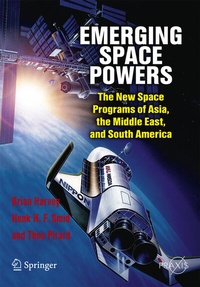
Emerging Space Powers
Description

This work introduces the important emerging space powers of the world.
Brian Harvey describes the origins of the Japanese space program, from rocket designs based on WW II German U-boats to tiny solid fuel 'pencil' rockets, which led to the launch of the first Japanese satellite in 1970. The next two chapters relate how Japan expanded its space program, developing small satellites into astronomical observatories and sending missions to the Moon, Mars, comet Halley, and asteroids.
Chapter 4 describes how India's Vikram Sarabhai developed a sounding rocket program in the 1960s. The following chapter describes the expansion of the Indian space program. Chapter 6 relates how the Indian space program is looking ahead to the success of the moon probe Chandrayan, due to launch in 2008, and its first manned launching in 2014. Chapters 7, 8, and 9 demonstrate how, in Iran, communications and remote sensing drive space technology.
Chapter 10 outlines Brazil's road to space, begun in the mid-1960's with the launch of the Sonda sounding rockets. The following two chapters describe Brazil's satellites and space launch systems and plans for the future. Chapters 13 and 14 study Israel's space industry. The next chapters look at the burgeoning space programs of North and South Korea.
The book ends by contrasting and comparing all the space programs and speculating how they may evolve in the future. An appendix lists all launches and launch attempts to date of the emerging space powers.
Reviews / Votes
From the reviews:
"Emerging Space Powers . discuss the space programs in Japan, India, Iran, Brazil, Israel, and North and South Korea. . Five appendixes provide a helpful list of launches for the nations discussed, a very good descriptive list of the space institutes in Iran . and a list of UN space treaties. . competently done and will interest those who want to learn about the history, technology, and potential of the space programs in these countries. Summing Up: Recommended. Upper-division undergraduates, general readers, and professionals." (A. M. Strauss, Choice, Vol. 48 (1), September, 2010)
"In the 1950s and 60s, space activities were dominated by the two superpowers, the United States and the Soviet Union. . Towards the end of the 20th Century and in the first decade of the current century, new players arrived on the scene, notably India, Korea . Brazil, Israel, and Iran. These up-and-coming space powers are the subject of this comprehensive account. Well illustrated throughout, this hefty tome is a valuable one-stop reference for the status of the programmes in emerging space nations . ." (Peter Bond, The Observatory, Vol. 131 (1221), April, 2011)
More details
Other editions
Additional editions