

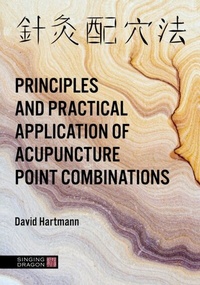
The Principles and Practical Application of Acupuncture Point Combinations
Published on 19. September 2019
504 pages
978-0-85701-352-1 (ISBN)
Description

A foundation textbook explaining how point combinations work in acupuncture practice. The book explains how each point works and how best to combine points for good clinical results. Students and practitioners need to respond to clinical challenges in creative and flexible ways and this book guides them in the art of construction of effective treatment protocols. Clinically useful combinations are presented throughout, along with case studies showing the application of theory to practice.
More details
Edition
Digital original
Language
English
Place of publication
London
United Kingdom
Publishing group
Jessica Kingsley Publishers
Edition type
Digital original
Illustrations
45 images
ISBN-13
978-0-85701-352-1 (9780857013521)
Copyright in bibliographic data and cover images is held by Nielsen Book Services Limited or by the publishers or by their respective licensors: all rights reserved.
Schweitzer Classification
Other editions
Additional editions
Book
09/2019
Singing Dragon
€68.50
Shipment within 3-4 weeks
Persons
David Hartmann is a lecturer at Endeavour College of Natural Health (ECNH), Australia. He is Director and Owner of 4 Little Monkeys Pty Ltd, a Fellow 5+ at Australian Acupuncture and Chinese Medicine Association (AACMA) and a member of the Chinese Medicine Board of Australia (CMBA).
Content
- Intro
- The Principles and Practical Application of Acupuncture Point Combinations by David Hartmann
- Foreword by John McDonald
- Acknowledgements
- Disclaimer
- Abbreviations and the Appendices
- Preface
- Part 1. The Foundations of Acupuncture Point Combinations
- 1. How I Treat Patients
- 1. Potential new patient
- 2. How I choose my points
- 3. Number of needles
- 4. Bilateral needling
- 5. Deliberate/sensible scattering
- 6. Patient positioning
- 7. Points on paper
- 8. In what order do I needle my points?
- 9. How do I needle?
- 10. Write the needle number down
- 11. Patient explanation
- 12. Universal Qì
- 13. Accessing Universal Qì
- 14. Needle retention time
- 15. Expecting results
- 16. Favorite channel
- 17. Favorite points
- 18. Follow-up phone call
- 2. Understanding Acupuncture Point Combinations
- 1. Why it matters
- 2. The dynamic movement of Vital Substances
- 3. Stagnations, stasis, accumulations
- 4. Stacking acupuncture points in one area
- 5. How do acupuncture point combinations work?
- 6. Local, adjacent, distal
- 7. Summary of good/bad acupuncture point combinations
- 8. Shapes, designs, patterns
- 9. Does it matter in what order the points are needled?
- 10. Cautions and contraindications with acupuncture point combinations
- 11. Treat the person, not the disease
- Part 2. The Framework of Acupuncture Point Combinations
- 3. How to Combine Acupuncture Points
- 1. Local and distal points on the same channel
- 2. Yin and Yáng partners - Wu Xíng
- 3. Yin/Yin partners - Six Divisions
- 4. Yáng/Yáng partners - Six Divisions
- 5. Points that treat the same Zàng Fu patterns
- 6. Points that treat the same signs/symptoms
- 4. Using Similar Pin Yin Names/Meanings When Combining Acupuncture Points
- 1. Pin Yin point combinations
- 2. SP 6 (San Yin Jiao) and TE 8 (San Yáng Luò)
- 3. LR 3 (Tài Chong) and ST 42 (Chong Yáng)
- 4. BL 17 (Gé Shu) and BL 46 (Gé Guan)
- 5. GB 15 (Tóu Lín Qì) and GB 41 (Zú Lín Qì)
- 6. KI 18 (Shí Guan) and CV 5 (Shí Mén)
- 7. BL 21 (Wèi Shu) and BL 50 (Wèi Cang)
- 8. LI 8 (Xià Lián) and ST 39 (Xià Jù Xu)
- 9. LI 9 (Shàng Lián) and ST 37 (Shàng Jù Xu)
- 10. KI 24 (Líng Xu) and HT 4 (Líng Dào)
- 11. CV 18 (Yù Táng), CV 21 (Xuán Ji) and BL 9 (Yù Zhen)
- 12. Feng points
- 13. Shén points
- 14. Tian points
- 5. Strategies/Types of Acupuncture Point Combinations
- 1. Top and bottom
- 2. Corresponding/mirroring
- 3. Local and distal
- 4. Left and right
- 5. Front and back
- 6. Whole body
- 6. Strategies/Types of Acupuncture Point Combinations - Small Combinations
- 1. Yuán (Original) Yin and Yáng
- 2. Crown and Third Eye
- 3. Triangle of Power (San Jiao Lì)
- 4. Open the Four Gates (Sì Guan)
- 5. The Three Regions/Powers - Heaven, Earth, Human (Tian Dì Rén)
- 6. Three Yin sixes
- 7. The Great Five
- 8. Host-Guest combination (Yuán Source and Luò Connecting)
- 7. Strategies/Types of Acupuncture Point Combinations - Larger Combinations
- 1. Figure Eight
- 2. Zàng Fu/San Jiao balance
- 3. Chain and lock
- 4. Bright Foyer, Watch Tower, Court, Fence and Shield
- Part 3. Wu Xíng/Five Elements Point Category and Acupuncture Point Combinations
- 8. Wu Xíng/Five Elements Point Category - Introductory Concepts
- 1. Introduction to the Wu Xíng/Five Elements
- 2. Wu Xíng Shu/Transporting points
- 3. Wu Xíng points
- 4. Wu Xíng Horary points and the Chinese clock
- 5. Wu Xíng Mother and Child points
- 9. Wu Xíng/Five Elements Point Category - Intermediate Concepts
- 1. Wu Xíng Sheng/Generating cycle for chronic disorders
- 2. Wu Xíng Kè/Controlling cycle for acute disorders
- 10. Wu Xíng/Five Elements Point Category - Advanced Concepts
- 1. Wu Xíng Chéng/Overacting cycle for complicated disorders
- 2. Wu Xíng Wu/Insulting cycle for complicated disorders
- 3. Wu Xíng mix and match
- Part 4. Chinese Medicine Esoteric Categories and Acupuncture Point Combinations
- 11. Qi Qíng/Seven Emotions
- 1. Brief history of emotions
- 2. Chinese medicine view of emotions
- 3. The Heart Shén and emotions
- 4. The emotions and their associated Yin and Yáng organs and Wu Xíng/Five Elements
- 5. Zàng Fu patterns and emotions
- 12. Qí Jing Ba Mài/Eight Extraordinary Vessels
- 1. Definition of the Qí Jing Ba Mài
- 2. Brief history of the Qí Jing Ba Mài
- 3. Overview of the Qí Jing Ba Mài
- 4. Functions of the Qí Jing Ba Mài
- 5. When to use the Qí Jing Ba Mài
- 6. How to use the Qí Jing Ba Mài
- 7. Opening and coupled pairings of the Qí Jing Ba Mài
- 8. The Qí Jing Ba Mài
- 13. Wu Shén/Five Spirits
- 1. Further concepts to grasp
- 2. Wu Shén/Five Spirits
- 3. Urinary Bladder Wu Shén/Five Spirits points
- 14. Wu Xíng/Five Element Archetypes
- 1. Definition
- 2. Brief history/overview
- 3. Archetype relationships with the emotions and Wu Shén/Five Spirits
- 4. What are the archetypes?
- 5. What is discussed for each archetype
- 6. The archetypes
- Appendix 1: Key Terms - English, Pin Yin and Traditional Chinese Characters
- Appendix 2: Acupuncture Point Terms - English, Pin Yin and Traditional Chinese Characters
- Appendix 3: Acupuncture Point Terms - Pin Yin, English and Traditional Chinese Characters
- Appendix 4: Cautions and Contraindications When Using Acupuncture
- Part 1: Points that are contraindicated
- Part 2: Points to use caution on
- Appendix 5: Special Point Category Tables
- References
- Further Reading
- About the Author
- Index
- Blank Page
