

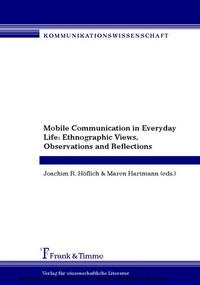
Mobile Communication in Everyday Life
Ethnographic Views, Observations and Reflections
1st Edition
Published on 1. January 2006
327 pages
978-3-86596-041-2 (ISBN)
Description

The mobile phone has become an integral part of our everyday life communication - in this sense a domestication of a 'nomadic' medium has taken place. For the very reason that the telephone has left its fixed home environment, it requires us to take an 'ethnographic view' in describing both this development and the changes taking place therein. Mobile Communication in Everyday Life takes a closer look at the mobile phone as an object of inquiry in the tradition of the so-called media ethnography. Consequently, the bene- fits and limitations of such research designs are the focus of the book. Some contributions focus on the tension between private and public communication, others on cultural dimensions. Overall, the book presents a range of the most up-to-date research in the field of mobile communication.
The Authors
Joachim R. Höflich is a professor at the University of Erfurt, Germany. He is also a leading expert in the field of mobile technologies and interpersonal communication. Joachim has published several books on the topic in German as well as many articles in English.
Maren Hartmann joined the University of Erfurt in 2004 (and can soon be found at the University of Bremen). Her research interests include media ethnographies, cybercultures and the domestication concept. She has published books as well as several articles on these topics.
The Authors
Joachim R. Höflich is a professor at the University of Erfurt, Germany. He is also a leading expert in the field of mobile technologies and interpersonal communication. Joachim has published several books on the topic in German as well as many articles in English.
Maren Hartmann joined the University of Erfurt in 2004 (and can soon be found at the University of Bremen). Her research interests include media ethnographies, cybercultures and the domestication concept. She has published books as well as several articles on these topics.
More details
Other editions
Additional editions
Maren Hartmann | Joachim Höflich
Mobile Communication in Everyday Life
Ethnographic Views, Observations and Reflections
Book
05/2006
1st Edition
Frank & Timme
€49.80
Shipment within 7-9 days
Content
1 - Contents [Seite 6]
2 - Introduction: The ethnographic view [Seite 12]
2.1 - Structure [Seite 16]
2.2 - Dedication [Seite 18]
2.3 - References [Seite 18]
3 - Places of Life - Places of Communication: Observations of Mobile Phone Usage in Public Places [Seite 20]
3.1 - Introduction: mobile communication and social arrangements [Seite 20]
3.2 - Mobile communication in the public sphere [Seite 24]
3.3 - Observations on the Piazza Matteotti [Seite 28]
3.4 - Behaviour on the piazza [Seite 32]
3.5 - Concluding remarks [Seite 47]
3.6 - References [Seite 49]
4 - Photos and Fieldwork: Capturing Norms for Mobile Phone Use in the US [Seite 56]
4.1 - Background [Seite 57]
4.2 - Photos as means of communication [Seite 57]
4.3 - Photos as data collection [Seite 60]
4.4 - Ur-form [Seite 63]
4.5 - Photography of mobile phone use [Seite 65]
4.6 - Strategies: decoys and distance [Seite 65]
4.7 - Mobile phone use photos as data [Seite 67]
4.8 - Presenting the ur-form of public mobile phone use [Seite 69]
4.9 - Contextual factors [Seite 70]
4.10 - Ethics [Seite 72]
4.11 - Conclusion [Seite 75]
4.12 - References [Seite 77]
5 - Everyday Contexts of Camera Phone Use: Steps Toward Techno-Social Ethnographic Frameworks [Seite 80]
5.1 - Introduction [Seite 80]
5.2 - Camera phone adoption and research [Seite 81]
5.3 - Research design [Seite 83]
5.4 - Techno-social situations of camphone use [Seite 88]
5.5 - Conclusion [Seite 100]
5.6 - Acknowledgements [Seite 101]
5.7 - References [Seite 102]
6 - Mobile Visuality and Everyday Life in Finland: An Ethnographic Approach to Social Uses of Mobile Image [Seite 104]
6.1 - Approaching the social uses of mobile images [Seite 105]
6.2 - Multi-method ethnography [Seite 106]
6.3 - Ethnographic field experiments [Seite 109]
6.4 - Camera phones and the cycle of 'moral panics' [Seite 111]
6.5 - Mobile image and telepresence [Seite 116]
6.6 - Ethnography and some methodological challenges [Seite 118]
6.7 - References [Seite 119]
7 - Unfaithful: Reflections of Enchantment, Disenchantment . and the Mobile Phone [Seite 124]
7.1 - Unfaithful [Seite 128]
7.2 - Secrecy and subterfuge [Seite 131]
7.3 - Conclusion [Seite 141]
7.4 - References [Seite 142]
8 - "I have a free phone so I don't bother to send SMS, I call" - The Gendered Use of SMS Among Adults in Intact and Divorced Families [Seite 146]
8.1 - Introduction [Seite 146]
8.2 - The use of SMS [Seite 147]
8.3 - Spoken and written language [Seite 147]
8.4 - Gender and electronically mediated language [Seite 148]
8.5 - SMS as a 'women's medium' [Seite 150]
8.6 - SMS and the life cycle [Seite 153]
8.7 - Social networking and the instrumental use of SMS [Seite 156]
8.8 - Contact with males [Seite 158]
8.9 - Male attitudes towards SMS [Seite 160]
8.10 - Authenticity via SMS [Seite 162]
8.11 - The ideology of voice interaction [Seite 163]
8.12 - The power dimensions of voice and SMS [Seite 164]
8.13 - Conclusion [Seite 165]
8.14 - References [Seite 168]
9 - Another Kind of 'Mobility': Mobiles in Terrorist Attacks [Seite 174]
9.1 - Some basic facts [Seite 175]
9.2 - Roles played by mobile phones [Seite 177]
9.3 - Mobile phone networks during March 2004 [Seite 180]
9.4 - Explosion-oriented role [Seite 183]
9.5 - Rescue role [Seite 185]
9.6 - Reinforcing kinship and friendship ties [Seite 187]
9.7 - Mass medium role [Seite 189]
9.8 - Conclusion [Seite 199]
9.9 - References [Seite 202]
10 - Fashion and Technology in the Presentation of the Self [Seite 204]
10.1 - Rationale [Seite 205]
10.2 - Identity, presentation of the self and new technologies [Seite 205]
10.3 - Mobile communication, fashion and presentation of the self [Seite 208]
10.4 - Aim and method [Seite 209]
10.5 - Results [Seite 211]
10.6 - Conclusion [Seite 224]
10.7 - References [Seite 225]
11 - How To Be in Two Places at The Same Time?- Mobile Phone Use in Public Places [Seite 228]
11.1 - The ethnographic work [Seite 231]
11.2 - Co-presence in public places: doing being a stranger [Seite 234]
11.3 - Mobile phone use in public: any topic, anywhere, anyone [Seite 236]
11.4 - Presence modulation [Seite 237]
11.5 - Conclusion [Seite 246]
11.6 - References [Seite 248]
12 - Beyond Talk, Beyond Sound: Emotional Expression and the Future of Mobile Connectivity [Seite 256]
12.1 - Preamble [Seite 256]
12.2 - Background [Seite 256]
12.3 - A way forward [Seite 259]
12.4 - Conceptualising emotion for design [Seite 261]
12.5 - Technologies for particular expressions [Seite 262]
12.6 - Stretching channels [Seite 263]
12.7 - The building blocks of expression [Seite 265]
12.8 - Lessons [Seite 267]
12.9 - Conclusion [Seite 269]
12.10 - References [Seite 270]
13 - A Mobile Ethnographic View on (Mobile) Media Usage? [Seite 274]
13.1 - Ethnographic media research [Seite 275]
13.2 - Domestication approach [Seite 276]
13.3 - Once again: what are media ethnographies? [Seite 279]
13.4 - Mobile media ethnography? [Seite 280]
13.5 - Urban Mobilities/ Urban Journeys9 [Seite 284]
13.6 - Urban Tapestries16 [Seite 289]
13.7 - The (im)possibility of a mobile ethnography? [Seite 294]
13.8 - References: [Seite 296]
14 - Ethnography, Related Research Approaches and Digital Media [Seite 300]
14.1 - Doing research in the rapidly changing environment of digital media [Seite 300]
14.2 - Some basics about empirical research [Seite 304]
14.3 - Some basics on qualitative research approaches [Seite 309]
14.4 - Some basics about research in order to construct new theories [Seite 311]
14.5 - Some basics about ethnography [Seite 313]
14.6 - Conclusion [Seite 316]
14.7 - References [Seite 318]
15 - Authors [Seite 322]
15.1 - Amalia Cianchi [Seite 322]
15.2 - Bella Ellwood-Clayton [Seite 322]
15.3 - Leopoldina Fortunati [Seite 322]
15.4 - Richard Harper [Seite 322]
15.5 - Maren Hartmann [Seite 323]
15.6 - Steve Hodges [Seite 323]
15.7 - Joachim Höflich [Seite 323]
15.8 - Lee Humphreys [Seite 323]
15.9 - Mizuko Ito [Seite 324]
15.10 - Friedrich Krotz [Seite 324]
15.11 - Amparo Lasen [Seite 324]
15.12 - Rich Ling [Seite 325]
15.13 - Santiago Lorente [Seite 325]
15.14 - Daisuke Okabe [Seite 325]
15.15 - Virpi Oksman [Seite 325]
2 - Introduction: The ethnographic view [Seite 12]
2.1 - Structure [Seite 16]
2.2 - Dedication [Seite 18]
2.3 - References [Seite 18]
3 - Places of Life - Places of Communication: Observations of Mobile Phone Usage in Public Places [Seite 20]
3.1 - Introduction: mobile communication and social arrangements [Seite 20]
3.2 - Mobile communication in the public sphere [Seite 24]
3.3 - Observations on the Piazza Matteotti [Seite 28]
3.4 - Behaviour on the piazza [Seite 32]
3.5 - Concluding remarks [Seite 47]
3.6 - References [Seite 49]
4 - Photos and Fieldwork: Capturing Norms for Mobile Phone Use in the US [Seite 56]
4.1 - Background [Seite 57]
4.2 - Photos as means of communication [Seite 57]
4.3 - Photos as data collection [Seite 60]
4.4 - Ur-form [Seite 63]
4.5 - Photography of mobile phone use [Seite 65]
4.6 - Strategies: decoys and distance [Seite 65]
4.7 - Mobile phone use photos as data [Seite 67]
4.8 - Presenting the ur-form of public mobile phone use [Seite 69]
4.9 - Contextual factors [Seite 70]
4.10 - Ethics [Seite 72]
4.11 - Conclusion [Seite 75]
4.12 - References [Seite 77]
5 - Everyday Contexts of Camera Phone Use: Steps Toward Techno-Social Ethnographic Frameworks [Seite 80]
5.1 - Introduction [Seite 80]
5.2 - Camera phone adoption and research [Seite 81]
5.3 - Research design [Seite 83]
5.4 - Techno-social situations of camphone use [Seite 88]
5.5 - Conclusion [Seite 100]
5.6 - Acknowledgements [Seite 101]
5.7 - References [Seite 102]
6 - Mobile Visuality and Everyday Life in Finland: An Ethnographic Approach to Social Uses of Mobile Image [Seite 104]
6.1 - Approaching the social uses of mobile images [Seite 105]
6.2 - Multi-method ethnography [Seite 106]
6.3 - Ethnographic field experiments [Seite 109]
6.4 - Camera phones and the cycle of 'moral panics' [Seite 111]
6.5 - Mobile image and telepresence [Seite 116]
6.6 - Ethnography and some methodological challenges [Seite 118]
6.7 - References [Seite 119]
7 - Unfaithful: Reflections of Enchantment, Disenchantment . and the Mobile Phone [Seite 124]
7.1 - Unfaithful [Seite 128]
7.2 - Secrecy and subterfuge [Seite 131]
7.3 - Conclusion [Seite 141]
7.4 - References [Seite 142]
8 - "I have a free phone so I don't bother to send SMS, I call" - The Gendered Use of SMS Among Adults in Intact and Divorced Families [Seite 146]
8.1 - Introduction [Seite 146]
8.2 - The use of SMS [Seite 147]
8.3 - Spoken and written language [Seite 147]
8.4 - Gender and electronically mediated language [Seite 148]
8.5 - SMS as a 'women's medium' [Seite 150]
8.6 - SMS and the life cycle [Seite 153]
8.7 - Social networking and the instrumental use of SMS [Seite 156]
8.8 - Contact with males [Seite 158]
8.9 - Male attitudes towards SMS [Seite 160]
8.10 - Authenticity via SMS [Seite 162]
8.11 - The ideology of voice interaction [Seite 163]
8.12 - The power dimensions of voice and SMS [Seite 164]
8.13 - Conclusion [Seite 165]
8.14 - References [Seite 168]
9 - Another Kind of 'Mobility': Mobiles in Terrorist Attacks [Seite 174]
9.1 - Some basic facts [Seite 175]
9.2 - Roles played by mobile phones [Seite 177]
9.3 - Mobile phone networks during March 2004 [Seite 180]
9.4 - Explosion-oriented role [Seite 183]
9.5 - Rescue role [Seite 185]
9.6 - Reinforcing kinship and friendship ties [Seite 187]
9.7 - Mass medium role [Seite 189]
9.8 - Conclusion [Seite 199]
9.9 - References [Seite 202]
10 - Fashion and Technology in the Presentation of the Self [Seite 204]
10.1 - Rationale [Seite 205]
10.2 - Identity, presentation of the self and new technologies [Seite 205]
10.3 - Mobile communication, fashion and presentation of the self [Seite 208]
10.4 - Aim and method [Seite 209]
10.5 - Results [Seite 211]
10.6 - Conclusion [Seite 224]
10.7 - References [Seite 225]
11 - How To Be in Two Places at The Same Time?- Mobile Phone Use in Public Places [Seite 228]
11.1 - The ethnographic work [Seite 231]
11.2 - Co-presence in public places: doing being a stranger [Seite 234]
11.3 - Mobile phone use in public: any topic, anywhere, anyone [Seite 236]
11.4 - Presence modulation [Seite 237]
11.5 - Conclusion [Seite 246]
11.6 - References [Seite 248]
12 - Beyond Talk, Beyond Sound: Emotional Expression and the Future of Mobile Connectivity [Seite 256]
12.1 - Preamble [Seite 256]
12.2 - Background [Seite 256]
12.3 - A way forward [Seite 259]
12.4 - Conceptualising emotion for design [Seite 261]
12.5 - Technologies for particular expressions [Seite 262]
12.6 - Stretching channels [Seite 263]
12.7 - The building blocks of expression [Seite 265]
12.8 - Lessons [Seite 267]
12.9 - Conclusion [Seite 269]
12.10 - References [Seite 270]
13 - A Mobile Ethnographic View on (Mobile) Media Usage? [Seite 274]
13.1 - Ethnographic media research [Seite 275]
13.2 - Domestication approach [Seite 276]
13.3 - Once again: what are media ethnographies? [Seite 279]
13.4 - Mobile media ethnography? [Seite 280]
13.5 - Urban Mobilities/ Urban Journeys9 [Seite 284]
13.6 - Urban Tapestries16 [Seite 289]
13.7 - The (im)possibility of a mobile ethnography? [Seite 294]
13.8 - References: [Seite 296]
14 - Ethnography, Related Research Approaches and Digital Media [Seite 300]
14.1 - Doing research in the rapidly changing environment of digital media [Seite 300]
14.2 - Some basics about empirical research [Seite 304]
14.3 - Some basics on qualitative research approaches [Seite 309]
14.4 - Some basics about research in order to construct new theories [Seite 311]
14.5 - Some basics about ethnography [Seite 313]
14.6 - Conclusion [Seite 316]
14.7 - References [Seite 318]
15 - Authors [Seite 322]
15.1 - Amalia Cianchi [Seite 322]
15.2 - Bella Ellwood-Clayton [Seite 322]
15.3 - Leopoldina Fortunati [Seite 322]
15.4 - Richard Harper [Seite 322]
15.5 - Maren Hartmann [Seite 323]
15.6 - Steve Hodges [Seite 323]
15.7 - Joachim Höflich [Seite 323]
15.8 - Lee Humphreys [Seite 323]
15.9 - Mizuko Ito [Seite 324]
15.10 - Friedrich Krotz [Seite 324]
15.11 - Amparo Lasen [Seite 324]
15.12 - Rich Ling [Seite 325]
15.13 - Santiago Lorente [Seite 325]
15.14 - Daisuke Okabe [Seite 325]
15.15 - Virpi Oksman [Seite 325]
Mobile Visuality and Everyday Life in Finland: An Ethnographic Approach to Social Uses of Mobile Image (p. 103-104)
Virpi Oksman
I'm currently waiting, I have two families near to me that both are now having babies through artificial insemination, so I'm waiting from both directions to get an MMS message pretty soon; it'll be exiting to see which one of them gets there first. And I'll be sure to feel hurt if I don't get them. That's how it's gotten nowadays. (Valma, 64, grandmother)
In recent years, as camera phones and digital cameras have become more common, sending visual messages has become increasingly easy. Visual communication is used most importantly between members of the immediate circle: MMS creates closeness between friends and family members and adds emotion to the communication; messages are often humorous and they function to maintain and enforce relationships and social bonds. Mobile visual communication has become one means of communication to complement the more traditional ways of keeping contact. For instance the news about the arrival of a baby or a new pet is delivered immediately through MMS, whereas before sending photographs in a letter was perhaps the most commonly used method.
The aim of this article is to observe the uses of visual mobile technology and the social meanings associated with it through an ethnographic research design. The research group at the University of Tampere in Finland has charted developments in the usage of mobile communication and the Internet since 1997. A longitudinal study of many years provides data for the observation of trends in technology use. Between 2002 and 2005 the University of Tampere has been analysing the wishes that users of various age groups have in relation to mobile media, data communication and value-added services. After 2002, the study of MMS communication has become an important aspect of the study. In 2005, field experiments have been carried out with key informants using 3G phones. The experiments are used to provide more detailed information on the usage situations of daily life and the special characteristics of the role of image in mobile data communication.
The research has utilised mainly two different types of ethnographic research design in the context of research on visual mobile communication: 1. field experiments and 2. longitudinal follow-up study of the phenomenon through thematic interviews and observation. The article analyses the types of knowledge that can be produced and the variety of information needs that it can be used for.
Approaching the social uses of mobile images
Mobile visual communication has been studied through several different methods in different countries. Often, research results have been acquired through field experiments where the subjects have received camera phones to use for a certain period of time. In some countries, such as Japan, interviews of camera phone owners have been possible for some years due to the high penetration level of the devices in the country (Okabe, 2004; Ito, 2005). Many empirical studies on mobile image highlight the personal and emotional nature of the communication (see Van House et al., 2004; Okabe, 2003; Koskinen, Kurvinen & Lehtonen, 2000; Kasesniemi et al., 2003; Scifo, 2004). In Japan for instance mobile images are experienced as very private - many say that sharing photos feels more 'intrusive' than just sending e-mail messages. Photos are mailed only to intimates such as a lover, a spouse or a very close friend. Decisions about sending an image or what kind of a photo to send are made based on social relationships (Okabe, 2004:10). Van House identified four traditional uses of photos: constructing a personal and group memory; creating and maintaining relationships; and self-presentation. On the basis of camera phone studies, a fifth category was also identified: functional images. From their data, the researchers concluded that camera phone use encourages experimentation with a more expressive use of images (Van House, 2004:3). Kindberg et al. (2005:46) observed in their study that the most common reason for capturing a mobile image was to enrich mutual experience by sharing an image with those who were co-present at the time.
Virpi Oksman
I'm currently waiting, I have two families near to me that both are now having babies through artificial insemination, so I'm waiting from both directions to get an MMS message pretty soon; it'll be exiting to see which one of them gets there first. And I'll be sure to feel hurt if I don't get them. That's how it's gotten nowadays. (Valma, 64, grandmother)
In recent years, as camera phones and digital cameras have become more common, sending visual messages has become increasingly easy. Visual communication is used most importantly between members of the immediate circle: MMS creates closeness between friends and family members and adds emotion to the communication; messages are often humorous and they function to maintain and enforce relationships and social bonds. Mobile visual communication has become one means of communication to complement the more traditional ways of keeping contact. For instance the news about the arrival of a baby or a new pet is delivered immediately through MMS, whereas before sending photographs in a letter was perhaps the most commonly used method.
The aim of this article is to observe the uses of visual mobile technology and the social meanings associated with it through an ethnographic research design. The research group at the University of Tampere in Finland has charted developments in the usage of mobile communication and the Internet since 1997. A longitudinal study of many years provides data for the observation of trends in technology use. Between 2002 and 2005 the University of Tampere has been analysing the wishes that users of various age groups have in relation to mobile media, data communication and value-added services. After 2002, the study of MMS communication has become an important aspect of the study. In 2005, field experiments have been carried out with key informants using 3G phones. The experiments are used to provide more detailed information on the usage situations of daily life and the special characteristics of the role of image in mobile data communication.
The research has utilised mainly two different types of ethnographic research design in the context of research on visual mobile communication: 1. field experiments and 2. longitudinal follow-up study of the phenomenon through thematic interviews and observation. The article analyses the types of knowledge that can be produced and the variety of information needs that it can be used for.
Approaching the social uses of mobile images
Mobile visual communication has been studied through several different methods in different countries. Often, research results have been acquired through field experiments where the subjects have received camera phones to use for a certain period of time. In some countries, such as Japan, interviews of camera phone owners have been possible for some years due to the high penetration level of the devices in the country (Okabe, 2004; Ito, 2005). Many empirical studies on mobile image highlight the personal and emotional nature of the communication (see Van House et al., 2004; Okabe, 2003; Koskinen, Kurvinen & Lehtonen, 2000; Kasesniemi et al., 2003; Scifo, 2004). In Japan for instance mobile images are experienced as very private - many say that sharing photos feels more 'intrusive' than just sending e-mail messages. Photos are mailed only to intimates such as a lover, a spouse or a very close friend. Decisions about sending an image or what kind of a photo to send are made based on social relationships (Okabe, 2004:10). Van House identified four traditional uses of photos: constructing a personal and group memory; creating and maintaining relationships; and self-presentation. On the basis of camera phone studies, a fifth category was also identified: functional images. From their data, the researchers concluded that camera phone use encourages experimentation with a more expressive use of images (Van House, 2004:3). Kindberg et al. (2005:46) observed in their study that the most common reason for capturing a mobile image was to enrich mutual experience by sharing an image with those who were co-present at the time.
