

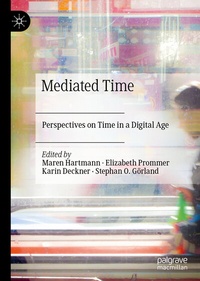
Mediated Time
Description

Exploring mediated time, this book contemplates how far (and in what ways) media and time are intertwined from a diverse set of theoretical and empirical angles. It builds from theoretical discussions concerning the question of mediation and the normative framing of time (especially acceleration) and works its way through questions of time for/of one's own, resisting temporalities, polychronicity, in-between-time, simultaneity and other time concepts.
It further examines specific time frames, imaginations of a media future and the past, questions of online journalism and multitasking or liveness. Bringing together authors from diverse backgrounds, this collection presents a rich combination of milestone articles, new empirical research, enriching theoretical work and interviews with leading researchers to bridge sociology, media studies, and science and technology studies in one of the first book-length publications on the emerging field of media and time.
Reviews / Votes
"Mediated Time is a theoretically ambitious deep-dive into the role and meaning of time as articulated through the lens of contemporary media. Joining an emerging literature on the reorganisation of time and space in post-industrial society, the volume explores not only the changing pace of everyday life due to mobile and digital technologies, but also the concept of mediated temporality itself. A must-read for those interested in the changing nature of time in our increasingly mediated lives." (Laura Grindstaff, Professor of Sociology, University of California, Davis, USA)"The accelerated pace of everyday life has become a major topic for the social sciences in recent decades. All too often, digitalization is seen as the cause. So a volume such as this, that examines the mediation of time from a number of theoretical and empirical perspectives, is a welcome addition [to the social sciences]. The range of excellent contributors and breadth of topics covered ensures that it will be read widely." (Judy Wajcman, Anthony Giddens Professor of Sociology, London School of Economics, UK)
More details
Other editions
Additional editions
Persons
Maren Hartmann is Professor of Communication and Media Sociology at the Berlin University of the Arts (UdK), Germany. She has published widely on media and time; appropriation, especially domestication; media and mobilities; and home and homelessness.
Elizabeth Prommer is Professor and Chair for Communication and Media Studies and Director of the Institute for Media Research at the University of Rostock, Germany. Her research circulates around the 'moving picture' across platforms; converging media environments; and gendered media production.
Karin Deckner is a researcher at the Berlin University of the Arts (UdK), Germany, where she is currently working on her Ph.D. about the dematerialization of 'keys'.
Stephan Oliver Görland is a postdoctoral fellow at the Centre for Media, Communication & Information Research (ZeMKI) at the University of Bremen, Germany, and associate member of the Berlin Institute for Integration and Migration Research (BIM) at the Humboldt University of Berlin, Germany.
Content
1. Introduction: Introducing Mediated Time.- 2. The Categorical Imperative of Acceleration: Speed as Moral Duty.- 3. The Normative Framework of (Mobile) Time: Chrononormativity, Power-Chronography and Mobilities.- 4. Exploring "Heterochronias".- 5. Eigenzeit. Revisited.- 6. An interview with Kristof Nyiri (Budapest, Hungary).- 7. Doing Time: The Data Temporalities in the Prison Context.- 8. Past and Future Media Homes: Digital Imaginaries of Early TV Homes and Homes of the Future.- 9. Emplacing (Inter)Mediated Time.- 10. An interview with Sarah Sharma (University of Toronto, CAN), commented upon by Judy Wajcman (London School of Economics, UK).- 11. Time as Key Category for Cultural Change.- 12. Synchronizing the Nation: History of Time Signals in Russia.- 13. Communication Efficiency: A New Perspective to Understand the Communication Technology Progress and Its Impacts on the National Economy.- 15. The Unfolding of Digital Journalism - Embodied Time(s) and News Events.- 16. ReallyDead Time?: Mobile Media Use in Interstices.- 17. Simultaneity during Polychronicity: Mediated Time and Mobile Media.- 18. Philip Auslander (Georgia Institute of Technology, USA) in conversation with Karin van Es (Utrecht University, Netherlands).- 19. Conclusion.
