

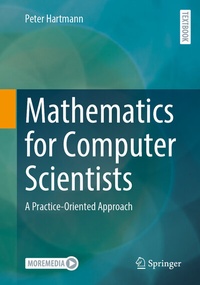
Mathematics for Computer Scientists
Description

This textbook contains the mathematics needed to study computer science in application-oriented computer science courses. The content is based on the author's many years of teaching experience.
The translation of the original German 7 th edition Mathematik für Informatiker by Peter Hartmann was done with the help of artificial intelligence. A subsequent human revision was done primarily in terms of content.
Textbook Features
- You will always find applications to computer science in this book.
- Not only will you learn mathematical methods, you will gain insights into the ways of mathematical thinking to form a foundation for understanding computer science.
- Proofs are given when they help you learn something, not for the sake of proving.
Mathematics is initially a necessary evil for many students. The author explains in each lesson how students can apply what they have learned by giving many real world examples, and by constantly cross-referencing math and computer science. Students will see how math is not only useful, but can be interesting and sometimes fun.
The Content
- Sets, logic, number theory, algebraic structures, cryptography, vector spaces, matrices, linear equations and mappings, eigenvalues, graph theory.
- Sequences and series, continuous functions, differential and integral calculus, differential equations, numerics.
- Probability theory and statistics.
The Target Audiences
Students in all computer science-related coursework, and independent learners.
More details
Other editions
Additional editions
Person
Peter Hartmann is a professor at Landshut University of Applied Sciences in the Department of Computer Science. The focus of his teaching is on mathematics for computer scientists and business informatics specialists.
Content
DISCRETE MATHEMATICS AND LINEAR ALGEBRA.- Sets and mappings.- Logic.- Natural numbers, complete induction, recursion.- Some number theory.- Algebraic structures.- Vector spaces.- Matrices.- Gaussian algorithm and systems of linear equations.- Eigenvalues, eigenvectors and basis transformations.- Scalar product and orthogonal maps.- Graph theory.- ANALYSIS.- The real numbers.- Sequences and series.- Continuous functions.- Differential calculus.- Integral calculus.- Differential equations.- Numerical methods.- PROBABILITY AND STATISTICS.- Probability spaces.- Random variables.- Important distributions and stochastic processes.- Statistical methods.- Appendix.
