

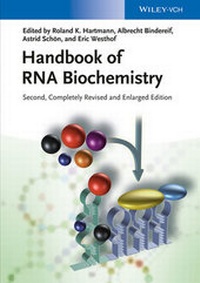
Handbook of RNA Biochemistry
2nd Edition
Published on 31. March 2015
XX, 1276 pages
978-3-527-65055-2 (ISBN)
Description

The second edition of a highly acclaimed handbook and ready reference.
Unmatched in its breadth and quality, around 100 specialists from all over the world share their up-to-date expertise and experiences, including hundreds of protocols, complete with explanations, and hitherto unpublished troubleshooting hints.
They cover all modern techniques for the handling, analysis and modification of RNAs and their complexes with proteins. Throughout, they bear the practising bench scientist in mind, providing quick and reliable access to a plethora of solutions for practical questions of RNA research, ranging from simple to highly complex.
This broad scope allows the treatment of specialized methods side by side with basic biochemical techniques, making the book a real treasure trove for every researcher experimenting with RNA.
Unmatched in its breadth and quality, around 100 specialists from all over the world share their up-to-date expertise and experiences, including hundreds of protocols, complete with explanations, and hitherto unpublished troubleshooting hints.
They cover all modern techniques for the handling, analysis and modification of RNAs and their complexes with proteins. Throughout, they bear the practising bench scientist in mind, providing quick and reliable access to a plethora of solutions for practical questions of RNA research, ranging from simple to highly complex.
This broad scope allows the treatment of specialized methods side by side with basic biochemical techniques, making the book a real treasure trove for every researcher experimenting with RNA.
More details
Other editions
Additional editions
Roland K. Hartmann | Albrecht Bindereif | Astrid Schön
Handbook of RNA Biochemistry
Book
05/2015
2nd Edition
Wiley-VCH
€169.00
Article exhausted; check different version
Roland K. Hartmann | Albrecht Bindereif | Astrid Schön
Handbook of RNA Biochemistry
Book
04/2014
2nd Edition
Wiley-VCH
€375.00
Article exhausted; check for reprint
Persons
Roland K. Hartmann is Professor of Pharmaceutical Chemistry at the Philipps-Universität Marburg (Germany). He studied Biochemistry at the Freie Universität Berlin where in 1988 he received the Ernst Reuter award for outstanding Ph.D. theses. His research interests include natural ribozymes, particularly ribonuclease P, interactions of RNAs with proteins and small ligands, aptamers, antisense and RNA interference.
Albrecht Bindereif is Professor of Biochemistry at the University of Giessen (Germany) since 1999. He studied Biochemistry in Tübingen and at the University of California, Berkeley. His postdoctoral work was done in Michael Green's laboratory at Harvard University. His research interests focus on the mechanism and regulation of mRNA splicing, both in the mammalian system and in trypanosomes.
Astrid Schön received her PhD from the Institute of Biochemistry at the University of Würzburg, and was a graduate fellow and postdoctoral associate with Dieter Söll at Yale University. She is currently a lecturer at the Institute of Biochemistry, University of Leipzig (Germany). Her research is focused on RNA metabolism and RNA-protein interactions, and the evolution of complex RNA enzymes.
Eric Westhof is Professor of Biophysics at the Université Louis Pasteur in Strasbourg (France) since 1988. He studied in Liège and Regensburg and was a Fulbright-Hays Research Fellow at the University of Wisconsin with M. Sundaralingam. His research is centered on the relationships between sequence, structure, evolution and functions of RNA molecules.
Albrecht Bindereif is Professor of Biochemistry at the University of Giessen (Germany) since 1999. He studied Biochemistry in Tübingen and at the University of California, Berkeley. His postdoctoral work was done in Michael Green's laboratory at Harvard University. His research interests focus on the mechanism and regulation of mRNA splicing, both in the mammalian system and in trypanosomes.
Astrid Schön received her PhD from the Institute of Biochemistry at the University of Würzburg, and was a graduate fellow and postdoctoral associate with Dieter Söll at Yale University. She is currently a lecturer at the Institute of Biochemistry, University of Leipzig (Germany). Her research is focused on RNA metabolism and RNA-protein interactions, and the evolution of complex RNA enzymes.
Eric Westhof is Professor of Biophysics at the Université Louis Pasteur in Strasbourg (France) since 1988. He studied in Liège and Regensburg and was a Fulbright-Hays Research Fellow at the University of Wisconsin with M. Sundaralingam. His research is centered on the relationships between sequence, structure, evolution and functions of RNA molecules.
Content
RNA SYNTHESIS
Enyzmatic synthesis, ligation and modification
Chemical synthesis
NEW: RNA detection and quantitation
STRUCTURE DETERMINATION
Sequence determination
NEW: Probing in vitro and in vivo
Footprinting techniques
Nucleotide analog interference mapping
Identification of interacting proteins and nucleic acids
Spectroscopic studies of RNA structure
Atomic structure determination
NEW: Functional assays
NEW: Mass spectrometry of RNA
NEW: Folding and unfolding of single RNA molecules
RNA GENOMICS & BIOINFORMATICS
Phylogenetic analysis
Structure prediction
Modeling of RNA structures
Molecular dynamics simulation
NEW: Searching and predicting small RNAs
NEW: RNA mining and RNomics in eukaryotes
NEW: Exon arrays
ANALYSIS OF RNA-PROTEIN INTERACTION
Isolation and purification of RNA-binding proteins
Sedimentation analysis of RNP complexes
Protein-RNA crosslinking
Immunoaffinity purification
NEW: TAP-tag affinity purification
Three-hybrid analysis to identify RNA-binding proteins
SELEX
In vitro selection of ribozymes and aptamers
In vivo SELEX
In vitro selection against small targets
NEW: Genomic SELEX
RNA INTERFERENCE
NEW: Chemical modification of siRNA
NEW: siRNA design and delivery
NEW: RNAi in mammalian cells
(partial contents)
Enyzmatic synthesis, ligation and modification
Chemical synthesis
NEW: RNA detection and quantitation
STRUCTURE DETERMINATION
Sequence determination
NEW: Probing in vitro and in vivo
Footprinting techniques
Nucleotide analog interference mapping
Identification of interacting proteins and nucleic acids
Spectroscopic studies of RNA structure
Atomic structure determination
NEW: Functional assays
NEW: Mass spectrometry of RNA
NEW: Folding and unfolding of single RNA molecules
RNA GENOMICS & BIOINFORMATICS
Phylogenetic analysis
Structure prediction
Modeling of RNA structures
Molecular dynamics simulation
NEW: Searching and predicting small RNAs
NEW: RNA mining and RNomics in eukaryotes
NEW: Exon arrays
ANALYSIS OF RNA-PROTEIN INTERACTION
Isolation and purification of RNA-binding proteins
Sedimentation analysis of RNP complexes
Protein-RNA crosslinking
Immunoaffinity purification
NEW: TAP-tag affinity purification
Three-hybrid analysis to identify RNA-binding proteins
SELEX
In vitro selection of ribozymes and aptamers
In vivo SELEX
In vitro selection against small targets
NEW: Genomic SELEX
RNA INTERFERENCE
NEW: Chemical modification of siRNA
NEW: siRNA design and delivery
NEW: RNAi in mammalian cells
(partial contents)
