

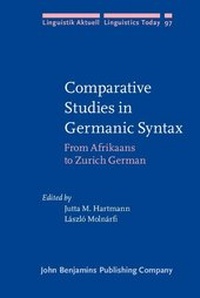
Comparative Studies in Germanic Syntax
From Afrikaans to Zurich German
1st Edition
Published on 22. November 2006
VI, 332 pages
978-90-272-9316-9 (ISBN)
Description

This selection of papers presented at the 20th Comparative Germanic Syntax Workshop brings together contributions that address issues in syntactic predication and studies in the nominal system, as well as papers on data from the history of English and German. Showing a strong comparative commitment, the contributions include studies on previously neglected data on case and predicative structures in Icelandic and other Germanic languages, on the (non-)syntactic distinction of predicative vs. argument NP/DPs, on quirky V2 in Afrikaans, the pronominal system, resumptive pronouns with relative clauses in Zurich German, as well as historical papers on word-formation processes, on auxiliary selection in relation to counter factuality, and on the development of VO-OV orders in the history of English. This volume presents a wide range of studies that enrich both the theoretical understanding and the empirical foundation of comparative research on the Germanic languages.
More details
Other editions
Additional editions
Jutta M. Hartmann | Laszlo Molnarfi
Comparative Studies in Germanic Syntax
From Afrikaans to Zurich German
Book
11/2006
John Benjamins Publishing Co
€132.50
Shipment within 10-15 days
Persons
Content
- Comparative Studies in Germanic Syntax
- Editorial page
- Title page
- LCC data
- Table of contents
- From Afrikaans to Zurich German
- References
- I. Studies on predication
- The Nom/Acc alternation in Germanic
- 1. Introduction
- 2. The distribution of Nom/Acc across the Germanic languages
- 2.1. Germanic relational case-marking
- 2.2. Non-Burzionian accusatives
- 2.3. The Germanic predicative Nom/Acc variation
- 3. Relational case
- 4. The nature of the predicative Nom/Acc variation
- 5. Conclusion
- References
- Shape conservation, Holmberg's generalization and predication
- 1. Introduction
- 2. Restrictions on object shift as a phonological phenomenon
- 3. Shape conservation as an explanation for object shift
- 4. Particle constructions
- 5. Predication theory
- 6. Shape distortion
- 6.1. DO-IO reorderings
- 6.2. The `inverse Holmberg effect'
- 7. Conclusion
- References
- Quirky verb-second in Afrikaans
- 1. Introduction
- 2. Coordinated predicates in comparative perspective
- 3. The base structure of Afrikaans coordinated predicates
- 3.1. Distribution of subjects
- 3.2. Distribution of adverbs
- 3.3. Distribution of objects
- 3.4. Distribution of separable particles
- 3.5. Summary of distributions
- 4. Coordination and feature bundles
- 5. Deriving the base structure for ILV constructions
- 5.1. Implications of the LCL for coordinated feature bundles
- 5.2. Deriving a simplex initial
- 5.3. Creating and moving a complex initial
- 6. Other types of moved verbal clusters
- 7. Conclusion
- References
- Nominal arguments and nominal predicates
- 1. Introduction
- 2. Bare singular nominals
- 3. Some tests for predicates
- 3.1. Embedding under `consider'
- 3.2. Topicalisation
- 3.3. Pseudoclefting
- 3.4. Nonrestrictive relative clause
- 3.5. Coordination
- 3.6. Summing up the tests
- 4. Definite nominal phrases
- 5. Possessed nominal phrases
- 5.1. Postnominal possessors
- 5.2. Prenominal possessors
- 6. Strong quantifiers, demonstratives, and personal pronouns
- 7. The Pred head
- 8. Conclusion
- References
- II. Studies on the (pro)nominal system
- Pronominal noun phrases, number specifications, and null nouns
- 1. Introduction
- 2. Morphological vs. semantic number
- 3. Pronominal noun phrases exhibit semantic agreement
- 3.1. Morphological dis-agreement: Pronoun(pl) + noun(sg)
- 3.2. Morphological dis-agreement: pronoun(sg) + noun(pl)
- 4. Pronominal noun phrases contain "individualizable'' and concrete nouns
- 5. The proposal
- 5.1. Accounting for morphological dis-agreement
- 5.2. Alternative analyses
- 5.3. Accounting for the semantic properties of Spec,DisP
- 6. Possible values on Num and DP-external "special'' agreement
- 6.1. Semantic number is not feature checking
- 6.2. Ruling out DP-internal semantic dis-agreement
- 6.3. Ruling out DP-external semantic dis-agreement
- 7. Pronouns of other morphological person and null nouns
- 7.1. Some non-canonical cases
- 7.2. The inventory of null nouns
- 8. Further issues
- 8.1. Semantic agreement is not a sufficient condition
- 8.2. Ruling out overgeneration due to DisP
- 9. Conclusion
- References
- Toward a syntactic theory of number neutralisation
- 1. Introduction
- 2. Number neutralisation in Dutch je `you'
- 3. Arguments against the lexicalist approach
- 3.1. A morphological argument
- 3.2. A comparative argument
- 3.3. Theoretical considerations
- 3.4. Diachronic evidence
- 4. Kayne's syntactic theory of number neutralisation
- 5. Number neutralisation in Dutch 3rd person pronouns
- 5.1. Middle Dutch 'hem'
- 5.2. Number neutralisation in Modern Dutch ze
- 5.3. Discourse properties of 'ze'
- 6. An application: The rise of English 'they'
- 7. Conclusions
- References
- Long relativization in Zurich German as resumptive prolepsis
- 1. Introduction: Relativization in Zurich German
- 1.1. General form of restrictive relatives in Zurich German
- 1.2. Distribution of resumptive pronouns: Local relativization
- 1.3. Distribution of resumptive pronouns: Long-distance relativization
- 2. Long relativization as aboutness relatives: Van Riemsdijk (to appear)
- 2.1. Locative relatives and aboutness relatives: Adverbial wo
- 2.2. Long relativization as aboutness relativization
- 2.3. Advantages
- 3. Problems of van Riemsdijk's (to appear) proposal
- 3.1. There seems to be a copy of the external head inside the relative
- 3.2. Reconstruction into the embedded clause
- 3.3. Obligatoriness of the resumptive
- 4. Proposal: Long relativization as resumptive prolepsis
- 4.1. The derivation in the matrix clause: Against a phrasal wo
- 4.2. Reconstruction into an opaque domain?
- 4.3. Movement in the complement CP derives a predicate
- 4.4. The link between the operator in the complement and the proleptic object: ellipsis
- 4.5. Why a resumptive?
- 5. A remaining issue: Locality and reconstruction
- 6. Resumptive prolepsis in Standard German and Dutch
- 7. Conclusion
- Acknowledgments
- References
- III. Historical studies
- Auxiliary selection and counterfactuality in the history of English and Germanic
- 1. Introduction
- 2. The first appearances of have with come
- 3. Isolating the counterfactual effect
- 4. Towards an explanation
- 5. Some cross-linguistic notes
- 6. Problems for other theories of auxiliary selection
- 7. Conclusion and open questions
- References
- The loss of residual "head-final'' orders and remnant fronting in Late Middle English
- 1. Introduction
- 2. EPP-satisfaction and pied-piping
- 3. The loss of residual head-final orders in Middle English
- 3.1. Stylistic fronting
- 3.2. Verb (Projection) Raising alternations
- 3.3. Conclusion
- 4. Some consequences
- 4.1. OV orders with modals in 15th-century English
- 4.2. The loss of vP-movement
- 4.3. The reanalysis of the modals in ENE
- 5. Conclusion
- References
- Syntactic sources of word-formation processes
- 1. Introduction
- 2. The development of suffixes in the history of English and German
- 3. Are morphological structures the same as syntactic structures?
- 3.1. Headedness, the X-bar schema and referentiality
- 3.2. Consequences for an analysis of the diachronic data: Loss of structure and loss of referentiality
- 4. Further evidence: The rise of genitive compounds in the history of German and English
- 4.1. German
- 4.2. English
- 5. Conclusion
- References
- Index
- The series Linguistik Aktuell/Linguistics Today
