

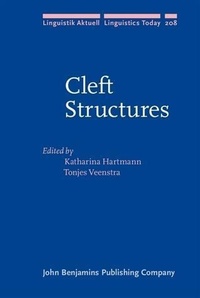
Cleft Structures
1st Edition
Published on 28. November 2013
VIII, 348 pages
978-90-272-7112-9 (ISBN)
Description

The phenomenon of clefts is beyond doubt a golden oldie. It has captivated linguists of different disciplines for decades. The fascination arises from the unique syntax of clefts in interaction with their pragmatic and semantic interpretation. Clefts structure sentences according to the information state of the constituents contained in them. They are special as they exhibit a rather uncommon syntactic form to achieve the separation of the prominent part, either focal or topical, from the background of the clause. Despite the long-lasting interest in clefts, linguists have not yet come to an agreement on many basic questions. The articles contained in this volume address these issues from new theoretical and empirical perspectives. Based on data from about 50 languages from all over the world, this volume presents new arguments for the proper derivation of clefts, and contributes to the ongoing debate on the information-structural impact of cleft structures. Theoretically, it combines modern syntactic theorizing with investigations at the interface between grammar and information-structure.
More details
Other editions
Additional editions
Katharina Hartmann | Tonjes Veenstra
Cleft Structures
Book
11/2013
John Benjamins Publishing Co
€104.94
Shipment within 10-15 days
Persons
Content
- Cleft Structures
- Editorial page
- Title page
- LCC data
- Table of contents
- List of contributors
- Introduction
- Part I: The Theoretical Context
- 1. Cleft desiderata
- 2. Typological variation
- 2.1 Clefting and focus marking
- 2.2 Agreement
- 2.3 From copulas to focus markers
- 3. Structural issues of it-clefts
- 3.1 From pseudoclefts to it-clefts
- 3.2 Predicative analyses
- 3.2.1 It-as-subject
- 3.2.2 Expletive analyses
- 3.3 Focus-based analyses
- 4. Semantic issues
- Part II: The articles
- References
- Part I
- Predication and specification in the syntax of cleft sentences
- 1. A Typology of cleft sentences
- 1.1 Pseudoclefts: Predicational vs specificational
- 1.2 It-clefts: Predicational vs specificational
- 2. Integrating the relative clause
- 2.1 The relative clause of contrastive it-clefts: A headless relative
- 2.2 Explaining the properties of it-clefts with the aid of the headless relative analysis
- 2.3 The relative clause of continuous-topic it-clefts: A pseudorelative
- 3. Some conclusions on predication and specification
- Acknowledgements
- References
- Wh-clefts and Verb-initial Word Order in Austronesian Languages
- 1. Introduction
- 2. Basic word order in seediq
- 2.1 Evidence for movement of the absolutive
- 2.2 Evidence for predicate-fronting
- 3. Structure of Wh-clefts
- 4. Evidence for the stranded DP constraint
- 5. Conclusion
- References
- (Pseudo)clefts at the Syntax-Prosody-Discourse Interface
- 1. (Pseudo)cleft Constructions: An introduction
- 2. Semantic Properties of (Pseudo)clefts
- 3. Syntactic implementation
- 3.1 Extraction effects
- 3.2 Case marking and antiagreement effects
- 4. The Information-Structural Articulation of (Pseudo)clefts
- 4.1 The information packaging in (pseudo)clefts
- 4.2 The relative DP as a dislocated constituent: Syntactic evidence
- 5. Derivation
- 5.1 Clefts
- 5.2 Pseudoclefts
- 5.3 Asymmetries between clefts and pseudoclefts
- 6. (Pseudo)clefts: Intonational Analysis
- 7. Conclusions
- References
- Clefts in Durban Zulu
- 1. Background
- 2. Structure of clefts: Data and generalizations
- 3. Prosodic phrasing in Durban Zulu and the phrasing of clefts
- 4. Zulu clefts: Analysis
- 4.1 Arguments against a monoclausal embedding structure
- 4.2 A bi-clausal structure
- 4.3 Headed relatives
- 4.4 Non-nominal clefts
- 5. Motivating the structure
- 5.1 The post-pivot phrase/clause is not extraposed
- 5.2 The copular sentence
- 5.2 The post-pivot phrase/clause
- 6. Conclusion
- References
- The cleft pronoun and cleft clause in English
- 1. Introduction
- 2. What specificational analyses get right: The non-expletive status of it
- 2.1 Syntactic arguments
- 2.2 Interpretative arguments
- 3. What specificational analyses get wrong: The behaviour of the cleft clause
- 3.1 Introduction
- 3.2 The cleft clause as a restrictive relative clause
- 3.3 The clefted XP as the antecedent of the cleft clause
- 3.3.1 Locality
- 3.3.2 Restrictions on predicational clefts
- 3.3.3 The features of the relative operator
- 3.3.4 Reduced cleft clauses
- 3.3.5 Evidence for a raising structure
- 3.3.6 Evidence that the clefted XP c-commands into the cleft clause
- 3.3.7 Evidence for a 'matching' derivation.
- 4. Conclusion
- References
- The morphosyntax of wolof clefts Structure and movement
- 1. Introduction
- 2. Background on wolof and cleft structures
- 3. Copulas and predicates
- 3.2 Decomposing copular structures
- 3.3 The size of the a- and l-copulas
- 3.4 On copulas and clefts
- 4. A´-Properties of Clefts
- 4.1 Island sensitivity
- 4.2 General reconstruction effects
- 4.3 Wolof-specific reconstruction diagnostics
- 5. Summary
- References
- Multiple focus and cleft sentences
- 1. Introduction
- 1.1 Clefted constituent expresses an exhaustive focus
- 1.2 Cleft clause expresses a pragmatic presupposition
- 2. Cleft sentences and the topic/comment mapping
- 2.1 Comment-topic clefts
- 2.2 Topic-comment clefts
- 3. Multiple focus clefts
- 3.1 Vice-versa clefts
- 3.2 Emphatic repetition clefts
- 3.3 Also and even clefts
- 4. Conclusion
- References
- Recursion of FocP in Malayalam
- 1. Introduction
- 2. Preverbal FocP
- 2.1 The position
- 2.2 Nature of preverbal FocP
- 3. Another focus construction
- 3.1 Exhaustive nature of clefts
- 3.2 Structure of clefts
- 4. Different domains, different information
- References
- Multiple Wh-questions and the cleft construction in Malayalam
- 0. Introduction
- 1. Clefts: A preliminary account
- 2. Wh-typology
- 3. Clefts in a minimalist model
- 3.1 The english cleft
- 3.2 Malayalam clefts: An analysis
- 3.3 Questions
- 3.4 Embedding
- 3.5 Mutiple wh-constructions
- 3.6 Disambiguation
- 3.7 Wh-phrases in relative clauses
- 4. The question interpretation
- 5. Phase impenetrability condition and agree
- References
- Cleft partitionings in Japanese, Burmese and Chinese
- 1. Introduction
- 2. Focusing and clefting strategies in Japanese and Burmese
- 2.1 Background information on Japanese and Burmese
- 2.2 Overt syntactic partitioning in Japanese
- 2.2.1 Syntactic structure
- 2.2.2 Exhaustiveness effects
- 2.3 Overt syntactic partitioning in Burmese/Myanmar
- 2.4 Nominalized main clauses with in-situ focus in Japanese and Burmese
- 2.5 Nominalized focusing structures in Japanese and Burmese: Summary
- 3. Chinese
- 3.1 Basic facts about Mandarin Chinese
- 3.2 The basic structure of clefts in Mandarin Chinese: some similarities and differences with Japanese and Burmese pseudoclefts
- 3.3 Exhaustiveness and positional restrictions with Chinese clefts
- 3.4 The syntax of Chinese clefts
- 3.5 The source of exhaustiveness in Chinese shì.de-clefts: Event presuppositions
- 4. Conclusion
- References
- Italian clefts and the licensing of infinitival subject relatives
- 1. Introduction
- 2. Licensing of infinitival subject relatives by contrastive focus
- 3. Parametric variation in the feature content of clefts
- 4. Syntactic evidence for the feature [+contrastive]
- 5. Syntactic analysis of the cleft constructions
- 6. Conclusion
- References
- Language index
- Subject index
