

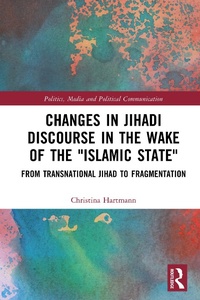
Changes in Jihadi Discourse in the Wake of the "Islamic State"
From Transnational Jihad to Fragmentation
1st Edition
Published on 10. November 2022
246 pages
978-1-000-65376-2 (ISBN)
Description

Changes in Jihadi Discourse in the Wake of the "Islamic State" explores how the transnational jihadi discourse changed with the development of the "Islamic State" terrorist group and resulted in the fragmentation of the jihadi movement.
From the Middle East, through Africa to South East Asia, today's jihadi movement is more fragmented than ever. Al-Qaida and the "Islamic State" compete not only with each other but also with local jihadi groups. Despite the fact that, in the wake of the "Islamic State", international jihadi groups are in fierce competition for supporters, little has been said on how the process of competition as well as external events changed the ideology of these groups and the topics relevant to them. Countering dominant research focusing on the differences between jihadi strains, this book explores how the appearance and temporary strength of the "Islamic State" changed the topics and talking points of other jihadi actors, such as al-Qaida. By analyzing primary sources in Arabic and English, the author sheds light on the inner- and inter-jihadi discourse and its development over the years. The book does not simply describe changes in topics; it traces these changes quantitatively and relates them to external events.
This book is aimed at academics, researchers, and postgraduate students interested in political science, security studies, jihadism, jihadi discourse, al-Qaida, "Islamic State", and Salafism, as well as practitioners and decision-makers in government agencies who wish to understand how transnational jihadi discourse has developed over the previous two decades.
From the Middle East, through Africa to South East Asia, today's jihadi movement is more fragmented than ever. Al-Qaida and the "Islamic State" compete not only with each other but also with local jihadi groups. Despite the fact that, in the wake of the "Islamic State", international jihadi groups are in fierce competition for supporters, little has been said on how the process of competition as well as external events changed the ideology of these groups and the topics relevant to them. Countering dominant research focusing on the differences between jihadi strains, this book explores how the appearance and temporary strength of the "Islamic State" changed the topics and talking points of other jihadi actors, such as al-Qaida. By analyzing primary sources in Arabic and English, the author sheds light on the inner- and inter-jihadi discourse and its development over the years. The book does not simply describe changes in topics; it traces these changes quantitatively and relates them to external events.
This book is aimed at academics, researchers, and postgraduate students interested in political science, security studies, jihadism, jihadi discourse, al-Qaida, "Islamic State", and Salafism, as well as practitioners and decision-makers in government agencies who wish to understand how transnational jihadi discourse has developed over the previous two decades.
More details
Series
Edition
1. Auflage
Language
English
Place of publication
London
United Kingdom
Publishing group
Taylor & Francis Ltd
Target group
College/higher education
Illustrations
3 Tables, black and white; 13 Line drawings, black and white; 13 Illustrations, black and white
ISBN-13
978-1-000-65376-2 (9781000653762)
Copyright in bibliographic data and cover images is held by Nielsen Book Services Limited or by the publishers or by their respective licensors: all rights reserved.
Schweitzer Classification
Other editions
Additional editions
Christina Hartmann
Changes in Jihadi Discourse in the Wake of the "Islamic State"
From Transnational Jihad to Fragmentation
Book
05/2024
1st Edition
Routledge
€63.30
Shipment within 10-20 days
Christina Hartmann
Changes in Jihadi Discourse in the Wake of the "Islamic State"
From Transnational Jihad to Fragmentation
Book
11/2022
1st Edition
Routledge
€186.20
Shipment within 10-20 days
Person
Christina Hartmann completed her PhD in Political Science at Friedrich-Alexander-University Erlangen-Nuremberg, Germany. She works as a consultant for local and international organizations, writing project proposals and project budgets for international donors. Her research interests include Political Islam, Salafism, Jihadism, Arab Spring, Political Transitions, and Art and Revolution.
Content
1. Introduction 1. Setting the Context 2. Historical Development of the Jihadi Fragmentation 3. Talking Points in Jihadi Discourse 4. Findings and Hypotheses Conclusion Appendix
