

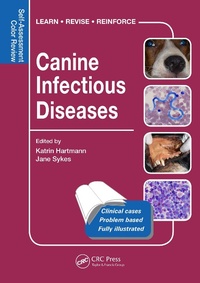
Canine Infectious Diseases
Self-Assessment Color Review
1st Edition
Published on 29. March 2018
288 pages
978-1-351-69652-4 (ISBN)
Description

Contains over 200 cases, covering every type of canine infectious disease
Features international contributors
Supplies the perfect companion to Self-assessment Color Review of Feline Infectious Diseases.
This book covers all types of canine infectious diseases, including infections caused by viruses, bacteria, parasites and fungi. Over 200 clinical cases are presented randomly, as in practice, and cover the range of infectious diseases which affect all the organ systems of the dog. Featuring international expert contributors, the illustrated cases contain integrated questions and detailed explanatory answers.
Features international contributors
Supplies the perfect companion to Self-assessment Color Review of Feline Infectious Diseases.
This book covers all types of canine infectious diseases, including infections caused by viruses, bacteria, parasites and fungi. Over 200 clinical cases are presented randomly, as in practice, and cover the range of infectious diseases which affect all the organ systems of the dog. Featuring international expert contributors, the illustrated cases contain integrated questions and detailed explanatory answers.
Reviews / Votes
The content and images are provided by renowned specialists at universities from around the world, and the text is clear, concise, and well written. Its premise of being a quick self-quizzing guide will make it an invaluable resource for veterinary students and review for experienced practitioners. Many of us understand diseases best through practice experience, and case-based learning, as presented in this book, is an effective and fun way to solidify knowledge about infectious diseases of dogs.- Elizabeth E. Alvarez, DVM, DABVP, University of Wisconsin, USA in JAVMA Vol 253, Issue 6, September 2018
The cases in Canine Infectious Diseases provide multiple real-life examples that provide students with details of clinical history, physical examination and gross pathology, as well as images and explanations of the pinnacle histopathology that underpins the majority of second year content. Although the authors have described this book as being predominantly for working vets and students on fourth-year rotations, it is evident that the clinical cases described would additionally aid revision for earlier years of study; when learning general pathology (often in year 2 of the veterinary course), it is useful to relate the lectured theory content into clinical examples. Overall, I found this book easy to read and extremely useful for revising second-year pathology and relating theory to clinical examples. Many key diseases are described in detail and the use of diagnostic test results, especially histopathology, aids understanding. I will undoubtedly relate to Canine Infectious Diseases throughout the veterinary course, and the size of the handbook additionally makes it ideal for taking to clinical placements. The textbook could be made more extensive to cover the full-range of potential canine infections, which would help establish it as a recognised reference point for vets in practice and during studies. I would highly recommend Canine Infectious Diseases to any veterinary student with an interest in the subject of infectious disease, or undertaking placements or revision, as well as to graduated veterinary surgeons who may need to reinforce their knowledge.
- Kayleigh Hanlon, Second Year BVMSci Student at University of Surrey, published on WikiVet, Dec 2018
The case-based approach allows the details of each case to be provided step-by-step, similar to how they may appear in real practice. This allows an opportunity for both veterinarians and veterinary students to test existing knowledge and ponder the case. The color illustrations are an excellent addition, helping to identify classic and unique features of a condition, and also to create a more pleasurable learning experience. Each case is concise allowing the text to be picked up for short periods of study.
- Janeen Junaid, DVM, MVSc, VCA Bay Cities Animal Hospital, Burlington, Ontario in Can Vet J 2019; 60(10):1114 The content and images are provided by renowned specialists at universities from around the world, and the text is clear, concise, and well written. Its premise of being a quick self-quizzing guide will make it an invaluable resource for veterinary students and review for experienced practitioners. Many of us understand diseases best through practice experience, and case-based learning, as presented in this book, is an effective and fun way to solidify knowledge about infectious diseases of dogs.
- Elizabeth E. Alvarez, DVM, DABVP, University of Wisconsin, USA in JAVMA Vol 253, Issue 6, September 2018
The cases in Canine Infectious Diseases provide multiple real-life examples that provide students with details of clinical history, physical examination and gross pathology, as well as images and explanations of the pinnacle histopathology that underpins the majority of second year content. Although the authors have described this book as being predominantly for working vets and students on fourth-year rotations, it is evident that the clinical cases described would additionally aid revision for earlier years of study; when learning general pathology (often in year 2 of the veterinary course), it is useful to relate the lectured theory content into clinical examples. Overall, I found this book easy to read and extremely useful for revising second-year pathology and relating theory to clinical examples. Many key diseases are described in detail and the use of diagnostic test results, especially histopathology, aids understanding. I will undoubtedly relate to Canine Infectious Diseases throughout the veterinary course, and the size of the handbook additionally makes it ideal for taking to clinical placements. The textbook could be made more extensive to cover the full-range of potential canine infections, which would help establish it as a recognised reference point for vets in practice and during studies. I would highly recommend Canine Infectious Diseases to any veterinary student with an interest in the subject of infectious disease, or undertaking placements or revision, as well as to graduated veterinary surgeons who may need to reinforce their knowledge.
- Kayleigh Hanlon, Second Year BVMSci Student at University of Surrey, published on WikiVet, Dec 2018
The case-based approach allows the details of each case to be provided step-by-step, similar to how they may appear in real practice. This allows an opportunity for both veterinarians and veterinary students to test existing knowledge and ponder the case. The color illustrations are an excellent addition, helping to identify classic and unique features of a condition, and also to create a more pleasurable learning experience. Each case is concise allowing the text to be picked up for short periods of study.
- Janeen Junaid, DVM, MVSc, VCA Bay Cities Animal Hospital, Burlington, Ontario in Can Vet J 2019; 60(10):1114
More details
Series
Edition
1. Auflage
Language
English
Place of publication
London
United Kingdom
Publishing group
Taylor & Francis Ltd
Target group
College/higher education
Professional and scholarly
Product notice
Reflowable
Illustrations
261 farbige Abbildungen, 36 s/w Tabellen
36 Tables, black and white; 261 Illustrations, color
File size
29,96 MB
ISBN-13
978-1-351-69652-4 (9781351696524)
Copyright in bibliographic data and cover images is held by Nielsen Book Services Limited or by the publishers or by their respective licensors: all rights reserved.
Schweitzer Classification
Other editions
Additional editions
Book
03/2018
1st Edition
CRC Press
€54.00
Article not available for order
Persons
Prof. Dr. Katrin Hartmann, Dip ECVIM-CA, qualified from the College of Veterinary Medicine of the Ludwig Maximilian University Munich in 1987. She obtained her Dr. med. vet. in small animal internal medicine in 1990. From 1988 to 1996, she was resident and clinical instructor at the Department of Small Animal Medicine at the University of Munich and from 1996 to 2001 she was assistant professor at the same department. She became Diplomate of the European College of Veterinary Internal Medicine - Companion Animals in 1999 and holds the German title of Fachtierarzt (specialised veterinarian) in both internal medicine and clinical pathology. From 2001 to 2003, she worked as associate professor of internal medicine at the Small Animal Department at the College of Veterinary Medicine, University of Georgia (USA). In 2003, she returned to Munich where she still works today as a full professor and chair of the Clinic of Small Animal Medicine at the Ludwig Maximilian University Munich. In 2009, she additionally was also appointed department head of the Center for Clinical Veterinary Medicine at the Ludwig Maximilian University Munich.
Dr. Jane Sykes, BVSc, PhD is Academic Administrator and Professor of Medicine & Epidemiology at UC Davis, CA. Her research focuses on infectious diseases of dogs and cats, especially those of immunocompromised patients; fungal diseases; bloodstream-associated bacterial infections. She is Board Certified in the American College of Veterinary Internal Medicine (Small Animal Internal Medicine).
Dr. Jane Sykes, BVSc, PhD is Academic Administrator and Professor of Medicine & Epidemiology at UC Davis, CA. Her research focuses on infectious diseases of dogs and cats, especially those of immunocompromised patients; fungal diseases; bloodstream-associated bacterial infections. She is Board Certified in the American College of Veterinary Internal Medicine (Small Animal Internal Medicine).
Content
Preface
Abbreviations
Broad classification of cases
Questions
Answers
Index
Abbreviations
Broad classification of cases
Questions
Answers
Index
