

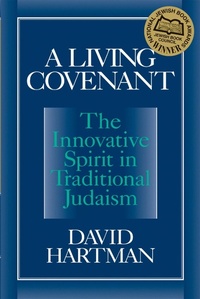
A Living Covenant
Description

"'A covenantal vision of life, with mitzvah (divine commandment) as the central organizing principle in the relationship between Jews and God, liberates the intellect and the moral will. I seek to show that a tradition mediated by the Sinai covenant can encourage the development of a human being who is not afraid to assume responsibility for the ongoing drama of Jewish history. Passive resignation is seen not to be an essential trait of one whose relationship to God is mediated by the hearing of mitzvot."
-from the Introduction
This interpretation of Jewish teaching will appeal to all people seeking to understand the relationship between the idea of divine demand and the human response, between religious tradition and modernity. Hartman shows that a life lived in Jewish tradition need not be passive, insulated, or self-effacing, but can be lived in the modern pluralistic world with passion, tolerance, and spontaneity.
The Judaic tradition is often seen as being more concerned with uncritical obedience to law than with individual freedom and responsibility. In A Living Covenant, Hartman challenges this approach by revealing a Judaism grounded in a covenant-a relational framework-informed by the metaphor of marital love rather than that of parent-child dependency. This view of life places the individual firmly within community. Hartman shows that the Judaic tradition need not be understood in terms of human passivity and resignation, but rather as a vehicle by which human individuality and freedom can be expressed within a relational matrix.
More details
Other editions
Additional editions
Person
A world-renowned philosopher and social activist, Dr. David Hartman (z"l) is the founder and president emeritus of the Shalom Hartman Institute in Jerusalem. Named after his late father, the Institute is dedicated to developing a new understanding of classical Judaism that provides moral and spiritual direction for Judaism's confrontation with modernity.
Presently professor emeritus at Hebrew University in Jerusalem, he received his rabbinic ordination from Yeshiva University's theological seminary in New York City. He is the author of many award-winning books, including A Living Covenant: The Innovative Spirit in Traditional Judaism (Jewish Lights) and Maimonides: Torah and Philosophic Quest, both winners of the National Jewish Book Award; A Heart of Many Rooms: Celebrating the Many Voices within Judaism (Jewish Lights), finalist for the National Jewish Book Award and a Publishers Weekly "Best Book of the Year"; and Love and Terror in the God Encounter: The Theological Legacy of Rabbi Joseph B. Soloveitchik (Jewish Lights).
Content
- Cover
- Title
- Dedication
- Contents
- Acknowledgments
- Introduction
- Part One THE HUMAN BEING IN JUDAISM
- Chapter 1: Fundamentals of a Covenantal Anthropology
- Chapter 2: Assertion Versus Submission: The Tension Within Judaism
- Chapter 3: "Halakhic Man": Soloveitchik's Synthesis
- Chapter 4: Ethics and Halakhah
- Chapter 5: Human Beings in the Presence of God
- Chapter 6: The Spirit of Judaic Prayer
- Appendix: Halakhic Critique of Soloveitchik's Approach to Prayer
- Chapter 7: Individual and Community in Prayer
- Part Two THE COVENANT AND THE LIVING GOD OF HISTORY
- Chapter 8: Rabbinic Responses to Suffering
- Chapter 9: The Rabbinic Renewal of the Covenant
- Chapter 10: Two Competing Covenantal Paradigms
- Chapter 11: The Celebration of Finitude
- Chapter 12: The Third Jewish Commonwealth
- Postscript
- Notes
- General Index
- Index of Jewish Sources
- About the Author
- Copyright
- Also Available
- About Jewish Lights
- Sign Up for E-mail Updates
- Send Us Your Feedback
