

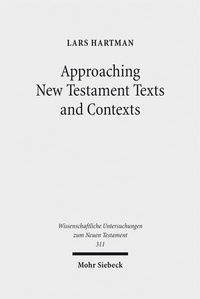
Approaching New Testament Texts and Contexts
Collected Essays II
1st Edition
Published on 12. July 2013
382 pages
978-3-16-152354-0 (ISBN)
Description

In diesem Band behandelt Lars Hartman viele wichtige Themengebiete. Einige seiner Aufsätze sind exegetischen und hermeneutischen Problemen gewidmet, so zum Beispiel den theoretischen Betrachtungen im Bezug darauf, was es bedeutet, einen Kommentar zu schreiben. Die folgenden Aufsätze sind detaillierte Untersuchungen diverser Aspekte der Textanalyse als Vorbereitung seines Kommentars zum Markusevangelium. Des weiteren hat Hartman wegweisende Texte zur Taufe geschrieben, im Besonderen hinsichtlich der Namensformel. Die letzten Aufsätze befassen sich mit dem hellenistischen Kontext zahlreicher Texte und Themen des Neuen Testaments, wie zum Beispiel die Untersuchung "Hellenistische Elemente in apokalyptischen Texten". Dieser Band ist eine angemessene Ergänzung zu Lars Hartmans früherer Sammlung textbezogener Untersuchungen zum Neuen Testament aus dem Jahre 1997.
More details
Other editions
Additional editions
Lars Hartman | Tord Fornberg | David Hellholm
Approaching New Testament Texts and Contexts
Collected Essays II
Book
07/2013
1st Edition
Mohr Siebeck
€159.00
Article exhausted; check different version
Persons
Author
Born 1930; 1957 ordained priest in the Lutheran Church of Sweden; 1966 ThD and Habilitation; 1971-90 Professor for New Testament Exegesis at Uppsala University; 1990-95 Director of the Church of Sweden Research Department; 1995 retirement; 2011 doctor honoris causa at Helsinki University.
ISNI:
ISNI:
Editor
Born 1941; 1980 Dr. theol.; 1982 Habilitation; 1979-83 assistant professor at the University of Linköping (Sweden); 1983-89 associate professor at the University of Bergen (Norway); 1990-2008 full professor of New Testament and its environment at the University of Oslo (Norway); since 2008 Emeritus.
ISNI:
ISNI:
Content
- Cover
- Table of Contents
- Preface
- Part I: Exegesis and Hermeneutics
- 1. Commentary: A Communication about a Communication
- 1. Theoretical Presuppositions
- 2. Mark 1:9-11
- 3. Final Comments
- 2. Exegetes - Interpreters?
- 1. Exegeses and Interpretation
- 2. Two Models
- 3. The Situation of the Text as the Focus
- 4. The Sender and the Text as the Focus
- 5. The Text as the Focus
- 6. The Reader as the Focus
- 3. Interpreting Eschatological Texts
- 1. Preliminaries
- 2. Hermeneutics of Eschatology
- 3. The Author and His Text
- 4. A Topical Interpretation
- 4. Bundesideologie in und hinter einigen paulinischen Texten
- 1. Begriffsbestimmung
- 2. Problemstellung
- 3. Bundesideologisch gefärbte Texte
- 4. Resumé
- 5. Is the Crucified Christ the Center of a New Testament Theology?
- 1. The Problem of the Center of the New Testament
- 2. The Crucified Christ in Paul
- 3. The Crucified Christ in John
- 4. Toward a NT Theology
- 6. Two Early Readings of First Corinthians
- 1. Introductory Remarks
- 2. First Letter of Clement
- 3. "Third Corinthians"
- 4. The Principle of Eccleastical Usage
- 5. Résumé
- 7. An Early Example of Jewish Exegesis
- 1. The Book of the Watchers
- 2. The Concept of Interpretation of Scripture
- 3. 1 Enoch 10:16-11:2
- 4. Interpretative Techniques
- 5. Theological Message
- 6. Excursus
- Part II: The Gospel of Mark
- 8. Grammar and Exegesis
- 1. Modern Translations
- 2. Ancient Grammarians
- 3. Discussion
- 9. Markus 6,3a im Lichte einiger griechischer Texte
- 1. Die bisherige Diskussion
- 2. Belege aus der hellenistischen Welt
- 3. Ergebnis
- 10. Loving "with Your Whole Heart" - Giving "Her Whole Living"
- 1. General Considerations
- 2. The Structure of Mark 11:1-12:44. Some Proposals
- 3. A New Proposal
- 4. The Great Commandment and True Worship
- 11. Mark 16:1-8: the Ending of a Biography-like Narrative and of a Gospel
- 1. The Problematic Endings of Mark
- 2. The Function of Mark 16:1-8 as a Gospel Ending
- 3. Earlier Passages in Mark
- 12. "Was soll ich tun, damit ich das ewige Leben erbe?"
- 1. Das Markusevangelium für Heidenchristen
- 2. Die Anwendung des Basileia-Begriffs
- 3. Die Leser/Hörer und die Gottesherrschaftsethik
- 4. Das Ehescheidungsverbot
- 5. Das Doppelgebot der Liebe
- 6. Der Zukunftsaspekt
- 7. Zusammenfassung
- Part III: Baptism
- 13. "Into the Name of Jesus"
- 1. Earlier Research
- 2. Jewish Use of the l?shem- (l?shum-) formula
- 3. Jesus as the Reference for Baptism
- 14. La formule baptismale dans les Actes des Apôtres
- 1. Les prépositions
- 2. Les génitifs
- 15. Early Baptism - Early Christology
- 1. The Baptismal Formula "in(to) the name of Jesus"
- 2. The Use of Christological Titles
- 16. Usages - Some Notes on the Baptismal Name-Formulae
- 1. The Formulae
- 2. Different Communication Situations
- 3. Conclusion
- Part IV: Hellenistic Contexts
- 17. Psyche - "Soul"?
- 1. How do the Words ?? and ???? Relate to Each Other?
- 2. The Word ???? in koine Greek
- 3. The Word ???? in the Septuagint
- 4. Conclusions
- 18. ".with the Overseers and Servants"
- 1. The Problem
- 2. An Overlooked Parallel
- 3. Is the Comparison Valid?
- 4. Institutionalization?
- 5. The Neglecting of the Diákonoi
- 6. Possible Tasks of the Philippian Officials as Surmised from the Letter
- 19. "He Spoke of the Temple of His Body" (John 2:13-22)
- 1. Temples and their Functions
- 2. Temple Imagery in John
- 20. Humble and Confident
- 1. Introductory Remarks
- 2. The Representatives of the Philosophy as a Minority
- 3. The Philosophy
- 4. The Philosophers' Attitude to the Majority
- 5. The Majority as Confronted by the Minority
- 21. The Human Desire to Converse with the Divine
- 1. What Does the Title Imply?
- 2. Texts to Be Considered
- 3. Main Features of the Divine
- 4. Cult Sites and Images of the Divine
- 5. Conclusion
- 22. Hellenistic Elements in Apocalyptic Texts
- 1. Introductory Remarks
- 2. Syncretism
- 3. Judaism as a Hellenistic Religion
- 4. The Non-Rational Acquisition of Knowledge
- 5. Astral Religion
- 6. An Individual Perspective
- 7. The Large Hellenistic World
- 8. The View of History
- 9. A Final Glance at the Small World
- 23. The Book of Revelation
- 1. Similarities in Apocalyptic Texts
- 2. The Situation Behind Rev 2-3
- 24. Universal Reconciliation (Col 1:20)
- 1. Preliminary Remark
- 2. Different Problems
- 3. Background to the Idea of Universal Reconciliation
- 4. The Content of Col 1:15-20
- 25. Code and Context
- 1. History of Research
- 2. The Text in Its Context
- 3. The Decalogue as a Structuring Factor
- 4. Conclusions
- Bibliography
- Texts and Editions
- Literature
- Selected Bibliography - Lars Hartman
- Acknowledgements
- Index of Modern Authors
- Index of Passages (selected)
- I. Israelite and Jewish Texts
- A. Old Testament
- B. Apocrypha, Pseudepigrapha and Other Early Jewish Texts
- C. Qumran and Related Texts
- D. Rabbinic Texts and Jewish Mysticism
- E. Jewish-Christian Texts
- II. Early Christian Texts
- A. New Testament
- B. Apostolic Fathers and Other Early Christian Texts
- III. Egyptian Texts
- A. Literary Texts, Papyri and Ostraca
- B. Published Compliations and Inscriptions
- IV. Classical Texts
- A. Greek Texts
- B. Latin Texts
- V. Published Compilations, Papyri and Inscriptions
