

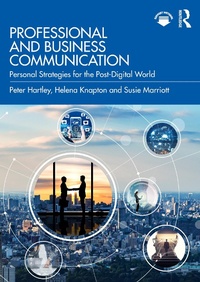
Professional and Business Communication
Personal Strategies for the Post-Digital World
3rd Edition
Published on 30. May 2023
380 pages
978-1-000-88594-1 (ISBN)
Description

This new edition of Professional and Business Communication is an ideal core communications textbook for students on business, management, and professional courses preferring a practice-focused and colloquial approach that combines accessibility with key theory. Techniques and processes detailed in the book include planning and preparing written communication, effective structures in documents, diverse writing styles, managing face-to-face interactions, using visual aids, delivering presentations, and organising effective meetings.
The third edition of this popular text has been thoroughly revised and updated to cover the dramatic shifts in communication practices that have been driven by remote working and increased technology use. It explores the current and likely future impact of these changes on communication practices, both for good (borderlessness; flexibility) and bad (isolation; burnout; fatigue) and looks at contemporary trends and future developments. This edition has also been revised to include even more examples, cases, tasks, activities, and discussion topics, with pedagogical features designed to aid international students. This popular text (and the accompanying website) will continue to support students on business, management, and professional courses for years to come.
The third edition of this popular text has been thoroughly revised and updated to cover the dramatic shifts in communication practices that have been driven by remote working and increased technology use. It explores the current and likely future impact of these changes on communication practices, both for good (borderlessness; flexibility) and bad (isolation; burnout; fatigue) and looks at contemporary trends and future developments. This edition has also been revised to include even more examples, cases, tasks, activities, and discussion topics, with pedagogical features designed to aid international students. This popular text (and the accompanying website) will continue to support students on business, management, and professional courses for years to come.
More details
Edition
3rd edition
Language
English
Place of publication
London
United Kingdom
Publishing group
Taylor & Francis Ltd
Target group
College/higher education
Product notice
Reflowable
Illustrations
52 Tables, black and white; 30 Halftones, black and white; 30 Illustrations, black and white
ISBN-13
978-1-000-88594-1 (9781000885941)
Copyright in bibliographic data and cover images is held by Nielsen Book Services Limited or by the publishers or by their respective licensors: all rights reserved.
Schweitzer Classification
Other editions
Additional editions
Peter Hartley | Susie Marriott | Helena Knapton
Professional and Business Communication
Personal Strategies for the Post-Digital World
Book
05/2023
3rd Edition
Routledge
€59.20
Shipment within 10-20 days
Peter Hartley | Susie Marriott | Helena Knapton
Professional and Business Communication
Personal Strategies for the Post-Digital World
Book
05/2023
3rd Edition
Routledge
€207.30
Shipment within 10-20 days
Persons
Peter Hartley is Visiting Professor at Edge Hill University, UK, National Teaching Fellow, and an independent educational consultant, with longstanding interests in communication and organisational behaviour and the application of new technologies in both educational and commercial organisations.
Helena Knapton is Learning and Teaching Lead in the Faculty of Education as well as a Senior Lecturer in Education delivering on the PGCertHE at Edge Hill University, UK. Her main research interests are graduate employability and the development of professional identity amongst academic colleagues, particularly those who are new to Higher Education.
Susie Marriott is Senior Lecturer in Marketing and Director of Employability & Enterprise in the Business School at Edge Hill University, UK. She also works as co-creator of live projects with third sector clients to simulate brand and social marketing campaigns for both Undergraduate and Masters programmes. With specialist expertise in assistive technologies, she is co-ordinator for Supporting Learners with Specific Learning Difficulties (SpLD) across the Business School.
Helena Knapton is Learning and Teaching Lead in the Faculty of Education as well as a Senior Lecturer in Education delivering on the PGCertHE at Edge Hill University, UK. Her main research interests are graduate employability and the development of professional identity amongst academic colleagues, particularly those who are new to Higher Education.
Susie Marriott is Senior Lecturer in Marketing and Director of Employability & Enterprise in the Business School at Edge Hill University, UK. She also works as co-creator of live projects with third sector clients to simulate brand and social marketing campaigns for both Undergraduate and Masters programmes. With specialist expertise in assistive technologies, she is co-ordinator for Supporting Learners with Specific Learning Difficulties (SpLD) across the Business School.
Content
Table of Contents
Part 1: How do we understand and analyse the ways we Communicate in Organisations
Chapter 1: Developing your Communication: Deciding where to start
Chapter 2: How should we analyse communication?
Chapter 3: What does communication mean?
Chapter 4: Communication Context 1: Culture and Structure
Chapter 5: Communication Context 2: The New Technology Landscape
Part 2: Presenting Information: Effective Methods and Media
Chapter 6: Planning and Organising Professional Written Communication
Chapter 7: Effective Writing Style
Chapter 8: Effective Design and Visual Aids
Chapter 9: Effective Documents for the Future
Part 3: Effective Interpersonal and Group Communication
Chapter 10: Effective Interpersonal Communication
Chapter 11: Interpersonal Skills in Practice
Chapter 12: Effective Meetings
Chapter 13: Effective Presentations
Chapter 14: Effective Teams
Part 4: Future-Gazing
Chapter 15: Change and Future-Gazing
Chapter 16: Planning your Future
Part 1: How do we understand and analyse the ways we Communicate in Organisations
Chapter 1: Developing your Communication: Deciding where to start
Chapter 2: How should we analyse communication?
Chapter 3: What does communication mean?
Chapter 4: Communication Context 1: Culture and Structure
Chapter 5: Communication Context 2: The New Technology Landscape
Part 2: Presenting Information: Effective Methods and Media
Chapter 6: Planning and Organising Professional Written Communication
Chapter 7: Effective Writing Style
Chapter 8: Effective Design and Visual Aids
Chapter 9: Effective Documents for the Future
Part 3: Effective Interpersonal and Group Communication
Chapter 10: Effective Interpersonal Communication
Chapter 11: Interpersonal Skills in Practice
Chapter 12: Effective Meetings
Chapter 13: Effective Presentations
Chapter 14: Effective Teams
Part 4: Future-Gazing
Chapter 15: Change and Future-Gazing
Chapter 16: Planning your Future
