

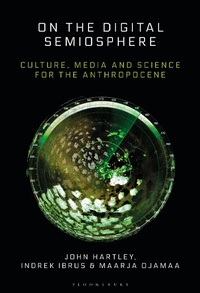
On the Digital Semiosphere
Culture, Media and Science for the Anthropocene
1st Edition
Published on 24. December 2020
360 pages
978-1-5013-6923-0 (ISBN)
Description

It is only since global media and digital communications became accessible to ordinary populations - with Telstar, jumbo jets, the pc and mobile devices - that humans have been able to experience their own world as planetary in extent. What does it mean to be one species on one planet, rather than a patchwork of scattered, combative and mutually untranslatable cultures? One of the most original and prescient thinkers to tackle cultural globalisation was Juri Lotman (1922-93). On the Digital Semiosphere shows how his general model of the semiosphere provides a unique and compelling key to the dynamics and functions of today's globalised digital media systems and, in turn, their interactions and impact on planetary systems.
Developing their own reworked and updated model of Lotman's evolutionary and dynamic approach to the semiosphere or cultural universe, the authors offer a unique account of the world-scale mechanisms that shape media, meanings, creativity and change - both productive and destructive. In so doing, they re-examine the relations among the contributing sciences and disciplines that have emerged to explain these phenomena, seeking to close the gap between biosciences and humanities in an integrated 'cultural science' approach.
Developing their own reworked and updated model of Lotman's evolutionary and dynamic approach to the semiosphere or cultural universe, the authors offer a unique account of the world-scale mechanisms that shape media, meanings, creativity and change - both productive and destructive. In so doing, they re-examine the relations among the contributing sciences and disciplines that have emerged to explain these phenomena, seeking to close the gap between biosciences and humanities in an integrated 'cultural science' approach.
Reviews / Votes
The monograph of Hartley, Ibrus and Ojamaa is an excellent starting point for the future of digital semiotics. The exceptional merit of these authors is to open the semiotic science of culture up to the economic/commercial dimension of digital culture. This had been completely ignored by previous contributions and allows for the multidimensional analysis of a wide variety of specific manifestations of new technologies and communication practices. * Kristian Bankov, Professor of Semiotics at New Bulgarian University, visiting Professor at Sichuan University, writing in The Digital Mind (2022) * In this book, John Hartley, Indrek Ibrus, and Maarja Ojamaa pass on the shining torch of Lotman's 20th century vision of cultural semiospheres that still had centers and peripheries to the generations of the Anthropocene facing new digital and global realities, which the authors illuminate with their advanced semiotic instrumentarium. * Winfried Noeth, Professor of Cognitive Semiotics, Catholic University of Sao Paulo, Brazil *More details
Edition
1. Auflage
Language
English
Place of publication
New York
United States
Publishing group
Bloomsbury Publishing PLC (Digital)
Target group
College/higher education
Illustrations
28 bw illus
ISBN-13
978-1-5013-6923-0 (9781501369230)
Copyright in bibliographic data and cover images is held by Nielsen Book Services Limited or by the publishers or by their respective licensors: all rights reserved.
Schweitzer Classification
Other editions
Additional editions
John Hartley | Indrek Ibrus | Maarja Ojamaa
On the Digital Semiosphere
Culture, Media and Science for the Anthropocene
Book
07/2022
Bloomsbury Academic USA
€44.70
Shipment within 15-20 days
Persons
John Hartley is John Curtin Distinguished Professor at Curtin University, Australia; previously founding Dean of Creative Industries at QUT, inaugural Head of the School of Journalism, Media and Cultural Studies at Cardiff University, Wales. He has published over 30 books on cultural, media, communication and journalism studies, and more recently creative economy and cultural science, with Google Scholar citations approaching 40,000.
Indrek Ibrus is Professor at Tallinn University, Estonia and the head of Center of Excellence in Media Innovation and Digital Culture (MEDIT: http://medit.tlu.ee/). His main strand of research is media innovation and the co-evolutionary effects of textual, social and economic dynamics in shaping the new forms of media. He is the co-editor (with Carlos Scolari) of Crossmedia Innovations: Texts, Markets, Institutions (2012).
Maarja Ojamaa is a research fellow at Tallinn University, Estonia and a member of MEDIT (http://medit.tlu.ee/). Her research has followed the paradigm of Lotmanian cultural semiotics, exploring transmediality, both on the micro level as a textual phenomenon and on the macro level as a mechanism of cultural auto-communication. Her work has been published in the International Journal of Cultural Studies, Sign System Studies, International Journal of Communication.
Indrek Ibrus is Professor at Tallinn University, Estonia and the head of Center of Excellence in Media Innovation and Digital Culture (MEDIT: http://medit.tlu.ee/). His main strand of research is media innovation and the co-evolutionary effects of textual, social and economic dynamics in shaping the new forms of media. He is the co-editor (with Carlos Scolari) of Crossmedia Innovations: Texts, Markets, Institutions (2012).
Maarja Ojamaa is a research fellow at Tallinn University, Estonia and a member of MEDIT (http://medit.tlu.ee/). Her research has followed the paradigm of Lotmanian cultural semiotics, exploring transmediality, both on the micro level as a textual phenomenon and on the macro level as a mechanism of cultural auto-communication. Her work has been published in the International Journal of Cultural Studies, Sign System Studies, International Journal of Communication.
Content
Part I. Spheres and Globes
1: A Semiotic Theory of Spheres
2: A Short History of Globes
3: Juri Lotman and Cultural Semiotics
Part II. Elements of the Digital Semiosphere
4: 'Inside Thinking Worlds'
5: Dialogue and Dynamics
6: Cultural Semiotics in a Multidisciplinary Environment
Part III. Micro-scale: Text
7: What Does Culture Want?
8: Text, Transmission, Translation
9: Text, Creation, Newness
10: Text, Preservation, Memory
Part IV. Meso-scale: Institution
11: Planetary Systems of Culture Production
12: Bubbles: Production of Continual Systems
13: Blows: Production of Discontinuities
14: Foam: Production of Dynamic Multiplicity
Part V. Macro-scale: System
15: Globe: Production of Digital Distinctions
16: The Digital Semiosphere and the Technosphere
17: Semiosis: Regulating Politics and Economics
18: Staged Conflict: New Demes and Classes
Part VI. Cultural Science for the Anthropocene
19: Populations of Rules: The Constitution and Coordination of Media-made Groups
20: Where to Now, Planet?
References
Acknowledgements
Index
1: A Semiotic Theory of Spheres
2: A Short History of Globes
3: Juri Lotman and Cultural Semiotics
Part II. Elements of the Digital Semiosphere
4: 'Inside Thinking Worlds'
5: Dialogue and Dynamics
6: Cultural Semiotics in a Multidisciplinary Environment
Part III. Micro-scale: Text
7: What Does Culture Want?
8: Text, Transmission, Translation
9: Text, Creation, Newness
10: Text, Preservation, Memory
Part IV. Meso-scale: Institution
11: Planetary Systems of Culture Production
12: Bubbles: Production of Continual Systems
13: Blows: Production of Discontinuities
14: Foam: Production of Dynamic Multiplicity
Part V. Macro-scale: System
15: Globe: Production of Digital Distinctions
16: The Digital Semiosphere and the Technosphere
17: Semiosis: Regulating Politics and Economics
18: Staged Conflict: New Demes and Classes
Part VI. Cultural Science for the Anthropocene
19: Populations of Rules: The Constitution and Coordination of Media-made Groups
20: Where to Now, Planet?
References
Acknowledgements
Index
