

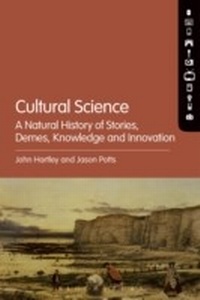
Cultural Science
A Natural History of Stories, Demes, Knowledge and Innovation
1st Edition
Published on 25. September 2014
264 pages
978-1-84966-603-9 (ISBN)
Description

This book is available as open access through the Bloomsbury Open Access programme and is available on www.bloomsburycollections.com.
Cultural Science introduces a new way of thinking about culture. Adopting an evolutionary and systems approach, the authors argue that culture is the population-wide source of newness and innovation; it faces the future, not the past. Its chief characteristic is the formation of groups or 'demes' (organised and productive subpopulation; 'demos'). Demes are the means for creating, distributing and growing knowledge. However, such groups are competitive and knowledge-systems are adversarial.
Starting from a rereading of Darwinian evolutionary theory, the book utilises multidisciplinary resources: Raymond Williams's 'culture is ordinary' approach; evolutionary science (e.g. Mark Pagel and Herbert Gintis); semiotics (Yuri Lotman); and economic theory (from Schumpeter to McCloskey).
Successive chapters argue that:
-Culture and knowledge need to be understood from an externalist ('linked brains') perspective, rather than through the lens of individual behaviour;
-Demes are created by culture, especially storytelling, which in turn constitutes both politics and economics;
-The clash of systems - including demes - is productive of newness, meaningfulness and successful reproduction of culture;
-Contemporary urban culture and citizenship can best be explained by investigating how culture is used, and how newness and innovation emerge from unstable and contested boundaries between different meaning systems;
-The evolution of culture is a process of technologically enabled 'demic concentration' of knowledge, across overlapping meaning-systems or semiospheres; a process where the number of demes accessible to any individual has increased at an accelerating rate, resulting in new problems of scale and coordination for cultural science to address.
The book argues for interdisciplinary 'consilience', linking evolutionary and complexity theory in the natural sciences, economics and anthropology in the social sciences, and cultural, communication and media studies in the humanities and creative arts. It describes what is needed for a new 'modern synthesis' for the cultural sciences. It combines analytical and historical methods, to provide a framework for a general reconceptualisation of the theory of culture - one that is focused not on its political or customary aspects but rather its evolutionary significance as a generator of newness and innovation.
Cultural Science introduces a new way of thinking about culture. Adopting an evolutionary and systems approach, the authors argue that culture is the population-wide source of newness and innovation; it faces the future, not the past. Its chief characteristic is the formation of groups or 'demes' (organised and productive subpopulation; 'demos'). Demes are the means for creating, distributing and growing knowledge. However, such groups are competitive and knowledge-systems are adversarial.
Starting from a rereading of Darwinian evolutionary theory, the book utilises multidisciplinary resources: Raymond Williams's 'culture is ordinary' approach; evolutionary science (e.g. Mark Pagel and Herbert Gintis); semiotics (Yuri Lotman); and economic theory (from Schumpeter to McCloskey).
Successive chapters argue that:
-Culture and knowledge need to be understood from an externalist ('linked brains') perspective, rather than through the lens of individual behaviour;
-Demes are created by culture, especially storytelling, which in turn constitutes both politics and economics;
-The clash of systems - including demes - is productive of newness, meaningfulness and successful reproduction of culture;
-Contemporary urban culture and citizenship can best be explained by investigating how culture is used, and how newness and innovation emerge from unstable and contested boundaries between different meaning systems;
-The evolution of culture is a process of technologically enabled 'demic concentration' of knowledge, across overlapping meaning-systems or semiospheres; a process where the number of demes accessible to any individual has increased at an accelerating rate, resulting in new problems of scale and coordination for cultural science to address.
The book argues for interdisciplinary 'consilience', linking evolutionary and complexity theory in the natural sciences, economics and anthropology in the social sciences, and cultural, communication and media studies in the humanities and creative arts. It describes what is needed for a new 'modern synthesis' for the cultural sciences. It combines analytical and historical methods, to provide a framework for a general reconceptualisation of the theory of culture - one that is focused not on its political or customary aspects but rather its evolutionary significance as a generator of newness and innovation.
More details
Edition
1. Auflage
Language
English
Place of publication
London
United Kingdom
Publishing group
Bloomsbury Publishing PLC
Target group
Professional and scholarly
ISBN-13
978-1-84966-603-9 (9781849666039)
Copyright in bibliographic data and cover images is held by Nielsen Book Services Limited or by the publishers or by their respective licensors: all rights reserved.
Schweitzer Classification
Other editions
Additional editions
John Hartley | Jason Potts
Cultural Science
A Natural History of Stories, Demes, Knowledge and Innovation
Book
03/2016
Bloomsbury Academic
€56.30
Shipment within 15-20 days
John Hartley | Jason Potts
Cultural Science
A Natural History of Stories, Demes, Knowledge and Innovation
Book
09/2014
Bloomsbury Academic
€137.10
Shipment within 3-4 weeks
Persons
John Hartley is Professor of Cultural Science and Director of the Centre for Culture and Technology at Curtin University, Western Australia; and Professor of Journalism, Media and Cultural Studies at Cardiff University, Wales. He was co-founder of the Australian Research Council's Centre of Excellence for Creative Industries and Innovation at Queensland University of Technology, where he held an ARC Federation Fellowship and was founding Dean of the Creative Industries Faculty. He has held visiting scholar positions in the USA, UK, China, Germany and Denmark. He was awarded the Order of Australia for service to education, and holds fellowships of the Australian Academy of the Humanities, Royal Society of Arts, and International Communication Association. He has published more than 20 books (as author, co-author or editor) in communication, cultural and media studies, including Popular Reality (Bloomsbury).
Jason Potts, Schumpeter Prize winner, is ARC Future Fellow, Professor and Principal Research Fellow in the School of Economics, Finance and Marketing at RMIT University, Melbourne, Australia; and Editor of the Journal of Institutional Economics. He is the author of 6 books and over 80 papers in evolutionary economics and innovation.
Jason Potts, Schumpeter Prize winner, is ARC Future Fellow, Professor and Principal Research Fellow in the School of Economics, Finance and Marketing at RMIT University, Melbourne, Australia; and Editor of the Journal of Institutional Economics. He is the author of 6 books and over 80 papers in evolutionary economics and innovation.
Content
Intro
1. Curiously Parallel - The Nature of Culture
Part I: Culture Makes Groups
2. Externalism - Identity ('Me' is 'We')
3. Demes - Universal-Adversarial Groupishness ('We' vs 'They')
4. Malvoisine - Bad Neighbours
5. Citizens - Demic Concentration Creates Knowledge
Part II: Groups Make Knowledge
6. Meaningfulness - The Growth of Knowledge
7. Newness - Innovation
8. Waste - Reproductive Success
9. Extinction - Resilience and Ossification
Part III: Outro
10. A Natural History of Demic Concentration
Acknowledgements
References
Index
1. Curiously Parallel - The Nature of Culture
Part I: Culture Makes Groups
2. Externalism - Identity ('Me' is 'We')
3. Demes - Universal-Adversarial Groupishness ('We' vs 'They')
4. Malvoisine - Bad Neighbours
5. Citizens - Demic Concentration Creates Knowledge
Part II: Groups Make Knowledge
6. Meaningfulness - The Growth of Knowledge
7. Newness - Innovation
8. Waste - Reproductive Success
9. Extinction - Resilience and Ossification
Part III: Outro
10. A Natural History of Demic Concentration
Acknowledgements
References
Index
