

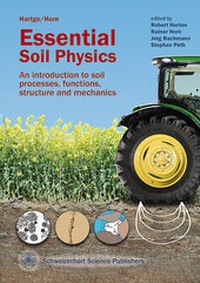
Essential Soil Physics
An introduction to soil processes, functions, structure and mechanics
1st Edition
Published on 27. May 2020
396 pages
978-3-510-65494-9 (ISBN)
Description

Also available in softcover Soils are the porous skin of the Earth with variable and complex structures composed of solid, liquid and gaseous phases. Being in close contact with the atmosphere, biosphere hydrosphere, and lithosphere, soils fulfill numerous functions as a filter, buffer, habitat for organisms and resource for raw materials and food rendering them as the basis for life on our Planet. Soils are subject to continuous transformations and their dynamic nature is important for the interaction of biological, biogeochemical and physical processes. At the same time soils are vulnerable and affected by human activity and often subject to degradation. This textbook (based on the 4th, German language edition) introduces the reader gently but comprehensively to soil physical processes. The authors discuss both the origin and dynamics of soil physical properties and functions - volume-mass relations of the solid, water and gas phases, grain and pore size distributions, permeability and storage capacity for water, gases and heat - and finally soil deformation and strength in relation to mechanical and hydraulic stresses resulting in structural changes through compaction, kneading, slaking and soil crusting. Unlike other soil physics textbooks, soil mechanical properties are herein described in great detail, because otherwise it is impossible to understand and adequately quantify soil stability and the effects of soil deformation on soil physical functions. The book treats the physics of water, gas and heat movement in soils and interactions with the solid phase at various scales and other factors in detail -- because these are considered the ultimate basis of any model of soil behavior. Threats to soils worldwide ultimately endanger food security for a growing world population. Because of this, the effects of soil use and degradation on transport processes, soil stability and pore functions are discussed, and options for soil protection, conservation, and amelioration are addressed. The authors close a gap between general soil science texts and very specialized treatments of foundation engineering by integrating the concepts of soil mechanics to achieve a comprehensive description of soil physical behavior. Traditional soil physics topics, such as soil ? water ? plant relations, soil hydrology and gas, heat and field water cycles are complemented by soil rheology, physicochemical and amelioration sciences. Well-known and recent advances in analytical approaches and methods are well explained to be of use to persons interested in improving plant growth and optimizing crop yield. This book is valuable for researchers, upper-level undergraduate students, and graduate students of agronomy, soil science, horticulture, geo-sciences, environmental science, landscape architects and everybody interested in understanding the intricate physical processes which control and modify soil functions. Problems are provided at the end of each chapter to enable readers to develop soil physics related problem solving skills.
Reviews / Votes
Das deutschsprachige Standardlehrbuch für Bodenphysik „Hartge/ Horn: Einführung in die Bodenphysik“ wurde in diesem Jahr als englischsprachige Ausgabe beim selben Verlag aufgelegt. Auf der Basis der überarbeiteten 4. Auflage wurde eine vollständige Übertragung ins Englische angefertigt. Neben den drei deutschen Autoren Jörg Bachmann, Rainer Horn und Stephan Peth ist als Erstautor der englischen Ausgabe der renommierte amerikanische Bodenphysiker Robert Horton von der Iowa State University dazugekommen. Er ist zusammen mit William A. Jury der Verfasser von „Soil Physics“, ebenfalls einem Standardlehrbuch zur Bodenphysik im englischsprachigen Raum, das zuletzt 2004 in der 6. Auflage bei Wiley erschienen ist. Die Übertragung ins Englische erfolgte mehr oder weniger als wörtliche Übersetzung. Sowohl die Gliederung als auch die Formeln und Abbildungen entsprechen einer 1:1 Transkription. Ergänzt wurden die einzelnen Kapitel um die ebenfalls im englischsprachigen Raum üblichen „Problems“. Dabei handelt es sich um Aufgaben samt Lösungen, die der Leser im Anschluss an den gebotenen Lehrstoff nutzen kann, um das neue erworbene Wissen anzuwenden. Zusätzlich wurde auch das Literaturverzeichnis erweitert, und darin enthaltene Fehler der 4. Auflage wurden korrigiert. Es finden sich jetzt deutlich mehr Hinweise auf vertiefende und weiterführende Literatur, was für den Leser vorteilhaft ist. Auch hier zeigt sich die „Handschrift“ des neuen Erstautors. Die englische Ausgabe behandelt damit ebenso alle wesentlichen Eigenschaften und Funktionen von Böden, die sich aus dem klassischen Drei-Phasen-System ableiten lassen. Es beginnt mit der festen Phase, den Größenverteilungen und Formen der Bodenteilchen (Kap. 1) und dem aus ihrer Anordnung resultierenden Gefüge und Porensystem (Kap. 2). Die Bodenmechanik in Kapitel 3 beschreibt die Veränderung des Bodengefüges und Porensystems unter dem Einfluss von Druck und Wasser. Die folgenden Kapitel 4 bis 6 behandeln die wesentlichen Wechselwirkungen der festen Bodenteilchen mit dem Wasser, den Kräften, denen das Wasser ausgesetzt ist, und der Wasserbewegung im Boden. Die Grundlagen zur Beschreibung des Gashaushalts finden sich in Kapitel 8, während die Wechselwirkung des Bodens mit der Umgebung in Kapitel 9 beschrieben wird. Was das Buch von anderen klassischen englischsprachigen Lehrbüchern – wie z. B. das von Jury und Horton – unterscheidet, sind die insbesondere auf die landwirtschaftliche Praxis ausgerichteten Kapitel 10 und 11, die sich mit Befahrung und Erosion beschäftigen. Im vorletzten Kapitel 12 finden sich die Grundlagen für den Lösungs- und Stofftransport in Böden, und in Kapitel 13 wird ein Ausblick auf zukünftige Entwicklungen der Bodenphysik gegeben. Die englische Ausgabe ist damit ebenso wie die deutsche eine sehr gut geschriebene und ausgezeichnet gestaltete Einführung in die Bodenphysik und als Basislehrbuch für Studierende unterschiedlicher Fachrichtungen gut geeignet. Martin Jansen, Göttingen forstarchiv 88, Heft 1 (2017), S. 24In der Vergangenheit war es üblich, englischsprachige Fachbücher ins Deutsche zu übersetzen. Die Autoren um Rainer Horn gehen den umgekehrten Weg und legen eine Übersetzung des bereits in der 4. Auflage erschienenen Lehrbuches „Einführung in die Bodenphysik“ vor. Als Co-Autor konnten sie Robert Horton von der Iowa State University gewinnen. Die Autoren geben zunächst eine Einführung in die grundlegenden physikalischen Prozesse im Boden. Es werden die maßgeblichen Prozesse der Bewegung von Wasser, Gasen und Wärme sowie die Interaktionen mit der festen Phase auf verschiedenen Skalenebenen ausführlich besprochen. Im Weiteren wird der Einfluss physikalischer Parameter (z. B. Körnung, Dichte, Durchlässigkeit, Druckbelastung) auf die Stabilität und Ertragsfähigkeit von Böden behandelt sowie Möglichkeiten der Bodenverbesserung und des Bodenschutzes diskutiert. Aufbauend auf den ersten beiden Kapiteln zu Körnung und Gefüge werden in den folgenden Abschnitten die mechanisch-hydraulischen Kräftesysteme, die Wechselwirkungen zwischen Wasser und Boden (einschl. Flockung und Peptisation sowie Quellung und Schrumpfung), die Verbreitung und Hydrostatik des Bodenwassers, die Wasserbewegung und die Gasphase im Boden sowie das thermische Verhalten des Bodens dargelegt. In weiteren Kapiteln werden der Pflanzenstandort und seine physikalische Veränderung, Gesetzmäßigkeiten der Erosion sowie Lösungstransport und Filterprozesse in Böden erläutert. Den Abschluss bildet das Kapitel über Perspektiven der Bodenphysik. Positiv hervorzuheben sind die zahlreichen teils farbigen Abbildungen, das ausführliche Literaturverzeichnis sowie die Auflistung wichtiger Maßeinheiten, Abkürzungen, Umrechnungen und Ableitungen. Der Titel des Buches sollte nicht darüber hinwegtäuschen, dass zum Verständnis und zur Vertiefung grundlegendes bodenphysikalisches Wissen vorausgesetzt wird. Es handelt sich weniger um ein Nachschlagewerk als ein didaktisch gut aufgebauter Begleiter für das (Selbst-)Studium. Letzteres wird gefördert durch Aufgaben am Ende jeden Kapitels sowie durch entsprechend Lösungen am Schluss des Buches. Mit der vorliegenden Neuerscheinung wird eine Lücke geschlossen, die infolge des zunehmenden Angebotes an englischsprachigen Vorlesungen und Seminare an den Universitäten entstanden ist. Hans-Georg Brod, Nienburg VDLUFA Mitteilungen 01/2017 | Seite 26
Essential Soil Physics – An introduction to soil processes, functions, structure and mechanics was edited by Robert Horton, Rainer Horn, Jörg Bachmann, and Stephan Peth, and published by Schweizerbart Science Publishers in 2016. The book within 391 pages contains Preface, Introduction, 13 Chapters, References, as well as tables of Commonly used units and conversion Factors and a Meaning of Abbreviations record. Comprehensive knowledge of the texture of soil and its physical, chemical and biological properties is essential in planning its proper use for human needs in the context of sustainable development. Such knowledge is also vital for the rational use of production space of plants, their regionalization, developing business plans, stacking crop rotation and tillage setting. Soil is a distributor of water, takes precipitation, partly serves as water storage reservoirs, partly passes it into the deeper layers to turn it into under ground water supplies, and partly evapotranspirates water back to the atmosphere. Knowledge about soil characteristics is also indispensable when it comes to description, interpretation and forecasting the course of analysing and modelling its physical, chemical and biological processes. The book presents very complex approach to description of soil as an integral part of the environment. In the first two chapters of the book, the authors present the texture and structure of soil from the perspective of its basic physical properties, whereas mechanical and hydraulic forces in soils are described in Chapter 3. This part of the book is the basis for further considerations of other phenomena occurring in soil system. Next three chapters describe the physics of soil water. The authors devote a lot of attention to interactions between water and soil, and also water movement within the soil in both saturated and unsaturated zones. In Chapter 7, 8 and 9 the reader can find a very detailed presentation of the phenomena of gas exchange in soil, its thermal properties, as well as the balance and common transport of water, heat and gas within soil. The following chapter is the description of soil as the habitat of plant growth and development. In Chapter 11 and 12, the authors describe the phenomena of erosion in soil and solute transport and filtration within it. Each of the 12 chapters ends with at least one practical problem concerning the presented material, which facilitates the better understanding of the presented theory. The final chapter offers a list of potential solutions to the discussed problems and the authors thoughts on the further development of the physics of the soil. The book contains many helpful figures and tables which highly raise its educational value. Overall, the book definitely leaves the reader satisfied with the examined matter and makes a significant contribution to knowledge of the scientific community. Cezary Sławiński International Agrophysics Vol. 31, Issue 1
“Essential soil physics” is the first English language edition of Hartge and Horn’s book which has had four previous editions in German. The book is also available in Spanish. I found this an excellent and accessible book which meets its stated target of readers who have a “knowledge of soil science and are interested in understanding the underlying physical processes which control soil functions to, ultimately, improve soil management and use.” Overall I found this a very readable, practical, and useful summary of the main tenants of soil physics including: soil texture and structure; soil mechanics; soil water and air content and movement; thermal behaviour; water, heat, and gas budgets of soils; plant habitats; soil erosion; and solute transport. Key literature is referenced for readers who need further detail in a particular area. The writing is clear and concise and all the major soil physical topics are explained without getting bogged down in the detail of the derivation of formulas. The practical applications related to topics such as drainage and irrigation scheduling were covered. Each chapter included a set of practical problems, with clear solutions given in an appendix, which would greatly aid the motivated readers understanding of the topics discussed. I particularly liked the inclusion of a chapter on “Mechanical and hydraulic forces in soils” that crossed over into engineering soil mechanics, an important area that is not always well covered in soil physics texts which tend to focus primarily on agronomic applications. In the chapter on thermal behaviour of soils I found the treatment of soil freezing and thawing processes particularly insightful as, though mainly written in the context of the winter freezing of soils in continental Europe and USA, it could be applied to the Antarctic cryosol situation. A final chapter on the future of soil physics provided some interesting perspectives. Of interest it pointed to the potential of “biological engineering” the study of the connection of physical and biological processes in soils, particularly in the thin moisture films on soil surfaces. The concluding comment that “Intensive research in the past decades has shown, however, that simple models, oblivious of the actual processes taking place in soils, are unable to predict or even approximate future changes in soils … or predict the consequences for ecosystems” provides the basis of the challenge for future work in soil physics. For a working soil scientist I recommend this book as a reference to own. I will also recommend our university library acquire a copy. I think it a useful text for graduate students to use however I suspect that only the most motivated and mathematically literate of undergraduate students would cope with it – the book assumes a basic knowledge of soil science and mathematics. If there was an opportunity to run a focussed soil physics course this would certainly be a recommended, if not required, text. It is also a book I would recommend to civil engineering and geotechnical engineering students and practitioners. Dr Megan Balks Soil News Issue # 2 – Vol # 65 – May 2017
Wolters Kluwer Health, Inc. does not allow reproducing its review in its entirety but the review concluded the following: "Compared with other familiar English-language soil physics text-books, this book provides expanded discussion of soil structure, and its importance is well integrated into treatment of most other topics. Particularly unique is that pore arrangement is discussed in contexts of both pedogenesis and shorter-term dynamic processes associated with water and gas redistribution. This emphasis offers readers insight on the complexity of processes occurring in field soils. Throughout the book, foreshadowing of concepts is also used in order to make ... Overall, this textbook provides a new presentation of soil physics concepts for the English-language audience, many conceptual figures and examples that can provide useful references for course content, and a compliment of both core and less-commonly treated soil physics subject matter." Soil Science: March 2017 - Volume 182 - Issue 3 - p 114
Vadose Zone Journal does not allow reproducing its review in its entirety but the review concluded the following: "Overall, Essentials in Soil Physics adds to the already available book material in soil physics by providing information beyond classical textbooks and nicely showing the interaction between soil mechanics and classical soil physics (soil hydrology). All chapters provide useful information, although some chapters or subsections seem to be a little bit unbalanced between complexity and simplicity, which is unavoidable given the diversity of soil physics aspects presented. The editorial team has to be commended for putting such diverse material together in a comprehensive textbook. I would recommend this book to graduate and undergraduate students of soil physics, soil chemistry, and soil biology but also to professionals in these disciplines for lecture preparation." Vadose Zone Journal Vol. 16, Iss. 5, 2017
More details
Other editions
Additional editions
Karl Heinrich Hartge | Rainer Horn | Robert Horton
Essential Soil Physics
An introduction to soil processes, functions, structure and mechanics 1st edition, based on the fourth, completely revised and extended German edition
Book
07/2016
1st Edition
Schweizerbart'sche, E.
€72.00
Shipment within 5-7 days
Content
1 - Preface [Seite 10]
2 - Introduction [Seite 11]
2.1 - Soils: integral part of our environment [Seite 11]
2.2 - Soil characteristics [Seite 12]
3 - Grain size distribution: texture [Seite 14]
3.1 - Classification [Seite 14]
3.1.1 - Grain sizes [Seite 15]
3.1.2 - Grain shapes [Seite 16]
3.1.3 - Grain mixtures [Seite 18]
3.2 - Common soil textures and their origin [Seite 21]
3.2.1 - Equation of sedimentation [Seite 23]
3.2.2 - Separation processes [Seite 23]
3.3 - Spatial distribution of textures [Seite 25]
3.4 - Modification of grain size distributions in soils [Seite 26]
3.5 - Grain size distribution and other soil properties [Seite 27]
3.6 - Methods to measure grain size distributions [Seite 30]
3.6.1 - Problems Chapter 1 [Seite 31]
4 - Soil structure and structural functions [Seite 33]
4.1 - Soil structure and internal morphology [Seite 33]
4.2 - Bulk density, particle density [Seite 35]
4.3 - Pore volume and void ratio [Seite 36]
4.3.1 - Theoretical quantities to describe pore volumes [Seite 37]
4.3.1.1 - Influence of grain size and shape on pore volume [Seite 37]
4.3.1.2 - Effect of particle size [Seite 38]
4.3.2 - Number of grain contacts [Seite 39]
4.3.2.1 - Relationship of contact number and pore volume fraction [Seite 39]
4.3.2.2 - Natural grain size distributions and aggregates [Seite 41]
4.3.3 - Influence of grain contact points on soil pedogenesis [Seite 41]
4.4 - Pore size distributions [Seite 43]
4.4.1 - Subdividing pore sizes [Seite 44]
4.4.2 - Shapes, sizes of pores, and modes of pore formation [Seite 46]
4.4.3 - Effects of pore size distribution on soil quality [Seite 47]
4.4.4 - Problems Chapter 2 [Seite 48]
5 - Mechanical and hydraulic forces in soils [Seite 49]
5.1 - Stability and the spatial arrangement of grains [Seite 49]
5.1.1 - Forces and stresses in soils [Seite 49]
5.1.2 - Subdivision of the forces and stresses within soils [Seite 53]
5.1.2.1 - Particle weight [Seite 54]
5.1.2.2 - Loads transmitted by solid phases of soils [Seite 54]
5.1.2.3 - Weight (overburden) stresses transmitted within the solid phase [Seite 54]
5.1.2.4 - Forces between the surfaces of adjacent particles [Seite 56]
5.1.3 - Stresses in three-dimensional space [Seite 56]
5.2 - Soil strength: the balance of forces [Seite 57]
5.2.1 - Shear resistance, a soil property [Seite 57]
5.2.1.1 - Shear resistance of soils and their determination [Seite 57]
5.3 - Stress strain relationship and time-dependent settlement [Seite 63]
5.3.1 - Stress strain relationship in soils [Seite 63]
5.3.2 - Time dependent settlement behavior of soils [Seite 65]
5.3.3 - The meaning of neutral stresses during loading [Seite 66]
5.4 - Stress-, strain-, and deformation processes in three-dimensional space [Seite 68]
5.4.1 - Stress and strain in three-dimensional space [Seite 68]
5.4.2 - Stress propagation within soils [Seite 68]
5.4.3 - Base failure as the result of the active and passive Rankine state [Seite 72]
5.5 - Flow behavior of soils: stresses between individual soil particles [Seite 75]
5.6 - Influence of soil properties on shear resistance [Seite 80]
5.7 - Mechanical changes of soil structure [Seite 81]
5.7.1 - Effects of anthropogenic activities on soils [Seite 81]
5.7.2 - Effects of animal activity and plant growth [Seite 83]
5.7.3 - Freezing effects [Seite 84]
5.7.4 - Soil compaction in civil engineering and construction [Seite 85]
5.7.5 - Problems Chapter 3 [Seite 87]
6 - Interactions between water and soil [Seite 88]
6.1 - Adsorption of water in soils [Seite 88]
6.1.1 - Adsorption mechanisms [Seite 88]
6.1.2 - Properties of water adsorbed on soil components [Seite 90]
6.2 - Flocculation and peptization of soil particles [Seite 91]
6.3 - Shrinkage of soils [Seite 93]
6.3.1 - Causes of soil shrinkage [Seite 93]
6.3.2 - Shrinkage in soils [Seite 96]
6.4 - Swelling of soils [Seite 97]
6.4.1 - Mechanisms of swelling: swelling pressure [Seite 98]
6.4.2 - Inhibition of swelling [Seite 101]
6.5 - Cracking up: crack formation in soils [Seite 102]
6.6 - Water as a factor of soil stability [Seite 105]
6.6.1 - Static water pressure [Seite 105]
6.6.2 - Flow pressure in soils [Seite 107]
6.7 - Wetting properties of soils [Seite 109]
6.7.1 - Causes and occurrence of inhibited wetting of soil particle surfaces [Seite 109]
6.7.2 - Contact angles and capillarity [Seite 110]
6.7.3 - Documenting wetting properties [Seite 113]
6.7.4 - Impact of wetting properties on the environmental and habitat functions of soils [Seite 115]
6.8 - Electrical flow potentials in soils [Seite 116]
6.9 - Aggregate shapes and functions [Seite 117]
6.9.1 - Natural aggregate-forming processes [Seite 118]
6.9.2 - Anthropogenic modification of soil aggregates [Seite 122]
6.10 - Effects of aggregate size, -shape and -age [Seite 122]
6.10.1 - Problems Chapter 4 [Seite 124]
7 - Distribution and hydrostatics of soil water [Seite 125]
7.1 - Distribution and origin of water in soils [Seite 125]
7.2 - Forces in soil water [Seite 126]
7.3 - The groundwater surface as reference plane [Seite 128]
7.4 - Soil water potential [Seite 129]
7.4.1 - Total water potential and component water potentials [Seite 130]
7.4.1.1 - Matric potential m [Seite 131]
7.4.1.2 - Gravitational potential z [Seite 131]
7.4.1.3 - Osmotic potential o [Seite 132]
7.4.1.4 - Overburden or load potential [Seite 132]
7.4.1.5 - Pressure potential P [Seite 133]
7.4.2 - Combining component potentials [Seite 133]
7.4.3 - Instruments for measuring soil water potentials [Seite 134]
7.5 - Equilibrium water potential [Seite 136]
7.6 - Relationship between matric potential and water content [Seite 137]
7.6.1 - Effect of grain size distribution on the matric potential/water content relationship [Seite 139]
7.6.2 - Influence of structure on the shape of the matric potential/water content relationship. [Seite 139]
7.6.3 - Hysteresis of the matric potential/water content curve [Seite 141]
7.6.4 - Measuring matric potential / water content curves [Seite 141]
7.6.5 - Mathematical description of the matric potential-water content relationship [Seite 143]
7.6.6 - Problems Chapter 5 [Seite 143]
8 - Movement of water within the soil [Seite 145]
8.1 - Water movement in water saturated soil [Seite 145]
8.1.1 - Fluid-dynamic phenomena in soils [Seite 145]
8.1.2 - Flow Fields [Seite 149]
8.1.3 - Boundary conditions and spatial limits of flow fields [Seite 149]
8.1.4 - One-dimensional flow [Seite 150]
8.1.5 - Two- and three-dimensional flows [Seite 152]
8.2 - Water movement in unsaturated soil [Seite 155]
8.3 - Transient flow [Seite 157]
8.3.1 - Hydraulic diffusivity [Seite 161]
8.4 - Hydraulic conductivity as a soil property [Seite 162]
8.5 - Vapor transport [Seite 170]
8.6 - Infiltration [Seite 171]
8.7 - Drainage [Seite 176]
8.8 - Evaporation [Seite 183]
8.8.1 - Problems Chapter 6 [Seite 190]
9 - The gas-phase of soils [Seite 195]
9.1 - The energetic state of the gas phase of soils [Seite 195]
9.2 - Composition of the gas phase in soils [Seite 197]
9.3 - Transport processes in the gas phase of soils [Seite 198]
9.3.1 - Gas diffusion [Seite 199]
9.3.2 - Mass fluxes in the gas phase of soils [Seite 201]
9.3.3 - Redistribution of gas within the soil [Seite 201]
9.3.4 - Problems Chapter 7 [Seite 204]
10 - Thermal behaviour of soils [Seite 206]
10.1 - Thermal properties of soils [Seite 206]
10.1.1 - Definitions [Seite 206]
10.1.2 - Heat capacity of soils [Seite 207]
10.1.3 - Thermal conductivity [Seite 210]
10.1.4 - Thermal diffusivity [Seite 212]
10.1.5 - Mechanisms of heat transport in soils [Seite 213]
10.2 - Modeling thermal conductivity [Seite 215]
10.3 - Techniques for measuring thermal properties [Seite 215]
10.4 - Phase transitions of H2O and their effects [Seite 216]
10.4.1 - Redistribution of water vapor by thermal flux [Seite 216]
10.4.2 - Freezing and the formation of ice [Seite 217]
10.4.3 - Freezing and water movement [Seite 218]
10.4.4 - Formation of structure [Seite 220]
10.4.5 - Problems Chapter 8 [Seite 222]
11 - Combined water-, heat-, and gas budget of soils [Seite 223]
11.1 - The atmosphere-soil interface [Seite 223]
11.1.1 - Radiation components and radiation budgets [Seite 223]
11.1.2 - Energy budget at the soil surface [Seite 226]
11.2 - Dynamics and temporal variations of the soil water budget [Seite 228]
11.2.1 - Ground- and floodwater [Seite 230]
11.2.2 - Path of matric potentials [Seite 233]
11.2.3 - Parameters characterizing water budgets [Seite 238]
11.2.3.1 - Field capacity [Seite 238]
11.2.3.2 - Permanent wilting point [Seite 241]
11.3 - Heat budget [Seite 241]
11.3.1 - Temperature distributions in soils [Seite 242]
11.3.2 - Heat sources [Seite 243]
11.3.3 - Soil temperature variations [Seite 243]
11.3.4 - Cumulative effects on the heat budget [Seite 247]
11.4 - Gas budget of soils [Seite 249]
11.4.1 - How water content affects gas distribution within the soil profile [Seite 250]
11.4.2 - Seasonal variations of soil air [Seite 252]
11.4.3 - Problems Chapter 9 [Seite 255]
12 - Plant habitats and their physical modification [Seite 257]
12.1 - Plant requirements in terms of water supply [Seite 257]
12.2 - Interaction of mechanical and hydraulic processes [Seite 260]
12.2.1 - Mechanical and hydraulic soil deformation [Seite 261]
12.2.2 - Pore function changes resulting from mechanical and hydraulic stresses [Seite 263]
12.2.3 - Interactions between hydraulic pore function and mechanical parameters [Seite 266]
12.2.4 - Effects of soil management on physical parameters [Seite 266]
12.3 - Modification of the hydraulic stress state [Seite 268]
12.3.1 - Drainage [Seite 269]
12.3.2 - Irrigation [Seite 272]
12.3.3 - Percolation [Seite 274]
12.4 - Modification of the mechanical stress state [Seite 275]
12.4.1 - Compaction [Seite 275]
12.4.2 - Loosening soils [Seite 276]
12.4.3 - Material rearrangement [Seite 277]
12.4.4 - Problems Chapter 10 [Seite 279]
13 - Soil erosion [Seite 282]
13.1 - Soil erosion: general principles [Seite 282]
13.1.1 - Delamination of particles or aggregates [Seite 283]
13.2 - Approaches to preventing erosion [Seite 287]
13.2.1 - Erodibility of soils [Seite 288]
13.2.2 - Erosivity of wind and water [Seite 289]
13.3 - Erosion models [Seite 289]
13.3.1 - Soil erosion by water [Seite 290]
13.3.2 - Soil erosion by wind [Seite 292]
13.3.3 - Problems Chapter 11 [Seite 292]
14 - Solute transport and filter processes in soils [Seite 295]
14.1 - Solute transport: basics [Seite 296]
14.1.1 - Breakthrough curves in porous media [Seite 296]
14.1.2 - Molecular diffusion [Seite 298]
14.1.3 - Convective flux and hydrodynamic dispersion [Seite 300]
14.1.4 - Adsorption [Seite 301]
14.1.5 - Convection-dispersion model of solute transport in soils [Seite 302]
14.1.6 - Additional factors influencing solute transport [Seite 304]
14.1.7 - Models describing solute transport [Seite 305]
14.2 - Filtering processes in soils [Seite 306]
14.2.1 - Filter types [Seite 306]
14.2.2 - Soils acting as filters [Seite 307]
14.2.3 - Filter efficiency [Seite 308]
14.2.4 - Optimizing filtering processes [Seite 310]
14.2.5 - Problems Chapter 12 [Seite 311]
15 - Future perspectives of soil physics [Seite 313]
16 - Solutions to the problems for chapters 1-12 [Seite 321]
16.1 - Solutions to problems in chapter 1 [Seite 321]
16.2 - Solutions to problems in chapter 2 [Seite 322]
16.3 - Solutions to problems in chapter 3 [Seite 323]
16.4 - Solutions to problems in chapter 4 [Seite 326]
16.5 - Solutions to problems in chapter 5 [Seite 327]
16.6 - Solutions to problems in chapter 6 [Seite 330]
16.7 - Solutions to problems in chapter 7 [Seite 335]
16.8 - Solutions to problems in chapter 8 [Seite 336]
16.9 - Solutions to problems in chapter 9 [Seite 337]
16.10 - Solutions to problems in chapter 10 [Seite 340]
16.11 - Solutions to problems in chapter 11 [Seite 345]
16.12 - Solutions to problems in chapter 12 [Seite 347]
17 - References [Seite 349]
18 - Commonly used units and conversion factors [Seite 376]
19 - Meaning of abbreviations [Seite 376]
19.1 - Basic conversions: density and pore volume [Seite 377]
19.2 - Transport [Seite 378]
19.3 - Derivation of the heat-budget equation [Seite 379]
19.4 - Energy Budget at the soil surface [Seite 380]
19.5 - Tensors [Seite 381]
19.6 - Conversion of data measured in different units [Seite 382]
20 - Index [Seite 383]
2 - Introduction [Seite 11]
2.1 - Soils: integral part of our environment [Seite 11]
2.2 - Soil characteristics [Seite 12]
3 - Grain size distribution: texture [Seite 14]
3.1 - Classification [Seite 14]
3.1.1 - Grain sizes [Seite 15]
3.1.2 - Grain shapes [Seite 16]
3.1.3 - Grain mixtures [Seite 18]
3.2 - Common soil textures and their origin [Seite 21]
3.2.1 - Equation of sedimentation [Seite 23]
3.2.2 - Separation processes [Seite 23]
3.3 - Spatial distribution of textures [Seite 25]
3.4 - Modification of grain size distributions in soils [Seite 26]
3.5 - Grain size distribution and other soil properties [Seite 27]
3.6 - Methods to measure grain size distributions [Seite 30]
3.6.1 - Problems Chapter 1 [Seite 31]
4 - Soil structure and structural functions [Seite 33]
4.1 - Soil structure and internal morphology [Seite 33]
4.2 - Bulk density, particle density [Seite 35]
4.3 - Pore volume and void ratio [Seite 36]
4.3.1 - Theoretical quantities to describe pore volumes [Seite 37]
4.3.1.1 - Influence of grain size and shape on pore volume [Seite 37]
4.3.1.2 - Effect of particle size [Seite 38]
4.3.2 - Number of grain contacts [Seite 39]
4.3.2.1 - Relationship of contact number and pore volume fraction [Seite 39]
4.3.2.2 - Natural grain size distributions and aggregates [Seite 41]
4.3.3 - Influence of grain contact points on soil pedogenesis [Seite 41]
4.4 - Pore size distributions [Seite 43]
4.4.1 - Subdividing pore sizes [Seite 44]
4.4.2 - Shapes, sizes of pores, and modes of pore formation [Seite 46]
4.4.3 - Effects of pore size distribution on soil quality [Seite 47]
4.4.4 - Problems Chapter 2 [Seite 48]
5 - Mechanical and hydraulic forces in soils [Seite 49]
5.1 - Stability and the spatial arrangement of grains [Seite 49]
5.1.1 - Forces and stresses in soils [Seite 49]
5.1.2 - Subdivision of the forces and stresses within soils [Seite 53]
5.1.2.1 - Particle weight [Seite 54]
5.1.2.2 - Loads transmitted by solid phases of soils [Seite 54]
5.1.2.3 - Weight (overburden) stresses transmitted within the solid phase [Seite 54]
5.1.2.4 - Forces between the surfaces of adjacent particles [Seite 56]
5.1.3 - Stresses in three-dimensional space [Seite 56]
5.2 - Soil strength: the balance of forces [Seite 57]
5.2.1 - Shear resistance, a soil property [Seite 57]
5.2.1.1 - Shear resistance of soils and their determination [Seite 57]
5.3 - Stress strain relationship and time-dependent settlement [Seite 63]
5.3.1 - Stress strain relationship in soils [Seite 63]
5.3.2 - Time dependent settlement behavior of soils [Seite 65]
5.3.3 - The meaning of neutral stresses during loading [Seite 66]
5.4 - Stress-, strain-, and deformation processes in three-dimensional space [Seite 68]
5.4.1 - Stress and strain in three-dimensional space [Seite 68]
5.4.2 - Stress propagation within soils [Seite 68]
5.4.3 - Base failure as the result of the active and passive Rankine state [Seite 72]
5.5 - Flow behavior of soils: stresses between individual soil particles [Seite 75]
5.6 - Influence of soil properties on shear resistance [Seite 80]
5.7 - Mechanical changes of soil structure [Seite 81]
5.7.1 - Effects of anthropogenic activities on soils [Seite 81]
5.7.2 - Effects of animal activity and plant growth [Seite 83]
5.7.3 - Freezing effects [Seite 84]
5.7.4 - Soil compaction in civil engineering and construction [Seite 85]
5.7.5 - Problems Chapter 3 [Seite 87]
6 - Interactions between water and soil [Seite 88]
6.1 - Adsorption of water in soils [Seite 88]
6.1.1 - Adsorption mechanisms [Seite 88]
6.1.2 - Properties of water adsorbed on soil components [Seite 90]
6.2 - Flocculation and peptization of soil particles [Seite 91]
6.3 - Shrinkage of soils [Seite 93]
6.3.1 - Causes of soil shrinkage [Seite 93]
6.3.2 - Shrinkage in soils [Seite 96]
6.4 - Swelling of soils [Seite 97]
6.4.1 - Mechanisms of swelling: swelling pressure [Seite 98]
6.4.2 - Inhibition of swelling [Seite 101]
6.5 - Cracking up: crack formation in soils [Seite 102]
6.6 - Water as a factor of soil stability [Seite 105]
6.6.1 - Static water pressure [Seite 105]
6.6.2 - Flow pressure in soils [Seite 107]
6.7 - Wetting properties of soils [Seite 109]
6.7.1 - Causes and occurrence of inhibited wetting of soil particle surfaces [Seite 109]
6.7.2 - Contact angles and capillarity [Seite 110]
6.7.3 - Documenting wetting properties [Seite 113]
6.7.4 - Impact of wetting properties on the environmental and habitat functions of soils [Seite 115]
6.8 - Electrical flow potentials in soils [Seite 116]
6.9 - Aggregate shapes and functions [Seite 117]
6.9.1 - Natural aggregate-forming processes [Seite 118]
6.9.2 - Anthropogenic modification of soil aggregates [Seite 122]
6.10 - Effects of aggregate size, -shape and -age [Seite 122]
6.10.1 - Problems Chapter 4 [Seite 124]
7 - Distribution and hydrostatics of soil water [Seite 125]
7.1 - Distribution and origin of water in soils [Seite 125]
7.2 - Forces in soil water [Seite 126]
7.3 - The groundwater surface as reference plane [Seite 128]
7.4 - Soil water potential [Seite 129]
7.4.1 - Total water potential and component water potentials [Seite 130]
7.4.1.1 - Matric potential m [Seite 131]
7.4.1.2 - Gravitational potential z [Seite 131]
7.4.1.3 - Osmotic potential o [Seite 132]
7.4.1.4 - Overburden or load potential [Seite 132]
7.4.1.5 - Pressure potential P [Seite 133]
7.4.2 - Combining component potentials [Seite 133]
7.4.3 - Instruments for measuring soil water potentials [Seite 134]
7.5 - Equilibrium water potential [Seite 136]
7.6 - Relationship between matric potential and water content [Seite 137]
7.6.1 - Effect of grain size distribution on the matric potential/water content relationship [Seite 139]
7.6.2 - Influence of structure on the shape of the matric potential/water content relationship. [Seite 139]
7.6.3 - Hysteresis of the matric potential/water content curve [Seite 141]
7.6.4 - Measuring matric potential / water content curves [Seite 141]
7.6.5 - Mathematical description of the matric potential-water content relationship [Seite 143]
7.6.6 - Problems Chapter 5 [Seite 143]
8 - Movement of water within the soil [Seite 145]
8.1 - Water movement in water saturated soil [Seite 145]
8.1.1 - Fluid-dynamic phenomena in soils [Seite 145]
8.1.2 - Flow Fields [Seite 149]
8.1.3 - Boundary conditions and spatial limits of flow fields [Seite 149]
8.1.4 - One-dimensional flow [Seite 150]
8.1.5 - Two- and three-dimensional flows [Seite 152]
8.2 - Water movement in unsaturated soil [Seite 155]
8.3 - Transient flow [Seite 157]
8.3.1 - Hydraulic diffusivity [Seite 161]
8.4 - Hydraulic conductivity as a soil property [Seite 162]
8.5 - Vapor transport [Seite 170]
8.6 - Infiltration [Seite 171]
8.7 - Drainage [Seite 176]
8.8 - Evaporation [Seite 183]
8.8.1 - Problems Chapter 6 [Seite 190]
9 - The gas-phase of soils [Seite 195]
9.1 - The energetic state of the gas phase of soils [Seite 195]
9.2 - Composition of the gas phase in soils [Seite 197]
9.3 - Transport processes in the gas phase of soils [Seite 198]
9.3.1 - Gas diffusion [Seite 199]
9.3.2 - Mass fluxes in the gas phase of soils [Seite 201]
9.3.3 - Redistribution of gas within the soil [Seite 201]
9.3.4 - Problems Chapter 7 [Seite 204]
10 - Thermal behaviour of soils [Seite 206]
10.1 - Thermal properties of soils [Seite 206]
10.1.1 - Definitions [Seite 206]
10.1.2 - Heat capacity of soils [Seite 207]
10.1.3 - Thermal conductivity [Seite 210]
10.1.4 - Thermal diffusivity [Seite 212]
10.1.5 - Mechanisms of heat transport in soils [Seite 213]
10.2 - Modeling thermal conductivity [Seite 215]
10.3 - Techniques for measuring thermal properties [Seite 215]
10.4 - Phase transitions of H2O and their effects [Seite 216]
10.4.1 - Redistribution of water vapor by thermal flux [Seite 216]
10.4.2 - Freezing and the formation of ice [Seite 217]
10.4.3 - Freezing and water movement [Seite 218]
10.4.4 - Formation of structure [Seite 220]
10.4.5 - Problems Chapter 8 [Seite 222]
11 - Combined water-, heat-, and gas budget of soils [Seite 223]
11.1 - The atmosphere-soil interface [Seite 223]
11.1.1 - Radiation components and radiation budgets [Seite 223]
11.1.2 - Energy budget at the soil surface [Seite 226]
11.2 - Dynamics and temporal variations of the soil water budget [Seite 228]
11.2.1 - Ground- and floodwater [Seite 230]
11.2.2 - Path of matric potentials [Seite 233]
11.2.3 - Parameters characterizing water budgets [Seite 238]
11.2.3.1 - Field capacity [Seite 238]
11.2.3.2 - Permanent wilting point [Seite 241]
11.3 - Heat budget [Seite 241]
11.3.1 - Temperature distributions in soils [Seite 242]
11.3.2 - Heat sources [Seite 243]
11.3.3 - Soil temperature variations [Seite 243]
11.3.4 - Cumulative effects on the heat budget [Seite 247]
11.4 - Gas budget of soils [Seite 249]
11.4.1 - How water content affects gas distribution within the soil profile [Seite 250]
11.4.2 - Seasonal variations of soil air [Seite 252]
11.4.3 - Problems Chapter 9 [Seite 255]
12 - Plant habitats and their physical modification [Seite 257]
12.1 - Plant requirements in terms of water supply [Seite 257]
12.2 - Interaction of mechanical and hydraulic processes [Seite 260]
12.2.1 - Mechanical and hydraulic soil deformation [Seite 261]
12.2.2 - Pore function changes resulting from mechanical and hydraulic stresses [Seite 263]
12.2.3 - Interactions between hydraulic pore function and mechanical parameters [Seite 266]
12.2.4 - Effects of soil management on physical parameters [Seite 266]
12.3 - Modification of the hydraulic stress state [Seite 268]
12.3.1 - Drainage [Seite 269]
12.3.2 - Irrigation [Seite 272]
12.3.3 - Percolation [Seite 274]
12.4 - Modification of the mechanical stress state [Seite 275]
12.4.1 - Compaction [Seite 275]
12.4.2 - Loosening soils [Seite 276]
12.4.3 - Material rearrangement [Seite 277]
12.4.4 - Problems Chapter 10 [Seite 279]
13 - Soil erosion [Seite 282]
13.1 - Soil erosion: general principles [Seite 282]
13.1.1 - Delamination of particles or aggregates [Seite 283]
13.2 - Approaches to preventing erosion [Seite 287]
13.2.1 - Erodibility of soils [Seite 288]
13.2.2 - Erosivity of wind and water [Seite 289]
13.3 - Erosion models [Seite 289]
13.3.1 - Soil erosion by water [Seite 290]
13.3.2 - Soil erosion by wind [Seite 292]
13.3.3 - Problems Chapter 11 [Seite 292]
14 - Solute transport and filter processes in soils [Seite 295]
14.1 - Solute transport: basics [Seite 296]
14.1.1 - Breakthrough curves in porous media [Seite 296]
14.1.2 - Molecular diffusion [Seite 298]
14.1.3 - Convective flux and hydrodynamic dispersion [Seite 300]
14.1.4 - Adsorption [Seite 301]
14.1.5 - Convection-dispersion model of solute transport in soils [Seite 302]
14.1.6 - Additional factors influencing solute transport [Seite 304]
14.1.7 - Models describing solute transport [Seite 305]
14.2 - Filtering processes in soils [Seite 306]
14.2.1 - Filter types [Seite 306]
14.2.2 - Soils acting as filters [Seite 307]
14.2.3 - Filter efficiency [Seite 308]
14.2.4 - Optimizing filtering processes [Seite 310]
14.2.5 - Problems Chapter 12 [Seite 311]
15 - Future perspectives of soil physics [Seite 313]
16 - Solutions to the problems for chapters 1-12 [Seite 321]
16.1 - Solutions to problems in chapter 1 [Seite 321]
16.2 - Solutions to problems in chapter 2 [Seite 322]
16.3 - Solutions to problems in chapter 3 [Seite 323]
16.4 - Solutions to problems in chapter 4 [Seite 326]
16.5 - Solutions to problems in chapter 5 [Seite 327]
16.6 - Solutions to problems in chapter 6 [Seite 330]
16.7 - Solutions to problems in chapter 7 [Seite 335]
16.8 - Solutions to problems in chapter 8 [Seite 336]
16.9 - Solutions to problems in chapter 9 [Seite 337]
16.10 - Solutions to problems in chapter 10 [Seite 340]
16.11 - Solutions to problems in chapter 11 [Seite 345]
16.12 - Solutions to problems in chapter 12 [Seite 347]
17 - References [Seite 349]
18 - Commonly used units and conversion factors [Seite 376]
19 - Meaning of abbreviations [Seite 376]
19.1 - Basic conversions: density and pore volume [Seite 377]
19.2 - Transport [Seite 378]
19.3 - Derivation of the heat-budget equation [Seite 379]
19.4 - Energy Budget at the soil surface [Seite 380]
19.5 - Tensors [Seite 381]
19.6 - Conversion of data measured in different units [Seite 382]
20 - Index [Seite 383]
