

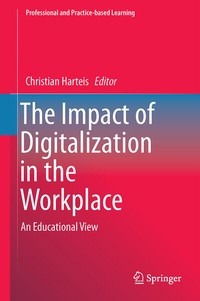
The Impact of Digitalization in the Workplace
Description

This edited volume brings together researchers from various disciplines (i.e. education, psychology, sociology, economy, information technology, engineering) discussing elementary changes at workplaces occurring through digitalization, and reflecting on educational challenges for individuals, organizations, and society. The latest developments in information and communication technology seem to open new potential, and the crucial question arises which kind of work can be replaced by technology? The contributors to this volume are scholars who have been conducting research on the influence of technological change on work and individuals for a long time. The book addresses researchers as well as practitioners in the field of adult education and human resource development.
More details
Other editions
Additional editions
Content
1. Machines, change, work: An educational view on the digitalization of work (Christian Harteis).- Part I: Changes in the workplaces through digitalization.- 2. Mind or machine? Opportunities and limits of automation (Petri Nokkelainen, Timo Nevalainen, & Kreeta Niemi).- 3. Collaborative systems and environments for future working life - towards the integration of workers, systems and manufacturing environments (Raja Hämäläinen, Minna Lanz, & Kari Koskinen).- 4. Digitalization of production, human capital, and organizational capital (Martin Schneider).- Part II: Educational challenges on individual level.- 5. ICT skills and competencies for SMEs: Results from a structured literature analysis on the individual level (Franz Lehner & Mathias Sundby).- 6. Effects of digitalized and flexible workplaces on parenthood - new concepts in gender relations or a return to traditional gender roles? (Anne-Dorethee Warmuth & Ilke Glockentöger).- 7. Learning in the context of work in a digital age:The use of digital media in informal and formal learning contexts (Sin Sing Ang, Mariana Orozo, David Gijbels, & Piet Van den Bossche).- 8. Integrated digitized video recordings in post-flight simulator training: A matter of reflection (Yoriko Kikkawa & Timothy J. Mavin).- Part III: Educational challenges on organizational level.- 9. IT capabilities for SMEs: An analysis at the organizational level (Franz Lehner & Mathias Sundy).- 10. Supporting the change to digitalized production environments through learning organization development (Christoph Fischer & Alexander Pöhler).- 11. Agency and learning in the work of software professionals (Katja Vähäsantanen & Anneli Eteläpelto).- PART IV: Educational challenges on societal level.- 12. Information privacy in a digitalized world: Private issue or public matter? (Franz Lehner & Aleksandra Dzepina).- 13. Accessing and securing conceptual and symbolic knowledge required for digital era work (Stephen Billett).- 14. The digitalization of workand social justice - reflections on the labour process of English Further Education teachers (James Avin & Cheryl Reynolds).
