

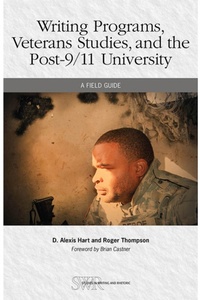
Writing Programs, Veterans Studies, and the Post-9/11 University
Description

D. Alexis Hart and Roger Thompson offer rich academic inquiry into the idea of ?the veteran? as well as into ways that veteran culture has been fostered or challenged in writing classrooms, in writing centers, and in college communities more generally.
For good reasons, the rise of veterans studies has occurred within the discipline of writing studies, with its interdisciplinary approach to scholarship, pedagogy, and community outreach. Writing faculty are often a point of first contact with veteran students, and writing classrooms are by their nature the site of disclosures, providing opportunities to make connections and hear narratives that debunk the myth of the stereotypical combat veteran of popular culture.
Presenting a more nuanced approach to understanding ?the veteran? leads not only to more useful research, but also to more wide-ranging and significant scholarship and community engagement. Such an approach recognizes veterans as assets to the college campus, encourages institutions to customize their veterans programs and courses, and leads to more thoughtful engagement with veterans in the writing classroom.
About the CCCC Studies in Writing & Rhetoric (SWR) Series
In this series, the methods of studies vary from the critical to historical to linguistic to ethnographic, and their authors draw on work in various fields that inform composition?including rhetoric, communication, education, discourse analysis, psychology, cultural studies, and literature. Their focuses are similarly diverse?ranging from individual writers and teachers, to classrooms and communities and curricula, to analyses of the social, political, and material contexts of writing and its teaching.
More details
Content
- Intro
- TITLE PAGE
- COPYRIGHT
- CONTENTS
- Foreword
- Acknowledgments
- Introduction: Theorizing the Post-9/11 Veteran
- 1. Writing (Veterans) Studies
- 2. The Rhetoric of the GI Bill: Defining Veteran Education
- Writing/Practices 1: Student Voices/Writing Genres
- 3. Transferring Veteran Knowledge
- 4. Developing Veteran-Informed Classrooms
- 5. Engaging Veteran Trauma
- Writing/Practices 2: Pedagogy and Programs
- Conclusion: Assets and Avenues
- Notes
- Works Cited
- Index
- Authors
