

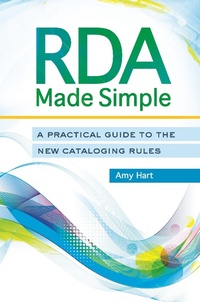
RDA Made Simple
A Practical Guide to the New Cataloging Rules
1st Edition
Published on 28. October 2014
192 pages
978-1-61069-486-5 (ISBN)
Description

Looking for a comprehensive, all-in-one guide to RDA that keeps it simple and provides exactly what you need to know? This book covers planning and training considerations, presents relevant FRBR and FRAD background, and offers practical, step-by-step cataloging advice for a variety of material formats.
The new cataloging standard, Resource Description and Access (RDA), will have far-reaching impacts on your library in terms of how it approaches resource description and access. RDA has been in use at the U.S. Library of Congress since early 2013 and is being widely adopted in the international library community. Today's catalogers need to understand RDA's basic concepts and principles as well as how to apply its rules in order to provide relevant information services in the 21st-century. This book helps you tackle the challenges of implementing the new cataloging code (RDA/Resource Description and Access) in the MARC environment, providing emphasis on practical, straightforward RDA advice for today's busy cataloger.
After a general discussion on planning and training for RDA, the author-a technical services/systems librarian with more than two decades' experience-presents a comprehensive review of RDA's conceptual basis in FRBR and FRAD before providing easy-to-follow, practical guidance on cataloging today's diverse library resources using the new code, covering print, audiovisual, and digital materials. The book is a must-have resource for librarians who catalog on a broad, general level, with or without authority work, and who may or may not be cataloging specialists, but are responsible for handling many different formats. Catalogers at busy libraries committed to getting their new materials out to their users as quickly as possible will also find this work extremely helpful.
The new cataloging standard, Resource Description and Access (RDA), will have far-reaching impacts on your library in terms of how it approaches resource description and access. RDA has been in use at the U.S. Library of Congress since early 2013 and is being widely adopted in the international library community. Today's catalogers need to understand RDA's basic concepts and principles as well as how to apply its rules in order to provide relevant information services in the 21st-century. This book helps you tackle the challenges of implementing the new cataloging code (RDA/Resource Description and Access) in the MARC environment, providing emphasis on practical, straightforward RDA advice for today's busy cataloger.
After a general discussion on planning and training for RDA, the author-a technical services/systems librarian with more than two decades' experience-presents a comprehensive review of RDA's conceptual basis in FRBR and FRAD before providing easy-to-follow, practical guidance on cataloging today's diverse library resources using the new code, covering print, audiovisual, and digital materials. The book is a must-have resource for librarians who catalog on a broad, general level, with or without authority work, and who may or may not be cataloging specialists, but are responsible for handling many different formats. Catalogers at busy libraries committed to getting their new materials out to their users as quickly as possible will also find this work extremely helpful.
More details
Edition
1. Auflage
Language
English
Place of publication
United States
Publishing group
Bloomsbury Publishing Plc
Target group
Interest Age: From 7 to 17 years
ISBN-13
978-1-61069-486-5 (9781610694865)
Copyright in bibliographic data and cover images is held by Nielsen Book Services Limited or by the publishers or by their respective licensors: all rights reserved.
Schweitzer Classification
Other editions
Additional editions
Book
10/2014
Libraries Unlimited Inc
€54.20
Shipment within 3-4 weeks
Person
Amy Hart has been a technical services/systems librarian for more than 20 years, most recently serving as head of bibliographic services at Minuteman Library Network in Natick, MA.
Content
Contents
Introduction: RDA Made Simple
Chapter 1: RDA History to 2008
Chapter 2: RDA HIstory 2008alt-1-5-0
Chapter 3: Planning for RDA
Chapter 4: Implementation Issues
Chapter 5: FRBR, FRAD, and RDA
Chapter 6: RDA's Introductory Chapter
Chapter 7: Navigating RDA
Chapter 8: Tips for Using RDA
Chapter 9: The "RDA Into MARC" Workflow: An Overview
Chapter 10: RDA Section 1: Manifestations and Items
Chapter 11: RDA Section 2: Naming Works and Expressions
Chapter 12: Describing Content for Works and Expressions
Chapter 13: RDA Section 6: Relationships of a Resource to Persons, Families, or Corporate Bodies
Chapter 14: RDA Section 8: Resource-to-Resource Relationships
Chapter 15: RDA Sections 3 and 9: Authority Work
Chapter 16: RDA Quick Reference Table of Contents
Chapter 17: RDA Into MARC Overview: Quick-Ref Chart
Chapter 18: MARC Chart: RDA Impacts
Chapter 19: MARC 264 Fields and Publication Dates
Chapter 20: Content, Media, and Carrier Types in MARC 33x
Chapter 21: Collaborations and Compilations
Chapter 22: Note Fields in RDA
Chapter 23: RDA Examples
Bibliography
Index
Introduction: RDA Made Simple
Chapter 1: RDA History to 2008
Chapter 2: RDA HIstory 2008alt-1-5-0
Chapter 3: Planning for RDA
Chapter 4: Implementation Issues
Chapter 5: FRBR, FRAD, and RDA
Chapter 6: RDA's Introductory Chapter
Chapter 7: Navigating RDA
Chapter 8: Tips for Using RDA
Chapter 9: The "RDA Into MARC" Workflow: An Overview
Chapter 10: RDA Section 1: Manifestations and Items
Chapter 11: RDA Section 2: Naming Works and Expressions
Chapter 12: Describing Content for Works and Expressions
Chapter 13: RDA Section 6: Relationships of a Resource to Persons, Families, or Corporate Bodies
Chapter 14: RDA Section 8: Resource-to-Resource Relationships
Chapter 15: RDA Sections 3 and 9: Authority Work
Chapter 16: RDA Quick Reference Table of Contents
Chapter 17: RDA Into MARC Overview: Quick-Ref Chart
Chapter 18: MARC Chart: RDA Impacts
Chapter 19: MARC 264 Fields and Publication Dates
Chapter 20: Content, Media, and Carrier Types in MARC 33x
Chapter 21: Collaborations and Compilations
Chapter 22: Note Fields in RDA
Chapter 23: RDA Examples
Bibliography
Index
