

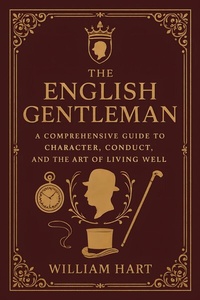
The English Gentleman
Description

Transform Your Life with Timeless Principles of Character, Success, and Refined Living
Discover the Secret to Lasting Success, Meaningful Relationships, and Personal Fulfilment Through the Art of Being a True Gentleman
In a world where superficial success often overshadows genuine character, "The English Gentleman: A Comprehensive Guide to Character, Conduct, and the Art of Living Well" offers a proven path to excellence that has stood the test of time. This isn't just another etiquette book-it's a complete blueprint for transforming your life through the cultivation of character, refinement, and authentic leadership.
What You'll Discover Inside This Life-Changing Guide:
Master the Three Pillars of Social Excellence
Discover the fundamental principles of awareness, thoughtfulness, and confidence that underpin all successful social interactions. These time-tested strategies will help you navigate any social situation with grace and effectiveness, whether in business meetings, social gatherings, or romantic relationships.
Accelerate Your Professional Success
Discover how gentlemanly conduct translates directly into career advancement, business success, and leadership opportunities. Learn the communication skills, relationship-building strategies, and ethical decision-making frameworks that top executives and successful entrepreneurs have used for generations.
Build Deeper, More Meaningful Relationships
Master the art of conversation, active listening, and emotional intelligence that create lasting connections with others. Whether you're seeking to improve your marriage, build stronger friendships, or become a better father, this guide provides the tools for relationship success.
Develop Unshakeable Character and Integrity
Learn how to build moral authority, self-discipline, and personal resilience that will serve you throughout life's challenges. Discover the philosophical foundations that have guided great men throughout history and how to apply these principles in modern contexts.
Why This Book is Different:
Unlike superficial "how-to" guides, "The English Gentleman" provides a comprehensive system for personal transformation based on centuries of proven wisdom. Author William Hart combines historical insights with modern psychology to create a practical roadmap for excellence that works in today's world.
What's Inside:
PART I: Historical Foundations and Importance
. The evolution of the gentleman ideal from medieval times to the modern era
. Philosophical foundations, including Cardinal Newman's revolutionary definition
. Why gentlemanly principles are more relevant than ever in contemporary society
. The psychology of character-based happiness and success
PART II: The Principles of Refined Behaviour
. Master the three pillars of etiquette that govern all social interactions
. Advanced conversation skills that make you memorable and influential
. Professional dress and grooming that commands respect and opens doors
. Dining etiquette and table manners for any occasion, from casual to formal
PART III: The Gentleman in Society
.Business and professional conduct that accelerates career success
.Relationship mastery for romance, marriage, and family life
.Leadership principles that inspire others and create positive change
.The path to a better, happier, and more fulfilling life
The Proven Benefits You'll Experience:
All prices
More details
Content
The Tudor Transformation: The Rise of Merit The rigid social structure of medieval England began to crack during the Tudor period (1485-1603), as economic changes and the growth of trade created new sources of wealth and influence. The devastating effects of the Black Death in the 14th and 15th centuries had already begun to disrupt traditional social arrangements, making it increasingly difficult for younger sons of the nobility to maintain their status through land ownership alone.
A crucial turning point came with the statute of 1 Henry V, chapter 5 (1413), which required that in all legal proceedings involving outlawry, the "estate, degree or mystery" of the defendant must be stated. This seemingly bureaucratic requirement had profound social implications, as it compelled society to confront questions of social classification and identity in new ways. By the 16th century, the concept of the "gentry" had emerged as a distinct social order, officially recognised and increasingly important in English society. Significantly, the badge of this distinction came to be associated with the heralds' recognition of the right to bear arms. While this development was historically questionable-many gentlemen of ancient lineage had never assumed coat armour-it became firmly established in popular understanding. This shift had revolutionary implications. If a gentleman was defined by his right to bear arms, then anyone who could obtain such rights could, in theory, become a gentleman. The heralds, always eager to expand their influence and income, were willing to grant arms to those who could afford them and meet specific basic requirements of respectability. William Harrison, writing in his "Description of England" (1577), captured this new reality when he observed that anyone who could "live without manual labour, and thereto is able and will bear the port, charge and countenance of a gentleman," could "for money have a coat and arms bestowed upon him by heralds.and [be] reputed for a gentleman ever after." This transformation represented a fundamental shift from a birth-based to a behaviour-based conception of gentlemanliness. While wealth remained important-one needed sufficient means to "bear the port, charge and countenance of a gentleman"-the emphasis was increasingly on how one conducted oneself rather than the circumstances of one's birth. The Victorian Synthesis: Education and Character The Victorian era (1837-1901) witnessed the full flowering of the gentleman ideal as we understand it today. This period saw the synthesis of traditional aristocratic values with emerging middle-class virtues, creating a new model of gentlemanliness that emphasised education, moral character, and social responsibility. The Victorians faced a particular challenge in defining gentlemanliness because their society was experiencing rapid social and economic change. The Industrial Revolution had created new forms of wealth and new social classes. At the same time, the expansion of the British Empire had brought English gentlemen into contact with diverse cultures and situations that tested traditional assumptions about proper behaviour. Victorian writers and thinkers grappled extensively with the question of what constituted a true gentleman. The concept was seen as crucial to understanding English society and character, yet it didn't remain easy to define precisely. As one Victorian commentator noted, the idea of the gentleman was "the necessary link in any analysis of mid-Victorian ways of thinking and behaving." Several categories of men were recognised as gentlemen by Victorian society. Members of the British aristocracy were gentlemen by right of birth, though it was paradoxically emphasised that birth alone could not make a man a true gentleman. The new industrial and mercantile elites sought recognition as gentlemen as a natural consequence of their growing wealth and influence, often facing resistance from the established aristocracy. Certain professions automatically conferred gentlemanly status: clergy of the Church of England, army officers, and members of Parliament were universally recognised as gentlemen. However, other equally respectable professions-such as engineering-were not accorded the same recognition, revealing the complex and sometimes arbitrary nature of social classification. The moral component of gentlemanliness became increasingly important during the Victorian period. Writers like Sir Walter Scott, in his enormously influential Waverley Novels, repeatedly explored the concept of the gentleman and the code of honour that should govern his behaviour. The revival of chivalric ideals, filtered through romantic literature and Victorian sensibilities, provided a moral framework for gentlemanly conduct that transcended mere social convention. John Ruskin, one of the most influential Victorian thinkers, offered a definition that captured this moral dimension: "The essence of a gentleman is what the word says, that he comes from a pure gens, or is perfectly bred. After that, gentleness and sympathy, or kind disposition and fine imagination." Ruskin also emphasised the social responsibilities of gentlemanliness, noting that "Gentlemen have to learn that it is no part of their duty of privilege to live on other people's toil." The Victorian solution to the problem of defining gentlemanliness was characteristically practical and democratic. By the latter part of the 19th century, it was almost universally accepted that the recipient of a traditional liberal education mainly based on Latin at one of the elite public schools-Eton, Harrow, Rugby, and their peers-would be recognised as a gentleman, regardless of his origins. This educational pathway to gentlemanliness represented a remarkable democratisation of the ideal. While these schools remained expensive and exclusive, they were not entirely closed to those of humble origins who possessed exceptional ability or benefactors willing to support their education. The emphasis on classical education reflected the Victorian belief that exposure to the literature, history, and values of ancient Greece and Rome would instil the moral and intellectual qualities essential to gentlemanly character. The Modern Evolution: Character Over Circumstance The 20th and 21st centuries have witnessed the continued evolution of the gentleman ideal, shaped by two world wars, social revolution, and the emergence of more egalitarian values. The rigid class distinctions that once defined English society have largely dissolved; yet, the aspiration to gentlemanly conduct has not only survived but has become more accessible and relevant than ever. The modern understanding of gentlemanliness has largely abandoned the historical emphasis on birth, wealth, or even education as defining characteristics. Instead, contemporary definitions focus almost exclusively on character, behaviour, and the impact one has on others. This represents the culmination of a centuries-long evolution from a hereditary caste to a behavioural ideal. Cardinal John Henry Newman's famous definition, written in 1852, anticipated this modern understanding: "It is almost a definition of a gentleman to say he is one who never inflicts pain." Newman's emphasis on the gentleman's effect on others rather than his social position or...
