

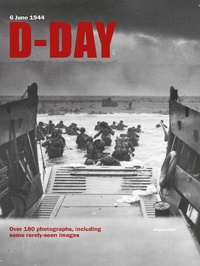
D-Day
6 June 1944
Published on 24. May 2024
224 pages
978-1-83886-538-2 (ISBN)
Description

"You are about to embark upon the Great Crusade, toward which we have striven these many months. The eyes of the world are upon you. The hope and prayers of liberty-loving people everywhere march with you." - General Dwight D. Eisenhower, Order of the Day, June 6, 1944 By May 1944, more than 2.8 million Allied troops, with 4,000 American, British and Canadian ships, were amassed in southern England, waiting to cross the English Channel in the largest seaborne invasion of history. More that 1,200 planes stood ready to deliver specialist airborne troops behind enemy lines, to silence German ground resistance and destroy local infrastructure, and to dominate the skies of the battle theatre. D-Day provides a photographic exploration of this monumental military and political event that helped bring about the end of Nazi Germany's four-year occupation of Europe. The book is divided into chapters covering the first days of the landings on the five beaches: Omaha, Utah, Gold, Juno and Sword; separate chapters cover the airborne landings of the famous American 82nd and 101st Airborne Divisions and the British 6th Airborne, as well as the crucial help of French Resistance fighters in providing intelligence and disrupting German communications and supply lines.
More details
Series
Language
English
Place of publication
United Kingdom
Publishing group
Amber Books Ltd
Edition type
Digital original
Product notice
Reflowable
Illustrations
Halftones, color; Halftones, black and white
File size
91,96 MB
ISBN-13
978-1-83886-538-2 (9781838865382)
Copyright in bibliographic data and cover images is held by Nielsen Book Services Limited or by the publishers or by their respective licensors: all rights reserved.
Schweitzer Classification
Other editions
Additional editions
Person
Stephen Hart is a Senior Lecturer with special responsibilities at the Department of War Studies, the Royal Military Academy Sandhurst. He has been published widely on military history topics, particularly British and German operations during WWII.
Content
Contents include:
Introduction: Four Years of Occupation Following the invasions of Norway, Denmark, the Low Countries and France in the spring of 1940, Nazi Germany dominated Western Europe for the next four years.
1: Preparations Details the extensive preparations for the biggest seaborne invasion in history, including the gathering of a huge force in southern England. Some formidable and ingenious weapons and equipment were produced specifically for the D-Day landings, including the bunker-busting AVREs, seaborne Duplex-drive Sherman tanks and mobile Mulberry harbours. Deception plans: Operation Fortitude.
2: German Defenses: The Atlantic Wall From June 1940 the Germans, wishing to invade Great Britain, contented themselves with coastal defences between Calais and Boulogne. However, from December 1941 they adopted an exclusively defensive strategy, perceiving the danger emerging from the West. Nazi Germany had at its disposal 50 divisions in France and the Low Countries, with another 18 stationed in Denmark and Norway. Although one of the most impressive engineering feats of modern times, British, American and Canadian troops breached the seemingly impregnable Nazi defences along an 80-mile stretch of French coastline at Normandy in a single day.
3: Behind Enemy Lines: French Resistance Details the efforts and sacrifice of the French Resistance and the vital intelligence gathering operations that preceded the invasion.
4: The Naval Operation Codenamed Operation Neptune, D-Day was the largest seaborne invasion in history. On 6 June 1944, 4,000 landing craft, supported by 3,000 naval combat ships, ancillary craft and merchant vessels, transported 132,600 assault troops from the south coast of England to the Normandy beaches, together with thousands of tons of vehicles, tanks, supplies and ammunition.
5: The Airborne Landings This chapter details the airborne and glider assault on the interior of Normandy by the US 82nd and 101st Airborne divisions and the British 1st Airborne Division.
6: The American Beaches: Utah and Omaha Omaha beach turned out to be the most heavily defended and the American forces landing there suffered terrible casualties to secure a bridgehead, made famous in the movie, Saving Private Ryan.
7: The British & Canadian Beaches: Gold, Juno and Sword Three brigades of the Canadian 3rd Infantry Division landed at Juno Beach, and achieved the deepest inland penetration of all Allied troops. On Gold Beach, British troops of XXX Corps were tasked with liberating the town of Bayeux as their main objective. At Sword Beach, on the extreme left of the Allied landings, the British 3rd Infantry Division had the key task of linking up with airborne forces who had landed east of the River Orne.
8: Aftermath The five beachheads were not connected until 12 June, by which time the Allies held a front around 97 kilometres (60 mi) long and 24 kilometres (15 mi) deep. Caen, a major objective, was still in German hands at the end of D-Day and would not be completely captured until 21 July.
Introduction: Four Years of Occupation Following the invasions of Norway, Denmark, the Low Countries and France in the spring of 1940, Nazi Germany dominated Western Europe for the next four years.
1: Preparations Details the extensive preparations for the biggest seaborne invasion in history, including the gathering of a huge force in southern England. Some formidable and ingenious weapons and equipment were produced specifically for the D-Day landings, including the bunker-busting AVREs, seaborne Duplex-drive Sherman tanks and mobile Mulberry harbours. Deception plans: Operation Fortitude.
2: German Defenses: The Atlantic Wall From June 1940 the Germans, wishing to invade Great Britain, contented themselves with coastal defences between Calais and Boulogne. However, from December 1941 they adopted an exclusively defensive strategy, perceiving the danger emerging from the West. Nazi Germany had at its disposal 50 divisions in France and the Low Countries, with another 18 stationed in Denmark and Norway. Although one of the most impressive engineering feats of modern times, British, American and Canadian troops breached the seemingly impregnable Nazi defences along an 80-mile stretch of French coastline at Normandy in a single day.
3: Behind Enemy Lines: French Resistance Details the efforts and sacrifice of the French Resistance and the vital intelligence gathering operations that preceded the invasion.
4: The Naval Operation Codenamed Operation Neptune, D-Day was the largest seaborne invasion in history. On 6 June 1944, 4,000 landing craft, supported by 3,000 naval combat ships, ancillary craft and merchant vessels, transported 132,600 assault troops from the south coast of England to the Normandy beaches, together with thousands of tons of vehicles, tanks, supplies and ammunition.
5: The Airborne Landings This chapter details the airborne and glider assault on the interior of Normandy by the US 82nd and 101st Airborne divisions and the British 1st Airborne Division.
6: The American Beaches: Utah and Omaha Omaha beach turned out to be the most heavily defended and the American forces landing there suffered terrible casualties to secure a bridgehead, made famous in the movie, Saving Private Ryan.
7: The British & Canadian Beaches: Gold, Juno and Sword Three brigades of the Canadian 3rd Infantry Division landed at Juno Beach, and achieved the deepest inland penetration of all Allied troops. On Gold Beach, British troops of XXX Corps were tasked with liberating the town of Bayeux as their main objective. At Sword Beach, on the extreme left of the Allied landings, the British 3rd Infantry Division had the key task of linking up with airborne forces who had landed east of the River Orne.
8: Aftermath The five beachheads were not connected until 12 June, by which time the Allies held a front around 97 kilometres (60 mi) long and 24 kilometres (15 mi) deep. Caen, a major objective, was still in German hands at the end of D-Day and would not be completely captured until 21 July.
