

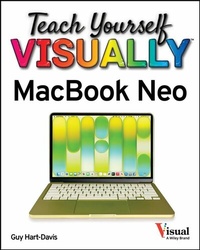
Teach Yourself VISUALLY MacBook Neo
Description

The visual learner's guide to getting up and running with your Apple laptop
Teach Yourself VISUALLY MacBook Neo covers all the vital information you need to start working on your MacBook Neo. With this highly-illustrated and easy-to-follow guide, you'll learn to navigate the macOS interface like a pro; customize your desktop with the widgets you need; and get your Neo working with iCloud, your iPhone, and your iPad. This book's graphical, step-by-step instructions walk you through everything from installation to organizing your life and enjoying multimedia, helping you to get the most out of the investment you've made in your MacBook.
This fully updated edition helps you become a MacBook Neo power user and exploit the features in macOS, Apple's state-of-the-art operating system, and the apps that come with it. If you prefer to learn visually, this is the book you need.
- Get up to speed with the latest macOS version and its new features
- Perform everyday tasks quickly and easily
- Customize settings to make macOS and its apps work the way you prefer
- Communicate via audio and video with FaceTime, via instant messaging with Messages, and via email with Mail
- Organize your life with Calendar, Contacts, Reminders, Notes, and Maps
- Make the most of your iCloud account
Instead of confusing tech-speak and vague instructions, this guide is packed with screenshots, easy-to-follow instructions, and a practical sensibility. Grab Teach Yourself VISUALLY MacBook Neo and explore all that your Neo can do.
More details
Other editions
Additional editions

Content
Chapter 1 Getting Started with Your MacBook Neo
Understanding the MacBook Neo 4
Set Up Your MacBook Neo 6
Start Your MacBook Neo and Log In 8
Explore the macOS Desktop 10
Connect to a Wireless Network 14
Give Commands 16
Open, Close, and Manage Windows 18
Using Control Center 20
Using Notifications 22
Add Widgets to Your Desktop 24
Put Your MacBook Neo to Sleep and Wake It Up 26
Log Out, Shut Down, and Resume 27
Chapter 2 Configuring Your MacBook Neo
Change the Wallpaper 30
Set Up a Screen Saver 32
Configure Battery and Sleep Settings 34
Customize the Dock 36
Configure the Menu Bar 38
Configure Control Center 40
Add or Remove Desktop Spaces 42
Make the Screen Easier to See 44
Configure the Keyboard 46
Configure the Trackpad or Other Pointing Device 48
Configure iCloud Settings 50
Add a Second Display or Use Your iPad as a Display 52
Connect Speakers, Printers, and External Drives 54
Keep macOS and Your Apps Up to Date 56
Configure Your MacBook Neo for Multiple Users 58
Chapter 3 Running Apps
Open an App and Quit It 62
Install and Remove Apps 64
Run an App Full Screen 66
Move, Resize, Fill, and Arrange Windows 68
Switch Quickly Among Apps 70
Switch Apps Using Mission Control 72
Switch Apps Using Stage Manager 74
Set Up and Use Dictation 76
Configure and Invoke Siri 78
Perform Tasks with Siri 80
Identify Problem Apps 82
Force a Crashed App to Quit 83
Back Up and Recover Files 84
Chapter 4 Managing Your Files and Folders
Explore Your MacBook Neo's File System 88
Using the Finder's Views 90
Work with Finder Tabs 92
Organize Your Desktop Files with Stacks 94
Search for a File or Folder 96
Create a New Folder 98
Rename a File or Folder 99
Copy or Move a File 100
Using the Trash 102
Transfer Files Using AirDrop 104
Chapter 5 Surfing the Web
Open Safari and Customize Your Start Page 108
Open a Web Page 110
Follow a Link to a Web Page 111
Open Several Web Pages at Once 112
Navigate Among Web Pages 114
Return to a Recently Visited Page 116
Set Your Home Page and Search Engine 118
Create Bookmarks for Web Pages 120
Using Reader View and Reading List 122
Organize Safari Tabs into Tab Groups 124
Chapter 6 E-Mailing, Chatting, and Calling
Set Up Your E-Mail Accounts 128
Send an E-Mail Message 130
Receive and Read Your Messages 132
Reply to or Forward a Message 134
Send and Receive Files via E-Mail 136
Reduce the Amount of Spam You Receive 138
Configure the Messages App 140
Chat with a Contact 142
Send and Receive Files with Messages 144
Sign In to FaceTime and Choose Settings 146
Make and Receive FaceTime Calls 148
Phone and Text from Your MacBook Neo 150
Chapter 7 Organizing Your Life
Manage Your Apple Account and iCloud Account 154
Create a New Calendar 156
Create an Event 158
Share a Calendar or Subscribe to a Calendar 160
Add Someone to Your Contacts 162
Organize Contacts into Lists 164
Create Notes 166
Track Your Commitments with Reminders 168
Make the Most of the Maps App 170
Implement Essential Privacy and Security Measures 172
Chapter 8 Enjoying Music, Video, Books, and Photos
Add Music to the Music App 176
Play Songs 178
Create Playlists and Smart Playlists 180
Enjoy Radio, Podcasts, and Videos 182
Read Books 184
Import Photos 186Browse Your Photos 188
Select Photos from Bursts 190
Crop, Rotate, or Straighten a Photo 192
Improve a Photo's Colors 194
Create Photo Albums and Slide Shows 196
Index 198
CHAPTER 2
Configuring Your MacBook Neo
You can customize many aspects of macOS to make it work the way you prefer. You can change the wallpaper; personalize the Dock icons, the menu bar, and Control Center; and adjust the keyboard and trackpad or other pointing device. You can also set your MacBook Neo to go to sleep automatically when you are not using it.
Configure Battery and Sleep Settings
Configure the Trackpad or Other Pointing Device
Add a Second Display or Use Your iPad as a Display
Connect Speakers, Printers, and External Drives
Keep macOS and Your Apps Up to Date
Configure Your MacBook Neo for Multiple Users
Change the Wallpaper
macOS enables you to change the wallpaper, the desktop background, to show the picture you prefer. macOS includes many varied desktop pictures, dynamic wallpapers that automatically change their colors to match the light conditions in your MacBook Neo's location, and solid colors. You can also set any of your own photos as the wallpaper. You can tile, stretch, or crop the photo to fill the screen or center it on the screen.
You can also choose between displaying a single picture on the desktop and displaying a series of images that change automatically.
Change the Wallpaper
Display the Wallpaper Pane in System Settings
The wallpaper is visible when no window is open in front of it.
+ click the desktop.
The contextual menu opens.
Click Change Wallpaper.
The Wallpaper pane in System Settings appears.
You can now apply a built-in wallpaper, one or more photos, or a color, as explained in the following subsections.
Apply a Built-In Wallpaper
Click the wallpaper you want to apply.
The wallpaper's preview appears.
The wallpaper's name appears.
For a dynamic wallpaper, click and then click Automatic, Light, or Dark, as needed.
Set the Show on all Spaces switch to On () or Off (), as needed.
Click Close ().
The System Settings window closes.
Apply One or More Photos as Wallpaper
Click Add Photo ().
You can click Choose File () to select a photo from your MacBook Neo's file system.
Click Choose from Photos () to display the Photos browser and then click the photo to use.
You can click Choose Folder () to choose a folder of images.
You can click Favorites () or an album.
A preview of the photo appears.
You can click Cycle () to cycle through the last few photos you chose.
Click and click the way to fit the photo to the screen. See the tip for details.
Click Close ().
Apply a Color as Wallpaper
Scroll down to the bottom of the Wallpaper pane.
You can click Show All to display all available colors.
You can click Cycle () to cycle through all the colors.
You can click Add () and use the Colors window to create a custom color.
Click the color.
Set the Gradient switch to On () if you want a gradient.
Click Close ().
TIP
Which option should I choose for fitting the image to the screen?
In the Wallpaper pane, choose Fit to Screen to match the image's height or width - whichever is nearest - to the screen. Choose Fill Screen to make an image fill the screen without distortion but cropping off parts that do not fit. Choose Stretch to Fill Screen to stretch the image to fit the screen exactly, distorting it as needed. Choose Center to display the image at full size in the middle of the desktop. Choose Tile to cover the desktop with multiple copies of the image.
Set Up a Screen Saver
macOS enables you to set a screen saver to hide what your screen is showing when you leave your MacBook Neo idle. A screen saver is an image, a sequence of images, a moving pattern, or a video that appears on the screen. You can choose what screen saver to use and the delay before it starts. If you apply one of macOS's moving wallpapers, you can use that wallpaper as the screen saver, too.
macOS comes with a variety of attractive screen savers. You can download other screen savers from websites, but be aware that third-party screensavers - especially free ones - might contain malware that attacks your Mac.
Set Up a Screen Saver
+ click System Settings () on the Dock.
The contextual menu opens.
Click Wallpaper.
The Wallpaper pane of System Settings appears.
Click Screen Saver ().
The Screen Saver dialog opens.
The thumbnail shows the current screen saver.
Click Start Screen Saver () and then click the appropriate delay, from After 1 minute to After 3 hours.
Note: Choosing Never in the Start Screen Saver pop-up menu prevents the screen saver from running.
To use the current screen saver, go to step 8. Otherwise, select Custom ().
The dialog expands to show the available screen savers.
Click the screen saver you want to use.
The thumbnail shows a preview of the screen saver.
The screen saver's name appears.
Click Done.
The Screen Saver dialog closes.
Click Clock Appearance.
The Clock Appearance pop-up panel appears.
Click Show large clock () and then click On Screen Saver and Lock Screen, On Lock Screen, or Never, as appropriate.
Click the font for the clock.
Drag the Weight slider to set the font weight.
Click Close ().
System Settings closes.
TIP
Must I use a screen saver to protect my MacBook Neo's screen from damage?
No. Screen savers originally protected cathode ray tube (CRT) displays from having static images "burned in" to their screens. LCD and LED screens, such as that on your MacBook Neo, do not suffer from this problem, so you need not use a screen saver; however, higher-end screens based on technologies such as organic light-emitting diode (OLED) may suffer burn-in problems. Nowadays you can use a screen saver to protect the information on-screen or to provide visual entertainment, but the best move is to put your MacBook Neo to sleep, which has the additional benefit of saving battery power.
Configure Battery and Sleep Settings
The Battery settings pane enables you to view your MacBook Neo's battery level and battery usage, configure power settings separately for when your Neo is running from the battery and from the power adapter, and set up a schedule for waking your Neo or making it sleep. You can set your MacBook Neo to turn off the display after a period of inactivity, dim the display on battery power, and enable Low Power Mode. You can put your MacBook Neo to sleep manually at any time by closing the lid or by clicking Apple () and Sleep.
Configure Battery and Sleep Settings
Click System Settings () on the Dock.
The System Settings window opens.
Click Battery ().
The Battery pane appears.
If you want to configure Low Power Mode, click Low Power Mode (), and then click Never, Always, Only on Battery, or Only on Power Adapter, as needed.
Click Battery Health ().
The Battery Health dialog opens.
Verify that the Battery Condition readout says Normal. If it says Service Recommended, contact Apple or an Apple Authorized Service Provider for advice.
The Maximum Capacity readout shows how much of the battery's design capacity remains, such as 83% remaining instead of 100%.
Set the Optimized Battery Charging switch to On () if you want your MacBook Neo to develop a customized charging routine based on your detected usage.
Click Done to close the...
