

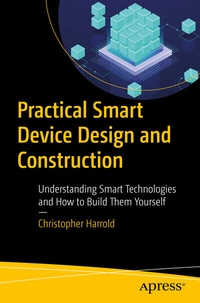
Practical Smart Device Design and Construction
Understanding Smart Technologies and How to Build Them Yourself
Published on 31. August 2020
XIII, 434 pages
978-1-4842-5614-5 (ISBN)
Description

With the rapid development of the Internet of Things, a gap has emerged in skills versus knowledge in an industry typically segmented into hardware versus software. Practitioners are now expected to possess capabilities across the spectrum of hardware and software skills to create these smart devices.
This book explores these skill sets in an instructive way, beginning at the foundations of what makes "smart" technology smart, addressing the basics of hardware and hardware design, software, user experiences, and culminating in the considerations and means of building a fully formed smart device, capable of being used in a commercial capacity, versus a DIY project.
Practical Smart Device Design and Construction includes a set of starter projects designed to encourage the novice to build and learn from doing. Each project also includes a summary guiding you where to go next, and how to tie the practical, hands-on experience together with what they have learned to take the next step on their own.
What You'll Learn
Who This Book Is For
Those with some technical skills, or at least a familiarity with technical topics, who are looking for the means and skills to start experimenting with combined hardware and software projects in order to gain familiarity and comfort with the smart device space.
This book explores these skill sets in an instructive way, beginning at the foundations of what makes "smart" technology smart, addressing the basics of hardware and hardware design, software, user experiences, and culminating in the considerations and means of building a fully formed smart device, capable of being used in a commercial capacity, versus a DIY project.
Practical Smart Device Design and Construction includes a set of starter projects designed to encourage the novice to build and learn from doing. Each project also includes a summary guiding you where to go next, and how to tie the practical, hands-on experience together with what they have learned to take the next step on their own.
What You'll Learn
-
Practical smart device design and construction considerations such as size, power consumption, wiring needs, analog vs digital, and sensor types and uses
-
Methods and tools for creating their own designs such as circuit board designs; and wiring and prototyping tools
-
Hands-on guidance through their own prototype projects and building it alongside the projects in this book
-
Software considerations for speed versus ease, security, and basics of programming and data analytics for smart devices
Who This Book Is For
Those with some technical skills, or at least a familiarity with technical topics, who are looking for the means and skills to start experimenting with combined hardware and software projects in order to gain familiarity and comfort with the smart device space.
More details
Series
Edition
1st ed.
Language
English
Place of publication
Berkeley
United States
Publishing group
APRESS
Target group
Professional and scholarly
Product notice
Reflowable
Illustrations
XIII, 434 p. 335 illus., 298 illus. in color.
File size
27,21 MB
ISBN-13
978-1-4842-5614-5 (9781484256145)
DOI
10.1007/978-1-4842-5614-5
Schweitzer Classification
Other editions
Additional editions
Christopher Harrold
Practical Smart Device Design and Construction
Understanding Smart Technologies and How to Build Them Yourself
Book
09/2020
APress
€53.49
Shipment within 15-20 days
Person
Chris Harrold is a 25 year veteran of IT, starting from help-desk and tech support through to leading technology organizations and departments. Throughout that career he has been privileged to witness one of the most exciting times in technology as the rapid pace of innovation and growth has driven technology from the realm of the corporation into the hands of the consumer. This has also spawned a rise in the creation of smart devices - devices that extend our own abilities and reach through the application of technology.
As a maker and creator, this ability to build things that can do tasks is innately exciting to Chris, and so he has stayed close to the smart device space, and has learned and built numerous things in that time. It is that process of building my skills in hardware, engineering, and product design that prompted Chris to write this book. While there is no way to convey a career of learning and study in a single book, his aim in writing this is to helpothers like Chris get started in the smart device space, by giving them the basic background, context, tools, and guidance to build on as they take their own projects to the next level.
As a maker and creator, this ability to build things that can do tasks is innately exciting to Chris, and so he has stayed close to the smart device space, and has learned and built numerous things in that time. It is that process of building my skills in hardware, engineering, and product design that prompted Chris to write this book. While there is no way to convey a career of learning and study in a single book, his aim in writing this is to helpothers like Chris get started in the smart device space, by giving them the basic background, context, tools, and guidance to build on as they take their own projects to the next level.
Content
Part 1: Smart.- Chapter 1: A Brief History of Smart Things.- Chapter 2: The DYI Smart Era.- Chapter 3: Beyond the Hype: Smart Today and Tomorrow.- Part 2: Smart Hardware.- Chapter 4: EE for the total n00b.- Chapter 5: Advanced Circuit Components.- Chapter 6: Circuit Building Lab.- Part 3: Smart Software.- Chapter 7: Touch, Taste, See, Hear, Smell.- Chapter 8: The Small Computer.- Chapter 9: Smart Device Building Lab.- Part 4: Performance.- Chapter 10: Smart System Building Lab.- Chapter 11: Your First Good PCB.
