

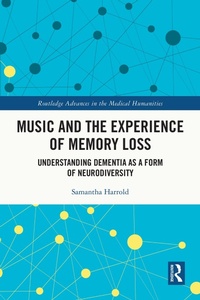
Music and the Experience of Memory Loss
Understanding Dementia as a Form of Neurodiversity
Published on 15. September 2025
174 pages
978-1-040-42362-2 (ISBN)
Description

This book is a creative and critical exploration of the memory loss experience. Drawing on in-depth case studies based on primary research, interviews, approaches from music therapy, and theory from Derrida, Malabou, and Royle, it explores how we might better support people living with memory loss.
Telling the story of an interpretative phenomenological analysis investigation, this innovative book focuses on conversations with ten people living with memory loss in a nursing home, alongside interviews with the pioneering dementia campaigner Wendy Mitchell. The author argues that, for residents who are living with memory loss, both the nursing home environment and the memory loss experience are uncanny. She considers how archival impulses may manifest themselves at the end of life, before exploring theories of both artistic plasticity and neuroplasticity, proposing that the memory loss state might be thought of as a kind of neurodiversity. The book concludes with suggestions for future methods that alleviate disorientation for people living with memory loss and help with acceptance, the reduction of stress, and better outcomes across multiple disciplines and practices, including music therapy, community musicianship, and the nursing home environment itself.
A better understanding of how it feels to live with memory loss is necessary for the development and improvement of practices that are designed to help the memory loss community. This book is an invaluable contribution to research around memory loss, for scholars and practitioners interested in medical humanities, dementia, social care nursing, occupational therapy, and music therapy, among others.
Telling the story of an interpretative phenomenological analysis investigation, this innovative book focuses on conversations with ten people living with memory loss in a nursing home, alongside interviews with the pioneering dementia campaigner Wendy Mitchell. The author argues that, for residents who are living with memory loss, both the nursing home environment and the memory loss experience are uncanny. She considers how archival impulses may manifest themselves at the end of life, before exploring theories of both artistic plasticity and neuroplasticity, proposing that the memory loss state might be thought of as a kind of neurodiversity. The book concludes with suggestions for future methods that alleviate disorientation for people living with memory loss and help with acceptance, the reduction of stress, and better outcomes across multiple disciplines and practices, including music therapy, community musicianship, and the nursing home environment itself.
A better understanding of how it feels to live with memory loss is necessary for the development and improvement of practices that are designed to help the memory loss community. This book is an invaluable contribution to research around memory loss, for scholars and practitioners interested in medical humanities, dementia, social care nursing, occupational therapy, and music therapy, among others.
More details
Series
Language
English
Place of publication
London
United Kingdom
Publishing group
Taylor & Francis Ltd
Target group
College/higher education
Professional and scholarly
Illustrations
3 Tables, black and white; 5 Line drawings, black and white; 5 Illustrations, black and white
File size
4,27 MB
ISBN-13
978-1-040-42362-2 (9781040423622)
Copyright in bibliographic data and cover images is held by Nielsen Book Services Limited or by the publishers or by their respective licensors: all rights reserved.
Schweitzer Classification
Other editions
Additional editions
Samantha Harrold
Music and the Experience of Memory Loss
Understanding Dementia as a Form of Neurodiversity
Book
09/2025
1st Edition
Routledge
€207.20
Shipment within 15-20 days
Person
Samantha Harrold is a writer, composer, musician, teacher, and medical humanities researcher. Her doctorate on the experience of memory loss is from the University of Sussex, UK.
Content
1. Introduction, 2. Sacks, Mitchell, and the question of value, 3. Five strange stories, 4. The uncanny, the archive and the plastic brain, 5. An alternate way of being and implications for future practice
