

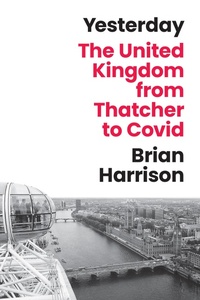
Yesterday
The United Kingdom from Thatcher to Covid
1st Edition
Published on 12. May 2026
896 pages
978-0-691-27421-8 (ISBN)
Description

The first major account of this transformative period in the history of Great Britain
Between 1990 and 2020, the United Kingdom experienced tension between unparalleled social change and a pragmatic political culture which sought continuity, compromise and gradualism. Thatcher's legacy was slowly digested, Blair's 'New Labour' thoroughly scrutinized and the decision was made after forty-seven years to leave the European Union. The UK's long-established major institutions-monarchy, parliament and the union between England, Scotland, Wales and Northern Ireland-were sorely tested. Yesterday provides the first fully documented history of this pivotal time in Great Britain.
Was the UK in decline? Brian Harrison points to Britain's unsuccessful adventures in Iraq and Afghanistan and its relative economic decline, underfunded hospitals, sink schools, over-filled prisons and terrorism of both Irish and Islamic varieties. Yet there were successes. Harrison shows how the UK's participatory institutions outmanoeuvred terrorism and precariously surmounted regional, intergenerational, ethnic and social-class tensions. This vibrant, creative society saw major improvements in time, place and recruitment for work, as well as growth and innovation in conservation, digitization, tourism, consumerism, sport and the arts. Some changes were revolutionary: in family life and relations between the generations, and in the ever-changing electronic media. And if religious observance was in decline, immigrants were introducing new faiths and even a revived religious fervour while attitudes to health and death were changing fast.
A panoramic and wide-ranging analysis by a scholar at the height of his powers, Yesterday paints an evocative, richly textured portrait of a people who were shedding their complacency and insularity and bracing themselves to face a very different but promising future.
Between 1990 and 2020, the United Kingdom experienced tension between unparalleled social change and a pragmatic political culture which sought continuity, compromise and gradualism. Thatcher's legacy was slowly digested, Blair's 'New Labour' thoroughly scrutinized and the decision was made after forty-seven years to leave the European Union. The UK's long-established major institutions-monarchy, parliament and the union between England, Scotland, Wales and Northern Ireland-were sorely tested. Yesterday provides the first fully documented history of this pivotal time in Great Britain.
Was the UK in decline? Brian Harrison points to Britain's unsuccessful adventures in Iraq and Afghanistan and its relative economic decline, underfunded hospitals, sink schools, over-filled prisons and terrorism of both Irish and Islamic varieties. Yet there were successes. Harrison shows how the UK's participatory institutions outmanoeuvred terrorism and precariously surmounted regional, intergenerational, ethnic and social-class tensions. This vibrant, creative society saw major improvements in time, place and recruitment for work, as well as growth and innovation in conservation, digitization, tourism, consumerism, sport and the arts. Some changes were revolutionary: in family life and relations between the generations, and in the ever-changing electronic media. And if religious observance was in decline, immigrants were introducing new faiths and even a revived religious fervour while attitudes to health and death were changing fast.
A panoramic and wide-ranging analysis by a scholar at the height of his powers, Yesterday paints an evocative, richly textured portrait of a people who were shedding their complacency and insularity and bracing themselves to face a very different but promising future.
More details
Language
English
Place of publication
Princeton, NJ
United States
Publishing group
De Gruyter
Target group
Professional and scholarly
Edition type
Digital original
Product notice
Reflowable
Illustrations
47 b/w illus.
File size
35,57 MB
ISBN-13
978-0-691-27421-8 (9780691274218)
Schweitzer Classification
Other editions
Additional editions
Book
05/2026
Princeton University Press
€47.50
Available immediately
Person
Brian Harrison is emeritus professor of modern history at the University of Oxford and an emeritus fellow of Corpus Christi College. His many books include Seeking a Role: The United Kingdom, 1951-1970; Finding a Role? The United Kingdom, 1970-1990; and Drink and the Victorians: The Temperance Question in England, 1815-1872. From 2000 to 2004, he was general editor of the Oxford Dictionary of National Biography.
Content
- Cover
- Contents
- Illustrations
- Abbreviations
- Introduction
- 1. The Political Sequence
- Conservatives in Power, 1990-97
- Centrist Labour, 1992-97
- Labour in Power, 1997-2010
- Conservatives at Sea, 1997-2010
- Conservatives in Coalition, 2010-15
- Labour Seeks a Role, 2010-20
- The Constitution in Crisis, 2015-20
- 2. The Structure of Government
- Monarchy Tried and Tested
- Six Prime Ministers
- A Flexible Executive
- Parliament under Fire
- Beyond Westminster and Whitehall
- A Constitutional Revolution?
- 3. The Political Environment
- The Party System
- General Elections
- Referendums
- Pressure Groups
- Media and Politics
- 4. Law and Disorder
- A Voluntarist Context
- Lawyers in Politics
- Public Order
- Private Squalor
- Terror
- 5. The United Kingdom and the World
- A Shock to the System
- 'Liberal Interventionism'
- European Union?
- Imperial Sunset?
- 6. The Face of the Country
- Conservation and Environment
- Transport and Towns
- House and Home
- Regional Complexities
- Town and Country
- 7. Social Class and Ethnicity
- Hierarchy and Heritage
- Middle-Class Manoeuvres
- 'Social Exclusion' and the Underclass
- The Minority Life Cycle
- Multiculturalism
- 8. Family Revolutions
- Sexuality Scrutinized
- Family Upheavals
- Youth Liberated?
- Feminism of a Kind
- 9. Health and Welfare
- A Central Dynamic
- Volunteers and Pressures
- Wavering on Welfare
- Old Age and Death
- 'Tacit Atheism'
- 10. The Life of Learning
- Classroom Controversy
- Universities in Flux
- Internet Revolution
- 11. Leisure and Culture
- The Arts in Context
- Recreational Affluence
- Media Triumphant
- Celebrity Culture
- 12. Industry and Commerce
- Consensus Thatcherism
- A Flexible Workforce
- Distribution of Wealth
- Consumers in Clover
- Credit Crunch and After
- Conclusions
- Slow Perception
- Current Realities
- Some Afterthoughts
- Acknowledgements
- Reference Notes
- Index
