

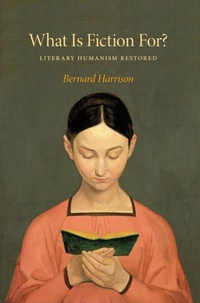
What Is Fiction For?
Literary Humanism Restored
Published on 29. December 2014
620 pages
978-0-253-01412-2 (ISBN)
Description

How can literature, which consists of nothing more than the description of imaginary events and situations, offer any insight into the workings of "human reality" or "the human condition"? Can mere words illuminate something that we call "reality"? Bernard Harrison answers these questions in this profoundly original work that seeks to re-enfranchise reality in the realms of art and discourse. In an ambitious account of the relationship between literature and cognition, he seeks to show how literary fiction, by deploying words against a background of imagined circumstances, allows us to focus on the roots, in social practice, of the meanings by which we represent our world and ourselves. Engaging with philosophers and theorists as diverse as Wittgenstein, Sartre, Merleau-Ponty, Foucault, Derrida, F. R. Leavis, Cleanth Brooks, and Stanley Fish, and illustrating his ideas through readings of works by Swift, Woolf, Appelfeld, and Dickens, among others, this book presents a systematic defense of humanism in literary studies, and of the study of the Humanities more generally, by a distinguished scholar.
Reviews / Votes
What Is Fiction For? Literary Humanism Restored brings the disciplines of literature and philosophy to bear on a single subject: the necessity of humane letters in education, the capacity of literature to transform and elevate the mind. * Academic Questions * The book is wide ranging and deeply engaged with a broad range of theoretical perspectives. . . . Recommended. * Choice * This book is not an easy read, but the effort is rewarding since its argument may very well represent a cornerstone in the history of ideas. It can certainly be a cornerstone of one's career: if one is a student in the humanities and has not yet developed needed certainties, this book can provide the grounding needed to develop them. The book's ideas are stoically, logically, and brilliantly defended. . . . Harrison's account ultimately defines itself as mandatory reading for anyone concerned with literature and literary humanism. * Partial Answers * One great virtue of the book is that Harrison's marriage of philosophy and literary criticism does genuine and novel work. It takes someone of Harrison's philosophical training to articulate the theoretical basis for his defense of literary humanism, and it takes his gifts as a critic to show what this humanism looks like in practice. * Journal of Aesthetics and Art Criticism * All those who care about literature, including admirers of the New Criticism, are indebted to Bernard Harrison for demonstrating, at length and in painstaking theoretical detail, the philosophical validity for the twenty-first century of 'merely what every common reader has always taken to be involved in ''talking about books.''' * The Weekly Standard * In What Is Fiction For? Harrison makes a strong case for the ongoing relevance of the study of iterature as a serious and worthwhile intellectual pursuit. * Eighteenth-Century Fiction * [A] hugely original and rich defence of literary humanism. . . . I think this book, and Harrison's library cognitivism more broadly, deserves more attention . . . . * British Journal of Aesthetics *More details
Language
English
Place of publication
Bloomington, IN
United States
Target group
Professional and scholarly
US School Grade: College Graduate Student and over
File size
1,70 MB
ISBN-13
978-0-253-01412-2 (9780253014122)
Copyright in bibliographic data and cover images is held by Nielsen Book Services Limited or by the publishers or by their respective licensors: all rights reserved.
Schweitzer Classification
Other editions
Additional editions
Book
12/2014
Indiana University Press
€28.50
Shipment within 10-20 days
Book
12/2014
Indiana University Press
€81.50
Shipment within 10-20 days
Person
Bernard Harrison is Emeritus E. E. Ericksen Professor of Philosophy at the University of Utah and Emeritus Professor in the Faculty of Humanities, University of Sussex, UK. He is author of Inconvenient Fictions: Literature and the Limits of Theory; The Resurgence of Anti-Semitism: Jews, Israel, and Liberal Opinion; and (with Patricia Hanna) Word and World: Practice and the Foundations of Language.
Content
Preface
Introduction
PART I: Getting Real
1. Humanism and its Discontents
2. The Mirror of Nature
3. Truth, Meaning and Reality
4. Leavis and Wittgenstein (I): A Living Language
5. Leavis and Wittgenstein (II): The "Third Realm"
PART II: Character, Language and Human Worlds
6. Nature and Artifice
7. Virginia Woolf and "The True Reality"
8. Aharon Appelfeld and the Problem of Holocaust Fiction
9. The Limits of Authorial License in Our Mutual Friend
PART III: Against "The Meaning of the Work"
10. Reactive versus Interpretive Criticism
11. Houyhnhnm Virtue
12. Sterne and Sentimentalism
PART IV: The Skeptic Side
13. Reanimating the Author
14. Persons and Narratives
15. Reading and Reading-In
16. Meaning It Literally: Derrida and his Critics Revisited
Epilogue: Telling the Great from the Good
Notes
Bibliography
Index
Introduction
PART I: Getting Real
1. Humanism and its Discontents
2. The Mirror of Nature
3. Truth, Meaning and Reality
4. Leavis and Wittgenstein (I): A Living Language
5. Leavis and Wittgenstein (II): The "Third Realm"
PART II: Character, Language and Human Worlds
6. Nature and Artifice
7. Virginia Woolf and "The True Reality"
8. Aharon Appelfeld and the Problem of Holocaust Fiction
9. The Limits of Authorial License in Our Mutual Friend
PART III: Against "The Meaning of the Work"
10. Reactive versus Interpretive Criticism
11. Houyhnhnm Virtue
12. Sterne and Sentimentalism
PART IV: The Skeptic Side
13. Reanimating the Author
14. Persons and Narratives
15. Reading and Reading-In
16. Meaning It Literally: Derrida and his Critics Revisited
Epilogue: Telling the Great from the Good
Notes
Bibliography
Index
