

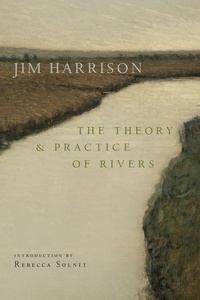
The Theory and Practice of Rivers
Description

In her heartfelt and powerful introduction, Rebecca Solnit calls this collection both an elegy, inspired by the death of Harrison's teenage niece, and a ?loose memoir? teeming with thoughts and images that leap intuitively across subjects, recalling myriad experiences, places, and encounters. A handwritten draft of the title poem, retrieved from Harrison's extensive literary archive, provides a rare and intimate window into his surging creative process. As Outside magazine puts it, The Theory and Practice of Rivers is filled with ?moving water, the search for consolation and meaning in the sublime rightness of wild landscape.? This contemporary classic speaks to the rivers and cascades in all of us, the ceaseless motion by which our lives are determined.
More details
Other editions
Additional editions
Persons
Jim Harrison (1937?2016) was the author of over three dozen books, including Legends of the Fall and Dalva, and served as the food columnist for the magazines Brick and Esquire. He published fourteen volumes of poetry, the final being Dead Man's Float (2016). His work has been translated into two dozen languages and produced as four feature-length films. As a young poet he co-edited Sumac magazine with fellow poet Dan Gerber, and earned fellowships from the National Endowment for the Arts and the Guggenheim Foundation. In 2007, he was elected into the Academy of American Arts and Letters. Regarding his most beloved art form, he wrote: ?Poetry, at its best, is the language your soul would speak if you could teach your soul to speak.? Jim Harrison certainly spoke the language.
Rebecca Solnit's nonfiction is capacious and innovative. She has received the Guggenheim Fellowship, the Lannan Literary Award, the Windham-Campbell Prize, and the National Book Critics Circle Award. Most known for Orwell's Roses, A Paradise Built in Hell, and Recollections of My Nonexistence, Solnit travels widely, sharing her original blends of memoir, scholarship, geography, and criticism. Her voice is singular and polyphonic, with the logistical talents of a prose writer and the concision of a lyric poet. She is an intersectional feminist and supports diverse causes, having founded Not Too Late, a climate project. An advocate of public education, she attended the Berkeley Graduate School of Journalism at the University of California, and has lived as a journalist, historian, activist, and independent writer since 1988. A contributing editor at Harper's Magazine and a frequent writer for The Guardian and Literary Hub, she is based in San Francisco, California.
