

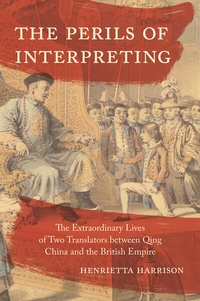
The Perils of Interpreting
Description

A fascinating history of China's relations with the West-told through the lives of two eighteenth-century translators
The 1793 British embassy to China, which led to Lord George Macartney's fraught encounter with the Qianlong emperor, has often been viewed as a clash of cultures fueled by the East's lack of interest in the West. In The Perils of Interpreting, Henrietta Harrison presents a more nuanced picture, ingeniously shifting the historical lens to focus on Macartney's two interpreters at that meeting-Li Zibiao and George Thomas Staunton. Who were these two men? How did they intervene in the exchanges that they mediated? And what did these exchanges mean for them? From Galway to Chengde, and from political intrigues to personal encounters, Harrison reassesses a pivotal moment in relations between China and Britain. She shows that there were Chinese who were familiar with the West, but growing tensions endangered those who embraced both cultures and would eventually culminate in the Opium Wars.
Harrison demonstrates that the Qing court's ignorance about the British did not simply happen, but was manufactured through the repression of cultural go-betweens like Li and Staunton. She traces Li's influence as Macartney's interpreter, the pressures Li faced in China as a result, and his later years in hiding. Staunton interpreted successfully for the British East India Company in Canton, but as Chinese anger grew against British imperial expansion in South Asia, he was compelled to flee to England. Harrison contends that in silencing expert voices, the Qing court missed an opportunity to gain insights that might have prevented a losing conflict with Britain.
Uncovering the lives of two overlooked figures, The Perils of Interpreting offers an empathic argument for cross-cultural understanding in a connected world.
More details
Other editions
Additional editions
Person
Content
- Cover
- Contents
- Acknowledgments
- Dramatis Personae
- Introduction
- Part I: Lives That Crossed the World
- Chapter 1. The Li Family of Liangzhou
- Chapter 2. George Leonard Staunton of Galway
- Chapter 3. Li Zibiao's Education in Naples
- Chapter 4. George Thomas Staunton's Peculiar Childhood
- Part II: Li Zibiao and Lord Macartney's Embassy
- Chapter 5. Finding an Interpreter for an Embassy to China
- Chapter 6. Crossing the Oceans
- Chapter 7. Other Possible Interpreters
- Chapter 8. Li Zibiao as Interpreter and Mediator
- Chapter 9. Speaking to the Emperor
- Chapter 10. Becoming an Invisible Interpreter
- Chapter 11. Li Zibiao after the Embassy
- Part III: George Thomas Staunton and the Canton Trade
- Chapter 12. George Thomas Staunton Becomes an Interpreter
- Chapter 13. Sir George Staunton, Translator and Banker
- Chapter 14. The British Occupation of Macao and Its Aftermath
- Chapter 15. A Linguist and His Troubles
- Chapter 16. The Amherst Embassy
- Part IV: Exclusion
- Chapter 17. Li Zibiao's Last Years in Hiding
- Chapter 18. Staunton in Parliament
- Chapter 19. The Opium War
- Chapter 20. Forgetting
- Conclusion
- Abbreviations
- Glossary
- Notes
- Selected Bibliography
- Illustration Credits
- Index
