

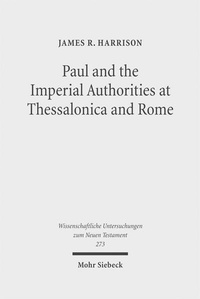
Paul and the Imperial Authorities at Thessalonica and Rome
A Study in the Conflict of Ideology
1st Edition
Published on 9. June 2011
428 pages
978-3-16-151562-0 (ISBN)
Description

James R. Harrison untersucht den Zusammenprall zwischen Paulus' eschatologischem Evangelium und dem julio-claudischen Herrscherkonzept. Die Ideologie des Herrschers mit seinem Anspruch auf die 'Herrschaft auf alle Ewigkeit' des Herrscherhauses über seine Untertanen verkörpert sich in der Vergötterung der Macht, die im Konflikt mit Paulus' Verkündigung der Herrschaft des auferstandenen Sohnes Gottes über die Welt stand. Dieser ideologische Konflikt wird anhand der Briefe an die Thessaloniken und Römer untersucht. Dies geschieht im Hinblick auf die Eschatologie des Paulus, die sich in jenen Briefen mit den lokalen Ansprüchen des imperialen Kultes im griechischen Osten und lateinischen Westen kreuzt. Zahlreiche literarische, dokumentarische, numismatische, ikonographische und archäologische Beweisstücke decken das 'symbolische Universum' der julio-claudischen Herrscher auf.
More details
Other editions
Additional editions
James R. Harrison
Paul and the Imperial Authorities at Thessalonica and Rome
A Study in the Conflict of Ideology
Book
06/2011
1st Edition
Mohr Siebeck
€144.00
Article exhausted; check different version
Person
Content
- Cover
- Preface
- Abbreviations
- Table of Contents
- Chapter 1: Introduction
- 1.1 Modern Scholarship on the 'Paul and Politics' Debate: A Survey of Its Proponents and Critics
- 1.2 Modern Scholarship on the 'Paul and Politics' Debate in Romans and in the Thessalonian Epistles
- 1.3 Modern Scholarship on the Imperial Cult and Its Relevance for the Thessalonian and Roman House Churches
- 1.4 Methodological Issues
- 1.4.1 The Literacy of First-Century Believers and Their Reception of Imperial Propaganda
- 1.4.2 The Issue of 'Hidden Transcripts': Discerning Paul's Political and Pastoral Intent
- 1.4.3 The Imperial Cult as a Cult among Other Cults: Avoiding Monolithic and Undifferentiated Approaches
- 1.4.3.1 New Testament Studies and the Imperial Context: Karl Galinsky's Case for a Nuanced Approach
- 1.4.3.2 New Testament Studies and the Imperial Context: The Issue of Appropriate Methodology
- 1.4.3.3 New Testament Studies and the Imperial Context: The Issue of Ideology
- 1.4.3.4 New Testament Studies and the Imperial Context: The Difference between the Imperial Cult at Rome and in the Greek East
- 1.4.3.5 The Limitations of the Ancient Evidence Regarding the Imperial Cult
- 1.5 The Aim and Structure of the Book
- Chapter 2: Paul and the Imperial Gospel at Thessalonica
- 2.1 Scholarly Debate on the Eschatology of 1 Thessalonians 4:13-5:11
- 2.2 Jewish and Roman Conceptions of Rule in 1 Thessalonians
- 2.2.1 Introduction
- 2.2.2 pa???s?a and ?p?f??e?a
- 2.2.3
- 2.2.4
- 2.2.5 s?t???a and ??p??
- 2.3 Paul's Critique of the Augustan Ideology of Rule and Apotheosis Traditions
- 2.4 Conclusion
- Chapter 3: 'The Ultimate Sinner': Paul and the Anti-Christ in Political Context
- 3.1 Introduction to the Modern Scholarly Debate
- 3.2 Jewish Precedents for the 'Man of Lawlessness' in the Intertestamental Period
- 3.3 Caligula's Attempt to Defile the Jerusalem Temple (AD 40)
- 3.4 Does Paul Speak of Caligula in 2 Thessalonians 2:3-4, 8?
- 3.4.1 Paul and the language of epiphany (2 Thess 2:8)
- 3.4.2 Paul and the language of lawlessness (2 Thess 2:3, 7, 8)
- 3.4.3 Paul and the language of deity (2 Thess 2:4)
- 3.5 Conclusion
- Chapter 4: Imperial Conceptions of Rule and Paul's Reign of Grace
- 4.1 Defining the Roman Sense of Time in Relation to Imperial Rule
- 4.1.1 Saeculum and the Centenary Celebrations at Rome
- 4.1.2 The Advent of the Golden Age of Saturn in the Reigns of Augustus and Nero
- 4.1.3 The amici and clientes of Augustus and the Erection of Monuments and Inscriptions to ??O?
- 4.1.4 Augustus' horologium
- 4.2 Paul, Jewish Eschatology and the Reign of Grace
- 4.3 Roman Conceptions of the Rule of the Caesars
- 4.3.1 Princeps a diis electus
- 4.3.2 The 'Age of Grace' from Augustus to Nero
- 4.3.3 The Ruler as 'Cosmic' Benefactor
- 4.3.4 Providentially Defining Events in the Reigns of the Rulers
- 4.3.5 The Ruler as triumphator: The Roman Ideology of Victory
- 4.3.6 The virtus of the Ruler
- 4.3.7 The Titles of the Ruler and the Language of 'Newness
- 4.4 The Triumph of Christ as Eschatological Ruler in Romans
- 4.4.1 Paul, Messianic Prophecy and the Golden Age
- 4.4.2 Paul, Redemption and the 'Newness' of the Julio-Claudian Dynasty
- 4.4.3 Paul, the Redemption of Creation and the Ruler
- 4.4.4 'More Than Conquerors': The Triumph of God's Love over the Ruling Powers
- 4.4.5 Paul, the Crushing of Satan and the Empire of Rome
- 4.5 Conclusion
- Chapter 5: Paul's 'Dishonoured Benefactor' in Augustan and Neronian Context
- 5.1 Political Factionalism and the Mid-Fifties House Churches of Rome
- 5.2 The Forum of Augustus and Imperial Eschatology at Rome
- 5.3 Anti-Augustan Propaganda and Imperial Ideology at Rome
- 5.4 Ovid and the Rhetoric of Imperial Exile
- 5.5 Paul's Dishonoured Benefactor and the Imperial Gospel in Romans 5:1-11
- 5.5.1 Preliminary Comments
- 5.5.2 Peace, Grace, the Hope of Divine Glory, and Love: The Rhetoric of Paul's Gospel in Its Imperial Context (Rom 5:1-5)
- 5.5.3 The Death of Christ and Imperial Rhetoric (Rom 5:6-9)
- 5.5.4 Divine Reconciliation and Imperial Rhetoric (Rom 5:10-11)
- 5.6 Conclusion
- Chapter 6: Paul and the Roman Ideal of Glory in the Epistle to the Romans
- 6.1 A Scholarly Oversight in the Study of Romans
- 6.2 The Roman Nobiles and the Quest for Ancestral Gloria
- 6.2.1 Defining Gloria
- 6.2.2 Sallust and Cicero on Gloria
- 6.2.2.1 A Survey of Sallust's Understanding of Gloria
- 6.2.2.2 A Survey of Cicero's Understanding of Gloria
- 6.2.3 The Scipionic Elogia and Gloria
- 6.2.4 Funeral Processions and the Commemoration of Ancestral Gloria
- 6.2.5 Roman Boasting Culture: the Duilius Inscription and Plautus
- 6.3 The Concentration of Gloria in the House of the Caesars
- 6.3.1 The Application of Gloria Terminology to the Caesars and the Decline of the Traditional Cursus Honorum
- 6.4 Paul and the Jewish Ideal of Glory
- 6.4.1 Paul's Theological Inheritance: The Jewish Context of Glory and Its Impact on Paul's Thought in Romans
- 6.4.1.1 Glory in the LXX
- 6.4.1.2 Glory in the Old Testament Pseudepigrapha, the Dead Sea Scrolls and the Rabbinic Literature
- 6.4.2 Case Studies of Glory in Jewish Thought
- 6.4.2.1 The Perspective of Philo and Josephus on Glory
- 6.4.2.2 Ben Sira on Ancestral Glory in Sirach 44:1-50:29
- 6.4.2.3 Divine Glory and the Roman Conquest: The Perspective of the Psalms of Solomon
- 6.4.3 What Would Jewish Auditors Have Made of Paul's Ideal of Glory?
- 6.5 Paul and the Roman Ideal of Glory
- 6.5.1 What Would Roman Auditors Have Made of Paul's Idealof Glory?
- 6.6 Conclusion
- Chapter 7: Did Paul Found a New Concept of State?
- 7.1 A Survey of Recent Scholarship on Romans 13:1-7
- 7.2 Greek and Roman Political Theorists on Submission to the Ruler
- 7.2.1 Greek Political Literature on the Ideal Ruler
- 7.2.1.1 The Pythagorean Political Theorists
- 7.2.1.2 Dio Chrysostom on Kingship and Tyranny
- 7.2.1.3 Musonius Rufus on Kingship and Philosophy
- 7.2.1.4 Plutarch on Rulers and the Nature of Statecraft
- 7.2.2 Roman Political Literature on the Ideal Ruler: Seneca's De Clementia
- 7.2.3 Conclusion
- 7.3 Jewish Perspectives on Submission to Gentile Rulers
- 7.4 Setting Romans 13:1-7 in Its Imperial Context
- Chapter 8: Conclusion
- 8.1 The Issue of Appropriate Methodology for Studies of Imperial Ideology and Its Relation to Paul's Epistles
- 8.2 Paul's Gospel and Imperial Thessalonica: Issues of Ideological Conflict in the Greek East
- 8.3 Paul's Gospel and Imperial Rome: Issues of Ideological Conflict in the Latin West
- 8.4 Further Research
- Appendix: Neronian Numismatic Evidence
- Bibliography
- Index of Passages
- Old Testament
- Apocrypha
- Pseudepigrapha
- Rabbinic Literature
- Qumran
- New Testament
- Index of Ancient Non-Literary Sources
- Index of Ancient Literary Sources
- Index of Modern Authors
- Index of Subjects
