

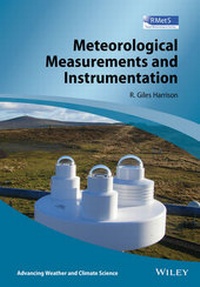
Meteorological Measurements and Instrumentation
Description

Reviews / Votes
""Thorough" is an apt description for the content of this book. A specialist book on Meteorological Measurements is long overdue, and this book is welcome. If a book was destined for sensor system designers it would need to be a thick volume, but for meteorologists needing to have a less detailed description of instruments it is ideal....all scientists/engineers need to be conversant with sensor systems, albeit at a high level (ie. to know how a system works, not necessarily to design it!). So, this book is "pitched" at just the right level." Weather, Royal Meteorological Society, April 2015More details
Other editions
Additional editions
Person
Content
Series Foreword xi
Preface xiii
Acknowledgements xv
Disclaimer xvii
1 Introduction 1
1.1 The instrumental age 2
1.2 Measurements and the climate record 2
1.3 Clouds and rainfall 3
1.4 Standardisation of air temperature measurements 4
1.5 Upper air measurements 5
1.5.1 Manned balloon ascents 6
1.5.2 Self-reporting upper air instruments 7
1.6 Scope and structure 8
2 Principles of Measurement and Instrumentation 9
2.1 Instruments and measurement systems 9
2.1.1 Instrument response characterisation 10
2.1.2 Measurement quality 12
2.2 Instrument response time 14
2.2.1 Response to a step-change 14
2.2.2 Response to an oscillation 15
2.3 Deriving the standard error 18
2.3.1 Sample mean 18
2.3.2 Standard error 20
2.3.3 Quoting results 20
2.4 Calculations combining uncertainties 21
2.4.1 Sums and differences 21
2.4.2 Products and quotients 22
2.4.3 Uncertainties from functions 23
2.5 Calibration experiments 23
3 Electronics and Analogue Signal Processing 27
3.1 Voltage measurements 28
3.2 Signal conditioning 28
3.2.1 Operational amplifiers 29
3.2.2 Operational amplifier fundamentals 30
3.2.3 Signal amplification 31
3.2.4 Buffer amplifiers 33
3.2.5 Inverting amplifier 33
3.2.6 Line driving 35
3.2.7 Power supplies 36
3.3 Voltage signals 38
3.3.1 Electrometers 38
3.3.2 Microvolt amplifier 40
3.4 Current measurement 41
3.4.1 Current to voltage conversion 42
3.4.2 Photocurrent amplifier 43
3.4.3 Logarithmic measurements 44
3.4.4 Calibration currents 45
3.5 Resistance measurement 46
3.5.1 Thermistor resistance measurement 46
3.5.2 Resistance bridge methods 47
3.6 Oscillatory signals 50
3.6.1 Oscillators 50
3.6.2 Phase-locked loops 53
3.6.3 Frequency to voltage conversion 54
3.7 Physical implementation 54
4 Data Acquisition Systems and Initial Data Analysis 57
4.1 Data acquisition 57
4.1.1 Count data 59
4.1.2 Frequency data 60
4.1.3 Interval data 60
4.1.4 Voltage data 61
4.1.5 Sampling 63
4.1.6 Time synchronisation 66
4.2 Custom data logging systems 66
4.2.1 Data acquisition cards 67
4.2.2 Microcontroller systems 67
4.2.3 Automatic Weather Stations 68
4.3 Management of data files 69
4.3.1 Data logger programming 69
4.3.2 Data transfer 70
4.3.3 Data file considerations 71
4.4 Preliminary data examination 72
4.4.1 In situ calibration 72
4.4.2 Time series 73
4.4.3 Irregular and intermittent time series 75
4.4.4 Further data analysis 75
5 Temperature 77
5.1 The Celsius temperature scale 77
5.2 Liquid in glass thermometry 78
5.2.1 Fixed interval temperature scales 78
5.2.2 Liquid-in-glass thermometers 79
5.3 Electrical temperature sensors 80
5.3.1 Thermocouple 81
5.3.2 Semiconductor 81
5.3.3 Thermistor 82
5.3.4 Metal resistance thermometry 83
5.4 Resistance thermometry considerations 86
5.4.1 Thermistor measurement 87
5.4.2 Platinum resistance measurement 89
5.5 Thermometer exposure 90
5.5.1 Radiation error of air temperature sensors 90
5.5.2 Thermometer radiation screens 91
5.5.3 Radiation errors on screen temperatures 93
5.5.4 Lag times in screen temperatures 95
5.5.5 Screen condition 98
5.5.6 Modern developments in screens 99
5.6 Surface and below-surface temperature measurements 99
5.6.1 Surface temperatures 99
5.6.2 Soil temperatures 100
5.6.3 Ground heat flux density 100
6 Humidity 103
6.1 Water vapour as a gas 103
6.2 Physical measures of humidity 105
6.2.1 Absolute humidity 106
6.2.2 Specific humidity 106
6.2.3 Relative humidity 107
6.2.4 Dew point and wet bulb temperature 107
6.3 Hygrometers and their operating principles 109
6.3.1 Mechanical 109
6.3.2 Chemical 111
6.3.3 Electronic 111
6.3.4 Spectroscopic 112
6.3.5 Radio refractive index 113
6.3.6 Dew point meter 114
6.3.7 Psychrometer 114
6.4 Practical psychrometers 116
6.4.1 Effect of temperature uncertainties 118
6.4.2 Ventilation effects 118
6.4.3 Freezing of the wet bulb 120
6.5 Hygrometer calibration using salt solutions 121
6.6 Comparison of hygrometry techniques 122
7 Atmospheric Pressure 123
7.1 Introduction 123
7.2 Barometers 123
7.2.1 Liquid barometers 124
7.2.2 Mercury barometers 125
7.2.3 Hypsometer 127
7.2.4 Aneroid barometers 127
7.2.5 Precision aneroid barometers 128
7.2.6 Flexible diaphragm sensors 129
7.2.7 Vibrating cylinder barometer 129
7.3 Corrections to barometers 129
7.3.1 Sea level correction 130
7.3.2 Wind speed corrections 131
8 Wind Speed and Direction 133
8.1 Introduction 133
8.2 Types of anemometer 133
8.2.1 Pressure plate anemometers 133
8.2.2 Pressure tube anemometer 134
8.2.3 Cup anemometers 134
8.2.4 Propeller anemometer 136
8.2.5 Hot sensor anemometer 137
8.2.6 Sonic anemometer 139
8.3 Wind direction 141
8.3.1 Wind vanes 142
8.3.2 Horizontal wind components 144
8.3.3 Multi-component research anemometers 146
8.4 Anemometer exposure 146
8.4.1 Anemometer deficiencies 146
8.5 Wind speed from kite tether tension 148
9 Radiation 151
9.1 Introduction 151
9.2 Solar geometry 154
9.2.1 Orbital variations 154
9.2.2 Diurnal variation 155
9.2.3 Solar time corrections 155
9.2.4 Day length calculation 156
9.2.5 Irradiance calculation 157
9.3 Shortwave radiation instruments 158
9.3.1 Thermopile pyranometer 158
9.3.2 Pyranometer theory 159
9.3.3 Silicon pyranometers 162
9.4 Pyrheliometers 162
9.5 Diffuse solar radiation measurement 164
9.5.1 Occulting disk method 164
9.5.2 Shade ring method 165
9.5.3 Reflected shortwave radiation 168
9.5.4 Fluctuations in measured radiation 169
9.6 Reference solar radiation instruments 171
9.6.1 Cavity radiometer 172
9.6.2 Secondary pyrheliometers 172
9.7 Longwave instruments 173
9.7.1 Pyrradiometer theory 173
9.7.2 Pyrradiometer calibration 174
9.7.3 Pyrgeometer measurements 175
9.7.4 Commercial pyrradiometers 175
9.7.5 Radiation thermometry 177
9.8 Sunshine duration 178
9.8.1 Campbell-Stokes sunshine recorder 180
9.8.2 Electronic sensors 181
10 Clouds, Precipitation and Atmospheric Electricity 183
10.1 Introduction 183
10.2 Visual range 183
10.2.1 Point visibility meters 184
10.2.2 Transmissometers 185
10.2.3 Present weather sensors 185
10.3 Cloud base measurements 186
10.4 Rain gauges 187
10.4.1 Tilting siphon 188
10.4.2 Tipping bucket 188
10.4.3 Disdrometers 191
10.5 Atmospheric electricity 191
10.5.1 Potential Gradient instrumentation 191
10.5.2 Variability in the Potential Gradient 192
10.5.3 Lightning detection 193
11 Upper Air Instruments 195
11.1 Radiosondes 195
11.1.1 Sounding balloons 196
11.2 Radiosonde technology 197
11.2.1 Pressure sensor 199
11.2.2 Temperature and humidity sensors 200
11.2.3 Wind measurements from position information 201
11.2.4 Data telemetry 202
11.2.5 Radio transmitter 203
11.3 Uncertainties in radiosonde measurements 204
11.3.1 Response time 204
11.3.2 Radiation errors 204
11.3.3 Wet-bulbing 206
11.3.4 Location error 207
11.3.5 Telemetry errors 208
11.4 Specialist radiosondes 209
11.4.1 Cloud electrification 209
11.4.2 Ozone 209
11.4.3 Radioactivity and cosmic rays 210
11.4.4 Radiation 210
11.4.5 Turbulence 211
11.4.6 Supercooled liquid water 211
11.4.7 Atmospheric aerosol 212
11.5 Aircraft measurements 212
11.5.1 Air temperature 212
11.5.2 Wind 212
11.5.3 Pressure 213
11.5.4 Altitude 213
11.6 Small robotic aircraft 213
12 Further Methods for Environmental Data Analysis 215
12.1 Physical models 215
12.1.1 Surface energy balance 215
12.1.2 Turbulent quantities and eddy covariance 217
12.1.3 Soil temperature model 218
12.1.4 Vertical wind profile 220
12.2 Solar radiation models 222
12.2.1 Langley's solar radiation method 222
12.2.2 Surface solar radiation: Holland's model 224
12.3 Statistical models 225
12.3.1 Histograms and distributions 226
12.3.2 Statistical tests 226
12.3.3 Wind gusts 229
12.4 Ensemble averaging 229
12.4.1 Solar radiation variation 230
12.4.2 Pressure tides 231
12.4.3 Carnegie curve 231
12.5 Spectral methods 233
12.5.1 Power spectra 233
12.5.2 Micrometeorological power spectra 235
12.6 Conclusion 237
Appendix A Writing a Brief Instrumentation Paper 239
A.1 Scope of an instrument paper 239
A.2 Structure of an instrument paper 239
A.2.1 Paper title 239
A.2.2 Abstract 240
A.2.3 Keywords 240
A.2.4 Motivation 240
A.2.5 Description 240
A.2.6 Comparison 241
A.2.7 Figures 241
A.2.8 Summary 242
A.2.9 Acknowledgements 242
A.3 Submission and revisions 242
Appendix B Anemometer Coordinate Rotations 243
References 247
Index 253
1
Introduction
The appearance of the sky and its relationship to the atmosphere's properties have, no doubt, always provoked curiosity, with early ideas on explaining its variations available from Aristotle. A defining change in the philosophy of atmospheric studies occurred in the seventeenth century, however, with the beginning of quantitative measurements, and the dawn of the instrumental age. Since then, elaborate devices to monitor and record changes in the elements have continued to develop, providing, along the way, measurements underpinning the instrumental record of past environmental changes, most notably in air temperature. This means that characterising and understanding early meteorological instruments are of much more than solely historical interest, as recovering past measurements, whilst recognising their limitations, can also have immediate geophysical relevance.
An important meteorological example is the reconstruction of past temperature variations from the miscellaneous thermometer records originally undertaken to satisfy personal curiosity. Ships' logbooks provide another example, in terms of geomagnetic field changes. Beyond the actual data produced in either case, this also provides a reminder that all measurements can have unforeseen applications well beyond their original motivation [1], either through a change of context in which the measurements are evaluated, or because other subsequently important information has unwittingly been included.1 Such future scope is probably impossible to predict completely, but it can to some extent be allowed for by ensuring a full appreciation of the related measurement science through careful description of the construction, calibration and recording procedures for the instrumentation employed. The possible future legacy implied by taking this historical perspective adds further motivation for rigour in the modern science of atmospheric measurement.
This chapter briefly highlights some of the major historical landmarks in development of instrumentation science for meteorology, and concludes with an overview of the book's material.
1.1 The instrumental age
Many of the early atmospheric measuring instruments were developed in Florence, due perhaps in part to the experimental physical science tradition inspired by Galileo, and availability of the necessary craftsmanship. This included early thermometers, such as the thermoscope produced during the late 1500s to determine changes in temperature. Following key instrument advances such as the invention of the barometer by Evangelista Torricelli in 1643 and an awareness of the need for standardisation of thermometers, modern quantitative study of the atmosphere can be considered to date from the mid-seventeenth century.
Early measurement networks followed from the availability of measuring technologies combined with the formation of learned scientific societies, which together provided the means to record and exchange information in a published form. Comparison of measurements required a system of standardisation, such as that achieved through common instrumentation, and in many cases, common exposure. For thermometers, an agreed temperature scale was necessary and the Celsius,2 Fahrenheit3 or Réaumur4 scales all originated in the eighteenth century [2]. The meteorological values were published as tables of readings, in many cases without any further processing, but which were sufficiently complete for analysis to be made later.
1.2 Measurements and the climate record
Early weather records can be found in 'weather diaries', which were usually kept by well-educated and well-resourced individuals able to purchase or construct scientific instruments such as barometers and thermometers. In some cases, these diaries contain considerable descriptive and quantitative geophysical data, such as those of temperature and rainfall measurements (Figure 1.1).
Figure 1.1 Example page from a weather diary (kept by an apothecary and surgeon, Thomas Hughes at Stroud, Gloucestershire, between 1771 and 1813), in which daily measurements of air pressure, temperature, humidity, rainfall and weather were recorded. As well as quantitative weather information, this particular diary includes other geophysical information, such as timings of earthquakes and even occurrence of the aurora borealis, an indirect measure of solar activity [3]. (Reproduced from Reference 3 with permission of The Met Office.)
Such early data sources are important because of the reference information they provide for the study of climate change, and they therefore remain of scientific value many centuries later. This is particularly true of the disparate thermometer measurements made in southern England from the 1600s, which, although made originally by individuals in an uncoordinated way, now provide an important climate data resource. The temperature readings were cross-checked and compiled5 in the 1950s, drawing on knowledge of the different instruments used and understanding of their exposures [4]. This important synthesis generated a long series of temperature data for an area conveniently described as 'Central England', amounting to an approximately triangular region bounded by Bristol, Manchester and London.
The Central England measurements form the longest continuous set of monthly instrumental atmospheric temperatures available anywhere in the world, beginning in January 1659. (Daily values are also available, beginning in 1772; see Reference 5.) Figure 1.2 shows minimum, maximum and mean annual temperatures of the monthly Central England Temperature (CET) series.
Figure 1.2 Monthly temperatures of 'Central England', originally constructed from historical thermometer records by Manley, and continued using updated modern measurements by the Hadley Centre of the UK Met Office [5]. The thick central line shows the annual mean temperature, with the upper and lower lines the mean values for summer (June-July-August) and winter (December-January-February) respectively (the degraded resolution of the early thermometers is also evident). (Reproduced from Reference 5 with permission of The Met Office.)
1.3 Clouds and rainfall
In the nineteenth century, classification, quantification and taxonomy became an important aspect of many sciences, particularly in the life sciences and geology, so it was natural for similar approaches to be extended to meteorology. The classification of clouds6 was one early aspect, and the compilation of rainfall data also helped further develop the quantitative basis for environmental description. Major developments in meteorology continued in the mid-nineteenth century, following the foundation of the Meteorological Society in 1850, and the establishment of the early Met Office in 1854 under Admiral Fitzroy.7 The British Association for the Advancement of Science convened a Rainfall Committee, with G.J. Symons as secretary. Compilation of historical rainfall data for the United Kingdom was a herculean undertaking, but, following adverts in many local newspapers leading to thousands of replies, Symons [6] did conclude in 1866 that 'there are not now very many records in private hands of which copies are not already obtained and classified.' The legacy of this work is the series of annual volumes of Symons British Rainfall. Further, a continuous series of monthly data [7] for England and Wales Precipitation (EWP) exists from 1766 (see Figure 1.3).
Figure 1.3 Annual rainfall for England and Wales. (Reproduced with permission of The Met Office.)
1.4 Standardisation of air temperature measurements
Standardised exposure for air temperature measurements began in the nineteenth century [8], when meteorological instruments were becoming increasingly available commercially.8 Early (1841) exposure of thermometers for air temperature measurement was through use of a Glaisher stand,9 a simple shading board which was rotated manually to prevent direct solar radiation reaching the thermometer [9]. The Glaisher stand's effectiveness depended on the diligence of the observer required to turn the stand after each reading. If the interval between readings became too long, direct sunlight could still reach the thermometer. The practical difficulty in manually turning the shade board yet retaining good ventilation was solved by Thomas Stevenson10 in 1863, in the form of a double-louvered wooden box painted gloss white. This gave protection to thermometers from solar radiation in all directions, and ensured long wave radiation exchange was with the interior of the screen. The use of a double-louver increased the length of the air path through the screen, which brought the interior of the screen material closer to air temperature than alternatives of simple slits or mesh. In its original form, the Stevenson screen was a wooden box 15 inches high, 14.5 inches long and 7.5 inches wide. It had a solid roof with integral ventilator, and the thermometers were mounted horizontally 4 feet above the ground.
Many minor variants on the Stevenson screen were made. The Scottish physicist John Aitken investigated screen properties [10], noting much later [11] that nothing had been done to mitigate the effects of thermal inertia of...
