

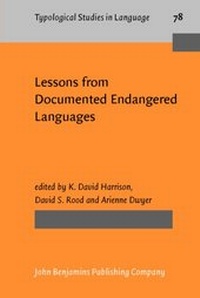
Lessons from Documented Endangered Languages
1st Edition
Published on 11. September 2008
VI, 375 pages
978-90-272-9020-5 (ISBN)
Description

This volume represents part of an unprecedented and still growing effort to advance, coordinate and disseminate the scientific documentation of endangered languages. As the pace of language extinction increases, linguists and native communities are accelerating their efforts to speak, remember, record, analyze and archive as much as possible of our common human heritage that is linguistic diversity. The window of opportunity for documentation is narrower than the actual lifetime of a language, and is now rapidly closing for many languages represented in this volume. The authors of these papers unveil newly collected data from previously poorly known and endangered languages. They organize highly complex linguistic facts - paradigms, affixes, vowel patterns - while pointing out the theoretically challenging aspects of these. Beyond this, they reflect on the social and human dimensions, discussing particular problems of nostalgia and modernity, memory and forgetting, and obsolescence and ethics, while viewing language as not merely data on a page but as a living creation in the minds and mouths of its speakers.
More details
Other editions
Additional editions
K. David Harrison | David S. Rood | Arienne Dwyer
Lessons from Documented Endangered Languages
Book
09/2008
John Benjamins Publishing Co
€121.90
Shipment within 10-15 days
Persons
Content
- Intro
- Table of contents
- A world of many voices
- Untangling human history
- Contested cultures
- Morphological complexity
- Emergent tone systems
- Shamans' chants and linguistic archeology
- Assessing endangerment
- The floodgates of memory
- Moribund yet living
- Challenges to linguistic theory
- Conversational strategies
- Kinship in context
- Acknowledgements
- Sri Lanka Malay revisited
- Foreword
- 1. Introduction
- 1.1. SLM speech communities
- 1.2. The linguistic base of SLM
- 2. Revisiting basic assumptions
- 2.1. The `Tamil bias'
- 2.2. SLM is not a Creole
- 3. Introduction to case in Kirinda Java and its adstrates
- 3.1. Accusative
- 3.2. Dative
- 3.3. Other cases
- 3.4. Basic case-alignment in KJ and its adstrates
- 3.5. Agglutinative morphology
- 3.6. Summary
- 4. Conclusions
- 4.1. Significance for the genesis of SLM
- 4.2. Significance for the classification of SLM varieties
- Acknowledgements
- References
- Working together
- 1. Introduction
- 2. The Trumai and their past
- 2.1. Paradise lost?
- 2.2. Which paradise?
- 2.3. What to do in this situation?
- 2.4. The reification of culture: Elements of explanation
- 2.5. ``Culturally preserved'': A new criterion in the Xingu intertribal hierarchy
- 3. Documentation: Bases, objects and means of interaction
- 3.1. The figure of the white man
- 3.2. Two contrasting positions on the work of documentation
- 3.3. Folklorisation
- 4. The impact and uses of documentation
- 4.1. Possession of knowledge, capacities, and problems of access to documentation
- 4.2. Memorization strategies and cultural change: Dealing with a new memory
- 4.3. The transmission of knowledge
- 5. Conclusion
- References
- Tense, Aspect and Mood in Awetí verb paradigms
- 1. Introduction
- 2. Verbs in a Word-and-Paradigm approach
- 2.1. Lexical words and word forms
- 2.2. Classification systems
- 3. Awetí verb paradigms: The person part
- 3.1. Three Awetí verb types
- 3.2. Active intransitive verbs and basic person categories
- 3.3. Transitive verbs and person hierarchy
- 3.4. Stative intransitive verbs
- 4. Tense-Aspect-Mood Category Affixes
- 4.1. Permissive mood prefixes
- 4.2. Aspect suffixes
- 4.3. Mood suffixes
- 5. Tense-Aspect-Mood auxiliary particles
- 5.1. A particle for the negated permissive
- 5.2. `Temporal' and `modal' particles: Factuality
- 6. The verb form system and system link of Awetí
- 6.1. The functional system
- 6.2. The structural system
- 6.3. The system link
- 7. Elements of Awetí verb paradigms: Examples
- 7.1. Synthetic form atupeju11: Problems with traditional glossings
- 7.2. Analytical form tut etoka: Analysis of discontinuous occurence
- 7.3. Syncretism for pejtup11 (synthetic form of a transitive verb)
- 7.4. Syncretism for etup tepe (analytical form of a transitive verb)
- 7.5. Synthetic form ito: No specific marking at all
- 7.6. Final remarks
- References
- Tonogenesis in Southeastern Monguor
- 1. Introduction
- 2. Contact environment and Mongolic prosody
- 3. The Monguor data
- 3.1. Patterns in monosyllables
- 3.2. CV.CV and CV.CVN lexemes
- 3.3. Reduplication
- 3.4. Anomalous tonal patterns
- 4. Discussion
- 5. Evidence from neighboring languages
- 6. Conclusions
- References
- Language, ritual and historical reconstruction
- Introduction
- The archaeology of the Upper Xingu
- The constitution of a plural society
- A view from the present
- References
- Endangered Caucasian languages in Georgia
- 0. Introduction
- 1. Phonological peculiarities
- 1.1. Svan
- 1.2. Tsova-Tush (Batsbi)
- 1.3. Udi
- 2. Morphology and morphosyntax
- 2.1. Noun, pronoun and verb morphology in Tsova-Tush (Batsbi) and Udi
- 2.2. Actant marking, ergativity and sentence structure
- 3. Determining linguistic parameters of language endangerment
- 3.1. Some preliminaries
- 3.2. The Batsbi case
- 3.3. The Svan case
- 3.4. The Udi case
- 3.5. Summary and outlook
- References
- Appendix: Batsbi poem by David Arindauli
- Contact, attrition and shift in two Chaco languages
- 1. Introduction
- 2. Tapiete
- 2.1. The speakers: current socio-linguistic situation
- 2.2. Prior research on the Tapiete language
- 2.3. Typological characteristics of the language
- 2.4. Borrowing in Tapiete
- 3. Vilela
- 3.1. The people
- 3.2. The speakers: current socio-linguistic situation
- 3.3. Prior research on the Vilela language
- 3.4. Typological characteristics
- 3.5. Language attrition and remembering in Vilela
- 4. Conclusions
- References
- Tofa language change and terminal generation speakers1
- 1. Overview
- 2. Background and demographic information
- 3. The imperative in modern Tofa
- 4. Mergers in the Tofa auxiliary verb system: New functions of ber- (/ ver-)
- 5. Russian code-mixing and contact-induced restructuring
- 5.1. Code-mixing
- 5.2. Contact-induced restructuring: Complex sentence formation
- 6. The Tofa vowel harmony system
- 7. Summary
- Abbreviations
- References
- Hocank's challenge to morphological theory
- 1. Introduction
- 2. The problem
- 3. Affixation
- 3.1. The notion of infix
- 3.2. The notion of interfix
- 3.3. Towards a theory of affixation
- 4. Morphological structure of Hocank verbs
- 4.1. Overview
- 4.2. Conjugation
- 4.3. Verb stems
- 5. Origins of initial stem components in Hocank
- 5.1. Outer applicatives
- 5.2. Outer instrumental prefixes (boo-, n=a=to a"0C=a=to a"0C-, m=a=to a"0C=a=to a"0C-, taa-)
- 5.3. appl.ben (gi-)
- 5.4. Reflexive/reciprocal (kii-/ kiki-)
- 5.5. obj.3pl / Indefinite Pronominal affix (wa-)
- 5.6. Compounding
- 6. Conclusion
- Abbreviations (see Lehmann 2004, Section 3)
- References
- A preliminary study of same-turn self-repair initiation in Wichita conversation
- 1. Introduction
- 2. Basic definitions and working assumptions
- 2.1. Definitions
- 2.2. Assumptions
- 3. Outline of the structure of this paper
- 4. The language, the data, and methodology
- 4.1. The language
- 4.2. The data
- 4.3. Methodology
- 5. Results
- 5.1. Forms of self-repair initiation
- 5.2. Some phonetic features of cutoff in same-turn self-repair initiation
- 5.3. The interaction between morphosyntax and repair in Wichita
- 6. Conclusion
- References
- Multimedia analysis in documentation projects
- 1. Introduction
- 2. The collection of video data in the =|Akhoe Hai||om project
- 3. The analysis of kin terms
- 4. The analysis of interrogatives
- 5. The analysis of reciprocals
- 6. Summary
- Acknowledgements
- Glosses
- References
- Index
