

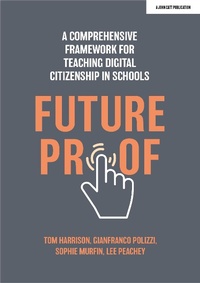
Futureproof
A comprehensive framework for teaching digital citizenship in schools
Published on 7. June 2022
254 pages
978-1-915361-27-1 (ISBN)
Description

Futureproof shows school leaders and teachers how they can educate for digital citizenship through the adoption of a new, comprehensive and coherent framework. The book addresses a gap as there are currently no well-known frameworks that provide a comprehensive approach to teaching digital citizenship education in UK schools. This is surprising given how digital technologies are part and parcel of most young people's lives today and will continue to be so in the future. Given that the technologies are constantly changing, it might be said that those responsible for teaching digital citizenship are shooting in the dark whilst trying to hit a moving target. The book brings clarity by explaining the theory and research behind the Futureproof framework, and through its focus on how it can be implemented in primary and secondary schools. The book includes details of the digital citizenship framework, an overview of learning and teaching outcomes and examples from practice throughout.
More details
Language
English
Place of publication
Saxmundham, Suffolk
United Kingdom
Target group
Professional and scholarly
File size
1,70 MB
ISBN-13
978-1-915361-27-1 (9781915361271)
Copyright in bibliographic data and cover images is held by Nielsen Book Services Limited or by the publishers or by their respective licensors: all rights reserved.
Schweitzer Classification
Other editions
Additional editions
Gianfranco Polizzi | Lee Peachey | Sophie Murfin
Futureproof: A comprehensive framework for teaching digital citizenship in schools
A comprehensive framework for teaching digital citizenship in schools
Book
05/2022
John Catt Educational Ltd
€21.50
Shipment within 3-4 weeks
Persons
Dr Tom Harrison is a Reader in the School of Education at the University of Birmingham. He is Director of Education at the Jubilee Centre for Character and Virtues and Programme Director for the MA Character Education. Tom is widely published in the field of education.
Dr Gianfranco Polizzi is a Research Fellow in the Jubilee Centre for Character and Virtues at the University of Birmingham, where he works on the Cultivating Cyber-Phronesis project. His research interests, which lie at the intersection of media and education studies, range from digital literacy and digital resilience to cyber-wisdom and digital citizenship.
Sophie Murfin is the CEO and Executive Principal of Wise Owl Trust comprising of three primary schools in Manchester. Sophie has written a programme of character education which is now in over 700 schools nationwide and international. Sophie is currently leading on a number of improvement programmes across Manchester including enhancing cross-phase transition, reducing the number of children at risk of exclusion and a place-based change project to support positive wellbeing.
Lee Peachey is a Deputy Headteacher at St Mary's Catholic High School which is a comprehensive 11-18 school and Sixth Form college. Lee leads on all facets of Personal Development at the school and college including Character Education, PSHE, Health and Wellbeing, Mental Health (pupils and staff), Student Leadership, Careers Education, British Values, Citizenship, Transition, Spirituality and Pupil Premium. Lee has created a professional learning network in the field of Personal Development which is over 3500 members strong from across the country.
Dr Gianfranco Polizzi is a Research Fellow in the Jubilee Centre for Character and Virtues at the University of Birmingham, where he works on the Cultivating Cyber-Phronesis project. His research interests, which lie at the intersection of media and education studies, range from digital literacy and digital resilience to cyber-wisdom and digital citizenship.
Sophie Murfin is the CEO and Executive Principal of Wise Owl Trust comprising of three primary schools in Manchester. Sophie has written a programme of character education which is now in over 700 schools nationwide and international. Sophie is currently leading on a number of improvement programmes across Manchester including enhancing cross-phase transition, reducing the number of children at risk of exclusion and a place-based change project to support positive wellbeing.
Lee Peachey is a Deputy Headteacher at St Mary's Catholic High School which is a comprehensive 11-18 school and Sixth Form college. Lee leads on all facets of Personal Development at the school and college including Character Education, PSHE, Health and Wellbeing, Mental Health (pupils and staff), Student Leadership, Careers Education, British Values, Citizenship, Transition, Spirituality and Pupil Premium. Lee has created a professional learning network in the field of Personal Development which is over 3500 members strong from across the country.
Content
- Cover
- Title Page
- Copyright Page
- Reviews
- Contents
- Preface
- Part 1: Introducing the digital citizenship framework
- The gap
- Building on what is already available
- It's not just teachers' responsibility
- Why the framework will help schools
- Futureproof
- What is digital citizenship education?
- Terminology used in the book
- Digital risks and opportunities
- Teachers' knowledge: differentiating form from content
- The theory underpinning the framework
- Introducing the framework: core components and objectives
- Part 2: The framework for digital citizenship education
- Introduction
- Component 1: Digital flourishing - establishing common expectations
- Component 2: Digital rules - enforcing minimum expectations
- Component 3: Digital character - enabling elevated expectations
- Part 3: Digital risks and opportunities
- Introduction
- Digital risks
- Digital opportunities
- Learning expectations and school policies
- Part 4: Implementing the framework
- Introduction
- Getting school staff and pupils on board
- Appointing a school champion
- Teacher education
- Working in partnership with parents
- Adapting the framework to meet diverse needs
- Evaluating impact
- Sources of further advice and support
- References
