

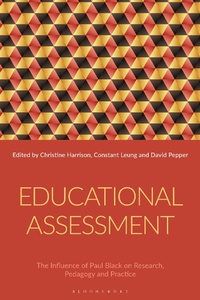
Educational Assessment
The Influence of Paul Black on Research, Pedagogy and Practice
1st Edition
Published on 19. October 2023
296 pages
978-1-350-28851-5 (ISBN)
Description

This book explores and builds on the extraordinary work of Professor Paul Black across assessment and pedagogy across the curriculum, including STEM, humanities and social science subjects.
This book explores the influence that Black has had within educational settings focusing on interpretations of the work and scholarship he has achieved across a range of settings and on the ways scholars, who have worked with him or been influenced by his ideas, have developed their research and teaching. The contributions are presented under three thematic sections, each of which reflects a set of shared educational concerns and values drawing on the natural and social sciences and developments in public policy. These concerns and values, with their emphasis on teacher assessment, provide a basis for a strategic, informed and coherent response to challenges in education, such as the cancellation of public examinations in the face of the Covid-19 pandemic.
This book explores the influence that Black has had within educational settings focusing on interpretations of the work and scholarship he has achieved across a range of settings and on the ways scholars, who have worked with him or been influenced by his ideas, have developed their research and teaching. The contributions are presented under three thematic sections, each of which reflects a set of shared educational concerns and values drawing on the natural and social sciences and developments in public policy. These concerns and values, with their emphasis on teacher assessment, provide a basis for a strategic, informed and coherent response to challenges in education, such as the cancellation of public examinations in the face of the Covid-19 pandemic.
More details
Edition
1. Auflage
Language
English
Place of publication
London
United Kingdom
Publishing group
Bloomsbury Publishing PLC
Target group
Professional and scholarly
Illustrations
10 bw illus
ISBN-13
978-1-350-28851-5 (9781350288515)
Copyright in bibliographic data and cover images is held by Nielsen Book Services Limited or by the publishers or by their respective licensors: all rights reserved.
Schweitzer Classification
Other editions
Additional editions
Christine Harrison | Constant Leung | David Pepper
Educational Assessment
The Influence of Paul Black on Research, Pedagogy and Practice
Book
05/2025
Bloomsbury Academic
€44.40
Shipment within 15-20 days
Christine Harrison | Constant Leung | David Pepper
Educational Assessment
The Influence of Paul Black on Research, Pedagogy and Practice
Book
11/2023
Bloomsbury Academic
€132.50
Shipment within 15-20 days
Persons
Christine Harrison is Professor in Science Education at King's College London, UK.
Constant Leung is Professor of Educational Linguistics at King's College London, UK.
David Pepper is Lecturer in International Education at King's College London, UK.
Constant Leung is Professor of Educational Linguistics at King's College London, UK.
David Pepper is Lecturer in International Education at King's College London, UK.
Content
List of Contributors
Introduction, Chris Harrison (King's College London, UK)
1. Paul Black - A Reflection On The Journey To Educational Research (1930 - 1976), Simon Black
2. Foreword: An Appreciation Of The Contribution Of Paul Black To National Policy On Curriculum And Assessment, Margaret Brown (King's College London, UK)
3. Putting Learners At The Heart Of The Assessment System, Dylan Wiliam (UCL Institute of Education, UK)
4. Inspiring Change In Classroom Assessment, Gordon Stobart (UCL Institute of Education, UK), Jo-Anne Baird (University of Oxford, UK) and Louise Hayward (University of Glasgow, Scotland)
5. Unifying The Purposes Of Teacher Assessment, Wynne Harlen (University of Bristol, UK
6. The Revolutionary International Transformation of Educational Assessment, Rick Stiggins (Assessment Training Institute, Portland, USA)
7. The Impact of Two Key Themes from Paul Black's Work on U.S. K-12 Policy and Practice, Margaret Heritage and Caroline Wylie (University of California, Los Angeles, USA)
8. The role of teachers in making and moderating assessment judgements: Opening the black box to challenge paradigms in Australia, Claire Wyatt-Smith and Lenore Adie (Australian Catholic University, Australia)
9. Student Involvement in Assessment: Queensland Teacher Repertoires of Practice, Val Klenowski and Jill Willis (Queensland University of Technology, Australia)
10. Assessment for equity: The role of formative assessment, Dennis Alonzo, Chris Davison (University of New South Wales, Australia) and Pasi Salhberg (Southern Cross University, Australia)
11. Changing the Culture of Classrooms, Changing the Responsibility of Students, Jo Boaler (Stanford Graduate School of Education, USA)
12. Using Research to Inform Practice and Teaching to Shape Research, Paul Spenceley and Chris Harrison (King's College London, UK)
13. Mapping the roads of learning: Linking learning progressions with assessments, Mark Wilson (University of California, Berkeley, USA)
14. Certificating Learning on the Basis of Teacher Assessment, Paul E. Newton (Ofqual, UK)
15. Braiding research, practice, policy and dissemination, Bronwen Cowie (University of Waikato, New Zealand)
16. Research design principles for dynamic teacher-researcher collaboration: Two stars and a wish, Natasha Serret (Nottingham Trent University, Institute of Education, UK) and Catarina F. Correia (UCL Institute of Education, UK)
Chronological list of Paul Black's key publications
Introduction, Chris Harrison (King's College London, UK)
1. Paul Black - A Reflection On The Journey To Educational Research (1930 - 1976), Simon Black
2. Foreword: An Appreciation Of The Contribution Of Paul Black To National Policy On Curriculum And Assessment, Margaret Brown (King's College London, UK)
3. Putting Learners At The Heart Of The Assessment System, Dylan Wiliam (UCL Institute of Education, UK)
4. Inspiring Change In Classroom Assessment, Gordon Stobart (UCL Institute of Education, UK), Jo-Anne Baird (University of Oxford, UK) and Louise Hayward (University of Glasgow, Scotland)
5. Unifying The Purposes Of Teacher Assessment, Wynne Harlen (University of Bristol, UK
6. The Revolutionary International Transformation of Educational Assessment, Rick Stiggins (Assessment Training Institute, Portland, USA)
7. The Impact of Two Key Themes from Paul Black's Work on U.S. K-12 Policy and Practice, Margaret Heritage and Caroline Wylie (University of California, Los Angeles, USA)
8. The role of teachers in making and moderating assessment judgements: Opening the black box to challenge paradigms in Australia, Claire Wyatt-Smith and Lenore Adie (Australian Catholic University, Australia)
9. Student Involvement in Assessment: Queensland Teacher Repertoires of Practice, Val Klenowski and Jill Willis (Queensland University of Technology, Australia)
10. Assessment for equity: The role of formative assessment, Dennis Alonzo, Chris Davison (University of New South Wales, Australia) and Pasi Salhberg (Southern Cross University, Australia)
11. Changing the Culture of Classrooms, Changing the Responsibility of Students, Jo Boaler (Stanford Graduate School of Education, USA)
12. Using Research to Inform Practice and Teaching to Shape Research, Paul Spenceley and Chris Harrison (King's College London, UK)
13. Mapping the roads of learning: Linking learning progressions with assessments, Mark Wilson (University of California, Berkeley, USA)
14. Certificating Learning on the Basis of Teacher Assessment, Paul E. Newton (Ofqual, UK)
15. Braiding research, practice, policy and dissemination, Bronwen Cowie (University of Waikato, New Zealand)
16. Research design principles for dynamic teacher-researcher collaboration: Two stars and a wish, Natasha Serret (Nottingham Trent University, Institute of Education, UK) and Catarina F. Correia (UCL Institute of Education, UK)
Chronological list of Paul Black's key publications
