

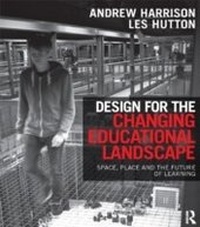
Design for the Changing Educational Landscape
Space, Place and the Future of Learning
1st Edition
Published on 15. October 2013
312 pages
978-1-134-48197-2 (ISBN)
Description

The whole landscape of space use is undergoing a radical transformation. In the workplace a period of unprecedented change has created a mix of responses with one overriding outcome observable worldwide: the rise of distributed space. In the learning environment the social, political, economic and technological changes responsible for this shift have been further compounded by constantly developing theories of learning and teaching, and a wide acceptance of the importance of learning as the core of the community, resulting in the blending of all aspects of learning into one seamless experience.
This book attempts to look at all the forces driving the provision and pedagogic performance of the many spaces, real and virtual, that now accommodate the experience of learning and provide pointers towards the creation and design of learning-centred communities.
Part 1 looks at the entire learning universe as it now stands, tracks the way in which its constituent parts came to occupy their role, assesses how they have responded to a complex of drivers and gauges their success in dealing with renewed pressures to perform. It shows that what is required is innovation within the spaces and integration between them. Part 2 finds many examples of innovation in evidence across the world - in schools, the higher and further education campus and in business and cultural spaces - but an almost total absence of integration. Part 3 offers a model that redefines the learning landscape in terms of learning outcomes, mapping spatial requirements and activities into a detailed mechanism that will achieve the best outcome at the most appropriate scale.
By encouraging stakeholders to creating an events-based rather than space-based identity, the book hopes to point the way to a fully-integrated learning landscape: a learning community.
This book attempts to look at all the forces driving the provision and pedagogic performance of the many spaces, real and virtual, that now accommodate the experience of learning and provide pointers towards the creation and design of learning-centred communities.
Part 1 looks at the entire learning universe as it now stands, tracks the way in which its constituent parts came to occupy their role, assesses how they have responded to a complex of drivers and gauges their success in dealing with renewed pressures to perform. It shows that what is required is innovation within the spaces and integration between them. Part 2 finds many examples of innovation in evidence across the world - in schools, the higher and further education campus and in business and cultural spaces - but an almost total absence of integration. Part 3 offers a model that redefines the learning landscape in terms of learning outcomes, mapping spatial requirements and activities into a detailed mechanism that will achieve the best outcome at the most appropriate scale.
By encouraging stakeholders to creating an events-based rather than space-based identity, the book hopes to point the way to a fully-integrated learning landscape: a learning community.
Reviews / Votes
"Overall, the book is successful in challenging existing use of learning space, and proposing new and innovative models for the future. Once you have read it, you are likely to re-evaluate your lab, classroom, studio -and the library -and the cafe -and the picnic bench -and even your own workspace, asking yourself how these potentially constraining environments be used to promote innovative practice in HE." - Katharyne McFarlane, Innovative Practice in Higher EducationMore details
Language
English
Place of publication
London
United Kingdom
Publishing group
Taylor & Francis Ltd
Target group
College/higher education
Professional and scholarly
Illustrations
1 s/w Tabelle, 96 Farbfotos bzw. farbige Rasterbilder, 45 farbige Zeichnungen
1 Tables, black and white; 45 Line drawings, color; 96 Halftones, color
File size
22,88 MB
ISBN-13
978-1-134-48197-2 (9781134481972)
Copyright in bibliographic data and cover images is held by Nielsen Book Services Limited or by the publishers or by their respective licensors: all rights reserved.
Schweitzer Classification
Other editions
Additional editions
Andrew Harrison | Les Hutton
Design for the Changing Educational Landscape
Space, Place and the Future of Learning
Book
10/2013
1st Edition
Routledge
€252.55
Shipment within 15-20 days
Andrew Harrison | Les Hutton
Design for the Changing Educational Landscape
Space, Place and the Future of Learning
Book
10/2013
1st Edition
Routledge
€119.11
Shipment within 15-20 days
Persons
Andrew Harrison is a researcher and consultant with experience in many aspects of space use. In 2011 he set up Spaces That Work, an independent consultancy specializing in learning environments. Before that he was Director of Learning and Research at DEGW, leading major research projects in the UK and internationally. These included Sustainable Accommodation for the New Economy, supported by the European Commission, Spaces for Personalized Learning for the UK Department for Children, Schools and Families, and Project Faraday, which developed new space and experience models for the teaching of secondary school science in Britain. He has also led projects exploring the impacts of technology and pedagogy change on school and higher education institution design, including work internationally for the Aga Khan University, the University of Central Asia, Aalto University in Finland and the Dublin Institute of Technology.
Les Hutton is a writer, editor and copywriter with experience in education, management, commercial property and architecture. Publications include Architectural Knowledge, The Distributed Workplace, The Responsive Office and Working Beyond Walls. He was the founder editor of Facilities magazine and has written extensively on the UK and international real estate market.
Les Hutton is a writer, editor and copywriter with experience in education, management, commercial property and architecture. Publications include Architectural Knowledge, The Distributed Workplace, The Responsive Office and Working Beyond Walls. He was the founder editor of Facilities magazine and has written extensively on the UK and international real estate market.
Content
Introduction: The Changing Learning Landscape 1. Linking Pedagogy to Space: Achieving Educational Transformation in School Design 2. Space for Personalised Learning 3. Creating Learning Communities: Blurring the Boundaries between School and University 4. The Changing Academic Workplace 5. Technology and the Blended Learning Environment 6. The Evolving Academic Library 7. Space for Research and Innovation 8. Rethinking the University Learning Landscape 9. Converting a Learning Landscape into a Masterplan 10. Achieving Educational Transformation
