

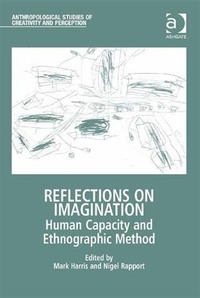
Reflections on Imagination
Human Capacity and Ethnographic Method
Published on 28. April 2015
316 pages
978-1-4724-1729-9 (ISBN)
Description

In this innovative volume, anthropologists turn their attention to a topic that has rarely figured as a focus of concerted investigation and yet which can be described as an intrinsic aspect of all human knowing and part of all processes by which human beings process information about themselves, their identities, their environments and their relations: the imagination. How do anthropologists use imagination in coming to know their research subjects? How might they, and how should they, use their imagination? And how do research subjects themselves understand, describe, justify and limit their use of the imagination?
Presenting a range of case studies from a variety of locations including the UK, US, Africa, East Asia and South America, this collection offers a comparative exploration of how imagination has been conceptualized and understood in a range of analytical traditions, with regard to issues of both methodology and ethnomethodology.
With emphasis not on abstraction but on imagination as activity, technique and subject situated in the middle of lives, Reflections on Imagination sheds new light on imagination as a universal capacity and practice - something to which human beings attend whenever they make sense of their environments and situate their life-projects in these environments - the means by which worlds come to be.
Presenting a range of case studies from a variety of locations including the UK, US, Africa, East Asia and South America, this collection offers a comparative exploration of how imagination has been conceptualized and understood in a range of analytical traditions, with regard to issues of both methodology and ethnomethodology.
With emphasis not on abstraction but on imagination as activity, technique and subject situated in the middle of lives, Reflections on Imagination sheds new light on imagination as a universal capacity and practice - something to which human beings attend whenever they make sense of their environments and situate their life-projects in these environments - the means by which worlds come to be.
Reviews / Votes
`An important and timely volume that brings together different perspectives on the surprisingly little explored topic of the imagination. In its ambitious scope and rich ethnographic detail, it promises to become essential reading for anthropologists and those working in related fields of enquiry.'Anna Grimshaw, Emory University, USA
`Arguably the single faculty that sets humanity most decisively apart from the rest of the animal kingdom, the imagination enters into our lives at every stage, enabling humans to create invisible connections, conjure up possible and impossible worlds, expand their horizons and produce metaphors and theories. This strikingly original volume convincingly demonstrates the importance of the imagination in ethnographic observation, anthropological analysis and the local lives under scrutiny. It showcases anthropology as a fundamental humanistic discipline.'
Thomas Hylland Eriksen, University of Oslo, Norway
`The contributors to this intriguing collection of essays criss-cross the terrain designated by the English terms "imagination", "the imagined", and "the imaginary", and their (approximate) equivalents in other languages. The reader is guided helpfully through a variety of learned genealogies of the imagination and treated to much evocative ethnography. Classic views, going back to Kant and beyond, are brought into conversation with the most contemporary anthropological theory, and anyone who aspires to practise ethnography will be challenged to rethink the role of the imagination in that rather peculiar enterprise. Highly recommended.'
David N. Gellner, University of Oxford, UK
More details
Series
Edition
New edition
Language
English
Place of publication
Farnham
United Kingdom
Publishing group
Taylor & Francis Ltd
Target group
Professional and scholarly
Edition type
New edition
Illustrations
Includes 33 b&w illustrations
File size
2,90 MB
ISBN-13
978-1-4724-1729-9 (9781472417299)
Copyright in bibliographic data and cover images is held by Nielsen Book Services Limited or by the publishers or by their respective licensors: all rights reserved.
Schweitzer Classification
Other editions
Additional editions
Book
04/2015
1st Edition
Routledge
€206.90
Shipment within 10-20 days
Persons
Mark Harris is Reader in Social Anthropology and Head of the Department of Anthropology at the University of St Andrews, UK. He is the author Life on the Amazon: The Anthropology of a Brazilian Peasant Village, and Rebellion on the Amazon: Race, Popular Culture and the Cabanagem in the North of Brazil, 1798-1840, the editor of Ways of Knowing and co-editor of Some Other Amazonians.
Nigel Rapport is Professor of Anthropological and Philosophical Studies and Director of the Centre for Cosmopolitan Studies at the University of St. Andrews, UK. He is the author of Transcendent Individual: Towards a Literal and Liberal Anthropology, The Trouble with Community: Anthropological Reflections on Movement, Identity and Collectivity, 'I am Dynamite': An Alternative Anthropology of Power, Social and Cultural Anthropology: The Key Concepts, and Of Orderlies and Men: Hospital Porters Achieving Wellness at Work and editor of Questions of Consciousness, British Subjects: An Anthropology of Britain, and Democracy, Science and The Open Society: A European Legacy?
Nigel Rapport is Professor of Anthropological and Philosophical Studies and Director of the Centre for Cosmopolitan Studies at the University of St. Andrews, UK. He is the author of Transcendent Individual: Towards a Literal and Liberal Anthropology, The Trouble with Community: Anthropological Reflections on Movement, Identity and Collectivity, 'I am Dynamite': An Alternative Anthropology of Power, Social and Cultural Anthropology: The Key Concepts, and Of Orderlies and Men: Hospital Porters Achieving Wellness at Work and editor of Questions of Consciousness, British Subjects: An Anthropology of Britain, and Democracy, Science and The Open Society: A European Legacy?
Content
Contents: Preface, Nigel Rapport and Mark Harris. Part I Introduction: `Imagination is in the barest reality': on the universal human imagining of the world, Nigel Rapport; From the river: making local histories of the imagination, Mark Harris. Part II Case Studies: Imagination, Methodology, Ethnomethodology: Re-imagining ethnography, Paul Stoller; Tango heart and soul: solace, suspension, and the imagination in the dance tourist, Jonathan Skinner; Imagination, History, the Uncanny: Historical imagination and imagining madness: the experience of colonial officers in French West Africa, Roy Dilley; Hauntings: from anthropology of the imagination to the anthropological imagination, Peter Collins; Imagination, Materiality and Consciousness: Reflections on the encounters of the imagination: ontology, epistemology and the limits of the real in anthropology, Mattia Fumanti; Granite and steel, Andrew Irving; Imagination and Social Imaginaries: Uses of Finland in Japan's social imaginary, Hideko Mitsui; The social imaginary and literature: understanding the popularisation of modern medicine in Brazil, Paulo Cesar Alves; Imagination, Scale, Otherness: The imagining life: reflections on imagination in political anthropology, Leo Coleman; Do forest children dream of electric light? An exploration of Matses children's imaginings in Peruvian Amazonia, Camilla Morelli; Imagination, Perspective, Emergence: Infrastructural imaginaries: collapsed futures in Mozambique and Mongolia, Morten Nielsen and Morten Axel Pedersen; Imagination/making: working with others and the formation of anthropological knowledge, James Leach. Part III Review: Afterword: an end to imagining?, Huon Wardle. Index.
