

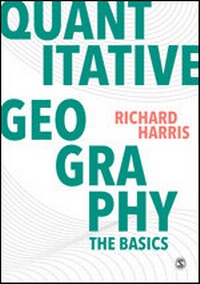
Quantitative Geography
The Basics
1st Edition
Published on 13. September 2016
328 pages
978-1-4739-3339-2 (ISBN)
Description

Numerical data are everywhere. Charts and statistics appear not just in geography journals but also in the media, in public policy, and in business and commerce too. To engage with quantitative geography, we must engage with the quantitative methods used to collect, analyse, present and interpret these data.
Quantitative Geography: The Basics is the perfect introduction for undergraduates beginning any quantitative methods course. Written in short, user-friendly chapters with full-colour diagrams, the book guides the reader through a wide range of topics from the basic to the more advanced, including:
Statistics
Maths
Graphics
Models
Mapping and GIS
R
Closely aligned with the Q-Step quantitative social science programme, Quantitative Geography: The Basics is the ideal starting point for understanding and exploring this fundamental area of Geography.
Quantitative Geography: The Basics is the perfect introduction for undergraduates beginning any quantitative methods course. Written in short, user-friendly chapters with full-colour diagrams, the book guides the reader through a wide range of topics from the basic to the more advanced, including:
Statistics
Maths
Graphics
Models
Mapping and GIS
R
Closely aligned with the Q-Step quantitative social science programme, Quantitative Geography: The Basics is the ideal starting point for understanding and exploring this fundamental area of Geography.
Reviews / Votes
'Quantitative Geography: The Basics' delivers exactly what the title promises. An engaging overview of the field that makes a strong case that all geographers can and should be exposed to statistical methods, if they are to fully engage with the contemporary discipline, and to participate effectively in wider, number-saturated, public debates. -- David O'Sullivan I like the pitch of this book because the reader is encouraged to think and use common sense when looking at statistical outputs and to be critical but not negative for the sake of it. Technical terms are explained, often with an analogy. Graphical presentation is covered in detail with examples of different ways of illustrating the same outputs so it is clear why choices help or hinder interpretation. Particular highlights are that using pie charts is a really bad idea and that the author has used parkrun data. However, as a founder and run director at Skipton parkrun, I must declare that my opinion is biased! -- Paul Norman I very much like the idea of this book. As a quantitative-based lecturer in a school of geography I struggle to find texts on statistics that will hold students' interests as they often crave geography-motivated examples. It is useful to have access to a statistics text that explicitly focuses on quantitative geography. The content is laid out in a straightforward manner and is not overly mathematical. I would be happy to suggest the text to my students. -- Daniel Goldberg This is an important book. Rich Harris makes a compelling case for why fluency with data, its collection, analysis and interpretation, is essential for geographers and geography today. The text provides a platform that encourages students to engage with ideas about data - relevant for all students whether interested in social, cultural or, economic geography, or hydrology, geomorphology or biogeography. This is a valuable addition to any introductory undergraduate geography reading list. -- Catherine Souch A remarkably pedagogic and perfectly illustrated quantitative geography manual that will delight students of all levels as much as their teachers -- Thierry FeuilletMore details
Series
Edition
First Edition
Language
English
Place of publication
London
United Kingdom
Target group
College/higher education
ISBN-13
978-1-4739-3339-2 (9781473933392)
Copyright in bibliographic data and cover images is held by Nielsen Book Services Limited or by the publishers or by their respective licensors: all rights reserved.
Schweitzer Classification
Other editions
Additional editions
Book
10/2016
1st Edition
SAGE Publications Ltd
€172.61
Shipment within 15-20 days
Book
09/2016
1st Edition
SAGE Publications Ltd
€118.20
Shipment within 15-20 days
Person
Richard Harris is Professor of Quantitative Social Geography at the School of Geographical Sciences, University of Bristol. He is the lead author on two textbooks about quantitative methods in geography and related disciplines: Statistics for Geography and Environmental Science (Prentice Hall, 2011) and Geodemographics, GIS and Neighbourhood Targeting (Wiley, 2005).
Richard's research interests are in the geographies of education and the education of geographers. He is currently Director of Bristol Q-Step Centre, part of a multimillion pound UK initiative to raise quantitative skills training among social science students, and has worked with both the Royal Geographical Society (with IBG) and Higher Education Academy to promote numeracy and to support the transition of students from schools to University.
Richard's research interests are in the geographies of education and the education of geographers. He is currently Director of Bristol Q-Step Centre, part of a multimillion pound UK initiative to raise quantitative skills training among social science students, and has worked with both the Royal Geographical Society (with IBG) and Higher Education Academy to promote numeracy and to support the transition of students from schools to University.
Content
PART 1: ABOUT QUANTITATIVE GEOGRAPHY
Introducing Quantitative Geography
The Use and Abuse of Statistics
PART 2: FOUNDATIONS OF QUANTITATIVE GEOGRAPHY
Principles of Statistics (or, how statistics work)
Some Maths and Notation
Descriptive and Inferential Statistics
Statistical Testing, statistical significance and why they are contentious
PART 3: DOING QUANTITATIVE GEOGRAPHY
Data Presentation and Graphics
Mapping and GIS
Looking at Relationships and Creating Models
Multiple regression and geography
Analysing Geographical Patterns and Differences
An Introduction to R
Introducing Quantitative Geography
The Use and Abuse of Statistics
PART 2: FOUNDATIONS OF QUANTITATIVE GEOGRAPHY
Principles of Statistics (or, how statistics work)
Some Maths and Notation
Descriptive and Inferential Statistics
Statistical Testing, statistical significance and why they are contentious
PART 3: DOING QUANTITATIVE GEOGRAPHY
Data Presentation and Graphics
Mapping and GIS
Looking at Relationships and Creating Models
Multiple regression and geography
Analysing Geographical Patterns and Differences
An Introduction to R
