


Promoting Equity in Schools
Collaboration, Inquiry and Ethical Leadership
Published on 8. September 2017
196 pages
978-1-351-60179-5 (ISBN)
Description

Around the world, countries are searching for ways of making their schools more effective for all children and young people. This book offers a new way of thinking about how to address this challenge. It sees improvement as requiring a collective effort that involves contributions from all members of a school community. Crucial to this is the idea of ethical leadership.
Promoting Equity in Schools is written by a team of academic researchers who had a most unusual opportunity to work with a network of schools over three years, experimenting to find more effective ways of including hard to reach learners. Bringing together practitioner knowledge and ideas from research carried out from a variety of perspectives, the authors provide rich accounts of what happened when the schools attempted to become more inclusive and fairer. In so doing, they throw light on the challenges this presents for school leaders.
The accounts presented in the book are located in Queensland, Australia, where the school system faces significant difficulties in relation to equity that resonate with similar difficulties around the world. These difficulties relate to policies that emphasize high-stakes testing and school choice, which tend to promote increased segregation, to the particular disadvantage of young people from low income and minority backgrounds. The arguments presented suggest that even where worrying policies are in place, with leadership driven by a commitment to equity, schools can still find space to develop more equitable ways of working.
Promoting Equity in Schools is written by a team of academic researchers who had a most unusual opportunity to work with a network of schools over three years, experimenting to find more effective ways of including hard to reach learners. Bringing together practitioner knowledge and ideas from research carried out from a variety of perspectives, the authors provide rich accounts of what happened when the schools attempted to become more inclusive and fairer. In so doing, they throw light on the challenges this presents for school leaders.
The accounts presented in the book are located in Queensland, Australia, where the school system faces significant difficulties in relation to equity that resonate with similar difficulties around the world. These difficulties relate to policies that emphasize high-stakes testing and school choice, which tend to promote increased segregation, to the particular disadvantage of young people from low income and minority backgrounds. The arguments presented suggest that even where worrying policies are in place, with leadership driven by a commitment to equity, schools can still find space to develop more equitable ways of working.
Reviews / Votes
Educators around the world have been dazed by the speed and impact of recent reforms based on markets, testing, and accountability. Too often the response has been paralysis and defensiveness, rather than innovation and collaboration. But there is a better way forward.In this deeply democratic and inspiring volume, based on a network of schools in Queensland, Australia, educators can learn about how they can protect themselves from the worst dimensions of recent reforms, while capitalizing on their latent potential. Promoting Equity in Schools is an indispensable volume for all educators who want serious, practical, and sustainable solutions to the nitty-gritty challenges of leadership today.
Dennis Shirley, Professor of Education, Lynch School of Education, Boston College, USA
A very remarkable book of international significance that could and should not only enable schools to transcend the narrowness of what they are so insistently required to do, but also help governments to return to education worthy of democracy as a way of living and learning together.
There are at least three compelling reasons why this book is important: it is at once principled, realistic and inspiring.
Principled because it returns us to education as a common good that cherishes the development of all young people in all their diversity, not just those whose test scores drive and distort the daily realities of so much contemporary schooling.
Realistic because it shows us how commitment to inclusion and equity is not only possible and productive within the narrow imperatives of high pressure policy requirements, but transformative of them.
Inspirational because its many examples, rooted in the realities of multiple cases and contexts, give us a sense that another way is not only desirable but possible.
In sum, it restores and sustains our educational integrity in contemporary contexts that too often invite its betrayal. It nurtures hope in hard times."
Emeritus Professor Michael Fielding, UCL Institute of Education, UK
This clearly evidenced and carefully argued book shows how schools that practice systematic inquiry, shared leadership and collaborative work ensure that many students can enjoy the full benefits of education, not just a few.
Pat Thomson, Professor of Education, University of Nottingham, UK
More details
Language
English
Place of publication
London
United Kingdom
Publishing group
Taylor & Francis Ltd
Target group
Professional and scholarly
Product notice
Reflowable
Illustrations
3 Tables, black and white; 5 Line drawings, black and white; 5 Illustrations, black and white
File size
1,60 MB
ISBN-13
978-1-351-60179-5 (9781351601795)
Copyright in bibliographic data and cover images is held by Nielsen Book Services Limited or by the publishers or by their respective licensors: all rights reserved.
Schweitzer Classification
Other editions
Additional editions
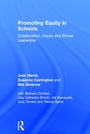
Jess Harris | Suzanne Carrington | Mel Ainscow
Promoting Equity in Schools
Collaboration, Inquiry and Ethical Leadership
Book
09/2017
1st Edition
Routledge
€215.41
Shipment within 10-20 days

Jess Harris | Suzanne Carrington | Mel Ainscow
Promoting Equity in Schools
Collaboration, Inquiry and Ethical Leadership
Book
09/2017
1st Edition
Routledge
€59.70
Shipment within 10-20 days
Persons
Jess Harris is Senior Lecturer in the School of Education at the University of Newcastle, Australia. Her research interests include school change, educational leadership, teacher learning, and the study of talk and social interaction using Ethnomethodology and Conversation Analysis.
Suzanne Carrington is a Professor and Assistant Dean (Research) in the Faculty of Education at the Queensland University of Technology, Australia. Suzanne's areas of expertise are in inclusive education, disability and teacher preparation for inclusive schools. She has engaged in research to inform policy and practice in Australian and international education contexts, more recently extending this research to the South Pacific and Asia.
Mel Ainscow is Professor Emeritus of Education at the University of Manchester, UK. Currently he leads Schools Challenge Cymru in Wales. He is a long-term consultant to UNESCO, working on international efforts to promote equity and inclusion globally. In the Queen's 2012 New Year honours list he was made a CBE for services to education.
Suzanne Carrington is a Professor and Assistant Dean (Research) in the Faculty of Education at the Queensland University of Technology, Australia. Suzanne's areas of expertise are in inclusive education, disability and teacher preparation for inclusive schools. She has engaged in research to inform policy and practice in Australian and international education contexts, more recently extending this research to the South Pacific and Asia.
Mel Ainscow is Professor Emeritus of Education at the University of Manchester, UK. Currently he leads Schools Challenge Cymru in Wales. He is a long-term consultant to UNESCO, working on international efforts to promote equity and inclusion globally. In the Queen's 2012 New Year honours list he was made a CBE for services to education.
Content
Foreword Ann Lieberman
Preface Jess Harris, Suzanne Carrington, and Mel Ainscow
Chapter 1. Addressing the challenge of equity Mel Ainscow, Jess Harris, and Suzanne Carrington
Chapter 2. A collaborative action research network Suzanne Carrington, Mel Ainscow, and Jess Harris
Chapter 3. Using accountability data as a catalyst Judy Smeed and Suzanne Carrington
Chapter 4. Listening to the voices of teachers Barbara Comber, Val Klenowski, and Jess Harris
Chapter 5. Students as active participants Nerida Spina, Val Klenowski, and Suzanne Carrington
Chapter 6. A whole-school approach to change Nerida Spina and Jess Harris
Chapter 7. Sharing knowledge beyond the school gate Mel Ainscow and Jess Harris
Chapter 8. Making sense of ethical leadership Lisa Catherine Ehrich and Suzanne Carrington
Chapter 9. Speaking to policy and practice: Implications for change Jess Harris, Mel Ainscow, and Suzanne Carrington
References
Index
Preface Jess Harris, Suzanne Carrington, and Mel Ainscow
Chapter 1. Addressing the challenge of equity Mel Ainscow, Jess Harris, and Suzanne Carrington
Chapter 2. A collaborative action research network Suzanne Carrington, Mel Ainscow, and Jess Harris
Chapter 3. Using accountability data as a catalyst Judy Smeed and Suzanne Carrington
Chapter 4. Listening to the voices of teachers Barbara Comber, Val Klenowski, and Jess Harris
Chapter 5. Students as active participants Nerida Spina, Val Klenowski, and Suzanne Carrington
Chapter 6. A whole-school approach to change Nerida Spina and Jess Harris
Chapter 7. Sharing knowledge beyond the school gate Mel Ainscow and Jess Harris
Chapter 8. Making sense of ethical leadership Lisa Catherine Ehrich and Suzanne Carrington
Chapter 9. Speaking to policy and practice: Implications for change Jess Harris, Mel Ainscow, and Suzanne Carrington
References
Index
