

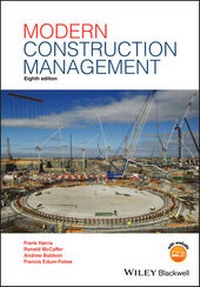
Modern Construction Management
Description

The overall themes for the Eighth Edition Modern Construction Management are:
* Drivers for efficiency: lean construction underpinning production management and off-site production methods.
* Sustainability: reflecting the transition to a low carbon economy.
* Corporate Social Responsibility: embracing health & safety and employment issues.
* Modern contractual systems driving effective procurement
* Building Information Modelling directed towards the improvement of collaboration in construction management systems
More details
Other editions
Additional editions
Persons
Frank Harris was Emeritus Professor of Construction Science at the University of Wolverhampton, UK.
Ronald McCaffer is Emeritus Professor in Construction Management at Loughborough University, UK.
Andrew Baldwin is Emeritus Professor in Construction Management at Loughborough University, UK.
Francis Edum-Fotwe holds a Lectureship in Construction and Project Management at Loughborough University, UK.
Content
About the authors xi
Preface to the eighth edition xiii
Companion website xv
1 Introduction 1
Structure of the book 2
Objectives and contents 3
2 Quality management 9
Summary 9
Introduction 9
Notions of quality 9
Quality in transition 10
Quality control and inspection 11
Quality assurance 13
Total quality management 20
A systems approach to managing quality 26
Further Reading 32
Section 1: Project production management 33
3 Production process improvement 35
Summary 35
Introduction to lean construction 35
Energy 36
Productivity 36
Economic development 37
International environmental protocols 45
UK emissions 47
Productivity improvement 49
Management systems 54
Management processes (see BS 6079) 60
Employee participation 71
Macro key performance indicators 87
Further Reading 88
4 Planning techniques and methods 89
Summary 89
Introduction 89
Planning in construction 89
Who plans? 90
Planning the design process 92
Planning for waste management 93
Planning for safety, health, and the environment (SHE) 94
Planning techniques 95
Other planning techniques 112
Modern construction planning 119
Monitoring progress and managing the time model 121
Construction planning and scheduling with 4D CAD and BIM 122
Planning multiple projects 123
Appendix 4.A. Normal Probability Distribution Tables (Table 4.3) 125
Further Reading 126
5 Workforce motivation 127
Summary 127
Introduction 127
Motivation theories 127
Payment systems, remuneration and performance 132
Further Reading 144
6 Project cost control 147
Summary 147
Why cost-control is essential for construction projects 147
A cost-control procedure for construction works 148
Points to consider when choosing a cost-control system 159
Management of the carbon footprint 160
Further Reading 160
7 Management of equipment 161
Summary 161
Acquisition of plant and equipment 161
The financing of equipment 162
Systematic plant selection 164
The essential characteristics of a decision situation 165
Setting hire rates 173
Marginal costing 180
Plant maintenance 180
Monitoring of maintenance servicing and exhaust emissions 181
Human-centred approaches 182
Further Reading 182
Section 2: Business management 183
8 Project procurement 185
Summary 185
Introduction 185
The construction process (BS 6079-1:2002) 186
ISO/BS procurement standards 189
Appointing the team/parties to the contract 190
Public contracts and supplies 192
Project manager/leader 193
The contract 197
Health and safety considerations 201
Categories of contract 204
Separated and cooperative contracts 204
Management-oriented contracts 207
Integrated contracts 211
Discretionary contracts 219
Performance of different contract categories 223
Client risk exposure for different contract categories 223
Further Reading 225
9 Estimating and tendering 227
Summary 227
Introduction 227
Parties involved in estimating and tendering 230
The estimating process 232
BOQ estimating 232
Collection and calculation of cost information 234
Project study 242
Preparing the estimate 243
Submitting the tender 251
Estimating in management contracting 252
Design and build 254
Cost planning 255
Cost management 255
Whole-life costing 256
Private finance initiative (PFI) 256
Computer aided estimating 257
BIM and estimating 258
Summary 259
Future Reading 260
10 Competitive bidding 261
Summary 261
Introduction 261
Part 1: A brief review of bidding strategy 262
Part 2: The importance of accuracy in estimating 268
Part 3: Some ways of using the existing theories 275
Recent developments in bidding 282
Client evaluation of bids 283
Further Reading 285
11 Company budgetary control 287
Summary 287
Introduction 287
Preparation of budgets 288
The carbon footprint 295
Further Reading 297
12 Cash flow and interim valuations 299
Summary 299
Introduction 299
The need for cash flow forecasting by contractors 299
The requirements of a forecasting system 301
Capital lock-up 306
The factors that affect capital lock-up 307
Interim valuations and cash flow 312
Measurement of work in activities 316
Computers and cash flow 316
Cash flow forecast by standardised models 319
Closing remarks 319
Further Reading 320
13 Economic assessments 321
Summary 321
Introduction 321
Interest 323
Economic comparisons 325
Profitability measures 328
Inflation 332
Accuracy of future estimates 336
Financial Modelling 340
Cost-benefit analysis 345
Some worked examples 347
Further Reading 354
Section 3: Administration and company management 355
14 Company organisation 357
Summary 357
Introduction 357
The function of a manager 357
Company organisational structures 359
Departments/functions 368
Health, safety, occupational welfare and pensions 376
Educational qualifications and vocational training 377
Corporate social responsibility 385
Management attitude 386
Construction companies in an internet age 387
Virtual companies 388
Collaborative working 388
Further Reading 388
15 Market planning and business development 389
Summary 389
Introduction 389
Market planning 389
The business-development process 390
16 International construction logistics and risks 401
Summary 401
Introduction 401
The international environment 402
Further Reading 409
17 Towards BIM and digital construction 411
Summary 411
Introduction 411
Information and information management 412
The construction company's business 413
Processes involved in a construction business 413
Information needs to support business processes 416
Management of contractors' information resources 417
Construction information systems 420
The construction information manager 425
The emergence of BIM 426
BIM standards 428
Digital construction 433
Further Reading 434
18 Financial management 435
Summary 435
Introduction 435
Types of businesses 435
Types of capital 440
The control of capital 446
The company accounts 449
Regulatory authorities 461
Further Reading 462
Section 4: Self-learning exercises 463
19 Questions - construction management 465
Questions 467
20 Questions - operational research (OR) 519
Summary 519
Questions 521
21 Questions - six sigma 533
Six sigma 534
Problems (readers should start with Problem 1) 534
Further Reading 555
Bibliography 557
Abbreviations and acronyms 571
Index 577
Chapter 1
Introduction
Modern management in construction addresses four principal areas of the industry:
- Management of the physical production phase or site construction management;
- Management of the various functions that make up and contribute to the delivery of projects, or total project and programme management;
- Management of the corporate establishments involved in the delivery of the constructed facilities and services or organisational management;
- Management of the industry to create an enabling commercial, regulatory, and conducive socio-economic environment, or sector management.
Construction Management addresses the effective planning, organisation, application, coordination, monitoring, control, and reporting of the core business processes of marketing, procurement, production, administration, accounts, and finance necessary to achieve economic success and/or profitability for an enterprise or organisation engaged in the provision of construction facilities. The functions may be performed by a client, contracting company, consultant firm, public body or a combination of such stakeholders contracted to bring a project or series of projects to safe completion on time, to budget, to the set quality and expected innovative, aesthetic, socially responsible, and environmental impact.
Construction Project Management focuses on the delivery of a specific solution by contracting with stakeholders who undertake combinations of the following indicative sub-processes relating to a specific project:
- Scoping and budgeting the project;
- Design coordination/management;
- Establishing the management structure of the management team;
- Marketing and procurement;
- Defining roles and responsibilities;
- Estimating and tendering;
- Stakeholder management;
- Project and construction methods planning, coordination, and control;
- Value and risk management;
- Organising, leading, and implementing controls;
- Production and productivity management;
- Management of labour resources, temporary works provision, equipment, plant, subcontractors, and suppliers;
- Time and subcontractor interface management;
- Cost and budgetary control, including cash flow forecasting;
- Quality management;
- Contract and progress payments administration;
- Legal issues;
- Information and communications technology (ICT) management;
- Health and Safety management, education, training and welfare provision;
- Corporate Social Responsibility (CSR);
- Management of the potential environmental impacts of construction;
- Commissioning, auditing, and recording of the project(s).
The Chartered Institute of Buildings, CIOB, provide a comprehensive set of definitions of Construction (Project) Management (CIOB 2014).
Significantly, as recent Constructing Excellence (CE) and government reports emphasise, the marked shift towards modern forms of contracting, rapid technological change, and greater environmental, social and economic accountability of construction pose ever-growing competition in a world of intensified global trading - not least the Corporate Social Responsibility notion of 'doing well by doing good' to enhance competitive advantage. Hence, an intelligent client will increasingly need to focus on achieving value at the operational and business levels through the appointment of a robust integrated 'best in class' supply chain of stakeholders, able to deliver the listed project services with the fresh, practicable, robust, measurable and auditable core competences and management processes.
Structure of the book
This book covers the principal responsibilities of Construction Management divided into four main sections; in addition, Chapters 1 and 2, which do not form part of the main sections, give specific consideration at the outset to the philosophy of the book as a means of explaining the succeeding chapters.
In particular, Chapter 2, Quality management in construction provides the platform for the succeeding chapters and describes the evolution of quality management from quality control through quality assurance to total quality management (TQM), as well as the current standards employed by construction organisations. It illustrates how quality is intertwined as a thread running through all subsequent sections and explores the emerging strategic role of quality as a driver for competitive advantage in construction. Looking at quality from the project perspective, it advocates a concerted effort by both client and contractor to make any quality agenda a reality, and explores a systems approach to attaining such an agenda. It concludes with a look at initiatives by the professional bodies associated with the construction to support and promote quality attainment and management.
- Section I deals with techniques relating to project production management.
- Section II covers the business aspects of management at both project and company levels, including environmental management and legislation guidelines.
- Section III addresses the executive management responsibilities for overall corporate control.
- Section IV brings together a selection of self-learning problems complemented with complete worked solutions for use in the classroom environment, tutorial exercises and seminar discussions, which are provided on the companion website.
The reasons for this particular presentation are:
- (1) Successful construction industry executives have distinct phases in their careers: the initial period is spent on site, followed by middle-management duties at the project level, culminating in a career with executive head-office activities. The sections are intended to cater for these phases.
- (2) The construction industry is inherently uncertain as a result of the nature of the industry itself - the competitive tendering process, the company's turnover, site production rates and the weather are all features that are characterised by variability and a degree of uncertainty. To be able to cope with such uncertainty, construction executives need to be acquainted with the relevant knowledge and tools for addressing these features. The management techniques described in this book help reduce variability and thus provide the basis for sound and effective decisions by aspiring executives. For example, with proper planning, the duration of a project is not just an experienced guess. The inevitable residual variability in even the best-run company needs to be controlled by:
- (a) Planning and setting targets;
- (b) Choosing methods to achieve such plans and targets;
- (c) Monitoring progress;
- (d) Taking corrective action when necessary.
This continual monitoring and revision is ultimately the only way to cope with uncertainty and variability.
Objectives and contents
Each chapter deals with a specific topic (which could, if exhaustively treated, form the basis of a whole book; suggestions for further reading appear at the end of each chapter, while references appear in the bibliography at the end of the book).
The level of detail aimed at is that which will provide the reader with a basic working knowledge of the topic, rather than with specialist expertise. For example, the planning section of the book explains the major techniques available for planning both repetitive and non-repetitive works in sufficient detail to allow intelligent engineers to apply them, providing sufficient comprehension for them to converse sensibly with a specialist support group such as a planning department. Engineers and builders need enough knowledge to understand, appreciate and, where necessary, question the work of specialist support staff such as accountants, cost clerks, planners, and plant managers. A grasp of the techniques described in the sections should help in achieving this skill. Specialists must not be allowed to hide safely in their own specialisms. Participation in the exercises in Section IV covering the numerical-based aspects of these techniques provides a deeper and better understanding of the implications of the various approaches to decision making.
The contents of each section are now discussed briefly below.
Section I
Section I relates specifically to project production management, including planning techniques, production process improvement, estimating and tendering, workforce motivation and cost control.
- Chapter 3: Production process improvement provides a foundation to the efficient delivery for the operational aspects of construction. The basis for evaluating such efficiency has shifted to include energy use, productivity, and national productivity reports, Building Information modelling (BIM), quality management, lean construction, benchmarking, digital technologies, waste management, asset management, Six Sigma, production measurement and sampling. The chapter also provides examples of the application of the production measurement.
- Chapter 4: Planning techniques and methods...
