

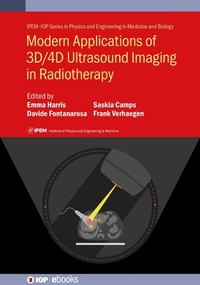
Modern Applications of 3D/4D Ultrasound Imaging in Radiotherapy
Description

This is a practical guide to the implementation of 3D/4D ultrasound imaging in radiography. Among its features are the coverage of the technology utilised for ultrasound-guided radiotherapy, clinical need and the advantages of using ultrasound. It is a useful tool for users that incorporates implementation, potential errors, uncertainties and training. This is a comprehensive review of the state-of-the-art technologies, which also looks at the future direction of this exciting field.
Researchers, students, hospital physicists and radiographers will all find this book of use as it guides them through current clinical situation and examines the full potential of ultrasound in radiotherapy.
Key Features
- Technology used for ultrasound guided RT
- Clinical need and advantages of using ultrasound
- Practical guide to implementation, including errors, uncertainties and training
- Comprehensive review of state-of-the-art
- Critical evaluation of field and future directions
More details
Other editions
Additional editions

Persons
Saskia Camps is a biomedical R&D engineer at the Swiss startup EBAMed. EBAMed develops and commercializes innovative solutions that allow for non-invasive treatment of cardiac arrhythmias using proton beams. Before joining EBAMed, Camps earned her PhD at the Eindhoven University of Technology in a collaboration with the Maastro Clinic (Maastricht, the Netherlands) and Philips Research (Eindhoven, the Netherlands). The focus of her PhD work was on automation of ultrasound image acquisition and interpretation for dose guidance in prostate cancer radiotherapy workflows.
Davide Fontanarosa is a physicist with a solid background in ultrasound imaging and medical physics. He worked in one of the top institutions for radiation therapy (MAASTRO Clinic, in the Netherlands) and in one of the largest industrial research laboratories in the world, Philips Research, as a Senior Scientist. Then he moved to Queensland University of Technology (Brisbane, Australia) where he is currently working as an Associate Professor and doing research in several fields related to ultrasound, imaging techniques and radiation therapy.
Emma Harris is a Reader of imaging and radiation physics at the Institute of Cancer Research in London, UK. Her research focuses on the application of radiation physics, ultrasound physics engineering and image processing to improve radiotherapy. She has spent more than a decade leading experimental studies of image guided radiotherapy and has devised and conducted a number of clinical studies investigating the use of ultrasound for image guidance of radiotherapy of cervical cancer, prostate cancer and paediatric cancers.
Frank Verhaegen is a Professor at the University of Maastricht (the Netherlands) and head of the physics research division of Maastro Clinic, a radiotherapy facility with photon, electron and proton beams. Before that, he was an Associate Professor at McGill University (Montreal, Canada). He is specialized in image guidance and dose calculations for radiotherapy. Both at Maastricht and Montreal he performed several research projects with medical companies developing novel 3/4D ultrasound imaging devices for radiotherapy. He is the co-author of several studies and review papers in this field.
Content
- Intro
- Preface
- Editor biographies
- Emma Harris
- Davide Fontanarosa
- Saskia Camps
- Frank Verhaegen
- List of contributors
- Glossary
- Chapter 1 Introduction
- 1.1 Image guided and adaptive radiotherapy
- 1.2 Rationale for using ultrasound guidance
- 1.3 A brief history of ultrasound in radiotherapy
- 1.4 Summary of the book structure
- References
- Chapter 2 Ultrasound imaging physics and technology
- 2.1 Basic physics of medical ultrasound
- 2.1.1 Medical ultrasound image formation
- 2.1.2 Speed of sound
- 2.1.3 Reflection and refraction
- 2.1.4 Attenuation
- 2.1.5 Ultrasonic speckle
- 2.2 Ultrasound probe technology
- 2.2.1 The ultrasound transducer element
- 2.2.2 Multi-element arrays
- 2.3 Three-dimensional ultrasound imaging
- 2.4 Ultrasound imaging parameters
- 2.4.1 Ultrasound transmit frequency
- 2.4.2 Transmit power control
- 2.4.3 Gain and time gain compensation
- 2.4.4 Imaging depth
- 2.4.5 Number and depth of foci
- 2.4.6 Frame or volume rate
- 2.4.7 Dynamic range
- 2.4.8 Tissue harmonic imaging
- Acknowledgements
- Consolidation quiz
- References
- Chapter 3 Registration of ultrasound with radiotherapy room coordinates
- 3.1 Methods for localising the ultrasound probe
- 3.2 Spatial calibration
- 3.2.1 Setup and transformations
- 3.2.2 Calibration methods and phantoms
- 3.2.3 Validation
- 3.3 Uncertainties and technical limitations
- 3.3.1 In-room alignment and tracking
- 3.3.2 Speed of sound errors
- 3.3.3 Probe pressure
- Consolidation quiz
- References
- Chapter 4 Ultrasound probe setup and image quality
- 4.1 Introduction
- 4.2 Clinical requirements for ultrasound image quality in radiotherapy
- 4.3 Ultrasound image quality conventions
- 4.4 Automatic quality assessment
- 4.5 Methods for image quality improvement
- 4.5.1 Automated probe set up and operator assistance
- 4.5.2 Improving image quality through spatial compounding
- 4.5.3 Improvements offered by 3D-extended aperture spatial compounding
- Consolidation quiz
- References
- Chapter 5 Ultrasound in the radiotherapy planning process
- 5.1 Introduction
- 5.2 Ultrasound for target volume definition
- 5.3 Automated segmentation of tissues on ultrasound images
- 5.3.1 Automatic segmentation of the prostate
- 5.3.2 Automatic segmentation of the uterus
- 5.4 Planning with the probe in place
- 5.4.1 Integration of the probe with imaging for planning
- 5.4.2 Challenges with creating clinically acceptable treatment plans that account for the probe
- Consolidation quiz
- References
- Chapter 6 Ultrasound for measuring interfraction organ motion
- 6.1 Introduction
- 6.2 Intermodality and intramodality imaging
- 6.3 Setup challenges
- 6.4 Anatomical sites
- 6.4.1 Prostate and prostate bed
- 6.4.2 Gynaecology
- 6.4.3 Liver
- 6.4.4 Breast
- Consolidation quiz
- References
- Chapter 7 Ultrasound for measuring intrafractional organ motion
- 7.1 Introduction
- 7.2 Motion monitoring approaches in ultrasound
- 7.2.1 Direct approaches
- 7.2.2 Indirect approaches
- 7.3 System requirements for intrafractional ultrasound guidance
- 7.3.1 Site-specific requirements
- 7.3.2 Technical requirements
- 7.3.3 Challenges and limitations
- 7.4 Clinical applications
- 7.4.1 In vitro studies
- 7.4.2 In vivo studies
- 7.5 Future directions and recommendations
- Consolidation quiz
- References
- Chapter 8 Applications of ultrasound to adaptive radiotherapy
- 8.1 Introduction
- 8.1.1 Adaptive radiotherapy
- 8.1.2 Imaging for adaptive radiotherapy
- 8.2 Ultrasound for pseudo CT creation for adaptive prostate radiotherapy
- 8.3 Ultrasound for adaptive radiotherapy for cervical cancer
- Consolidation quiz
- References
- Chapter 9 Automation and robotics in ultrasound-guided radiotherapy
- 9.1 Why automation?
- 9.2 Robotic ultrasound-guided radiotherapy tasks
- 9.2.1 Technical considerations
- 9.2.2 Automated probe positioning
- 9.2.3 Dynamic adaptation
- 9.2.4 Optimisation of target visibility
- 9.2.5 Probe repositioning during treatment
- 9.3 System integration
- 9.3.1 Calibration for robotic ultrasound guidance
- 9.3.2 Collision avoidance
- 9.4 Current robotic systems
- 9.4.1 First-generation systems
- 9.4.2 Second-generation systems
- 9.5 Practical implementation and considerations
- 9.5.1 Workflow integration
- 9.5.2 System accuracy and quality assurance
- 9.5.3 Treatment quality
- 9.5.4 Safety
- 9.5.5 Acceptance
- 9.6 Take home message
- Consolidation quiz
- References
- Chapter 10 Artificial intelligence applications in ultrasound-guided radiotherapy
- 10.1 Introduction
- 10.2 Supervised learning approaches
- 10.2.1 Traditional machine learning methods
- 10.2.2 Deep learning methods
- 10.2.3 Prostate ultrasound-guided radiotherapy
- 10.2.4 Liver ultrasound-guided radiotherapy
- 10.3 Weakly supervised and unsupervised learning approaches
- 10.4 Clinical implementation
- Consolidation quiz
- References
- Chapter 11 Ionoacoustics
- 11.1 Introduction
- 11.2 Signal formation and detection
- 11.3 Pioneering investigations on ionoaoustics and first clinical testing
- 11.4 Renaissance of ionoacoustics and ongoing developments
- 11.5 Future clinical implementation
- 11.6 Conclusion and outlook
- Acknowledgement
- Consolidation quiz
- References
- Chapter 12 Future directions for ultrasound imaging in radiotherapy
- 12.1 Introduction
- 12.2 The future of automation
- 12.3 New probe technology
- 12.4 Adaptive radiotherapy
- 12.5 Integration into proton therapy
- 12.6 Ultrasound for the measurement of tumour response to radiotherapy
- 12.6.1 Doppler and contrast enhanced ultrasound
- 12.6.2 Ultrasound elastography
- 12.6.3 Ultrasound tissue characterisation
- References
- Chapter
- Chapter 2
- Chapter 3
- Chapter 4
- Chapter 5
- Chapter 6
- Chapter 7
- Chapter 8
- Chapter 9
- Chapter 10
- Chapter 11
