

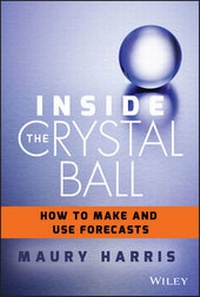
Inside the Crystal Ball
Description

More details
Other editions
Additional editions
Person
Content
Acknowledgments xiii
Introduction: What You Need to Know about Forecasting xv
Chapter 1 What Makes a Successful Forecaster? 1
Grading Forecasters: How Many Pass? 2
Why It's So Difficult to Be Prescient 8
Bad Forecasters: One-Hit Wonders, Perennial Outliers, and Copycats 16
Success Factors: Why Some Forecasters Excel 22
Does Experience Make Much of a Difference in Forecasting? 23
Chapter 2 The Art and Science of Making and Using Forecasts 27
Judgment Counts More Than Math 28
Habits of Successful Forecasters: How to Cultivate Them 34
Judging and Scoring Forecasts by Statistics 43
Chapter 3 What Can We Learn from History? 51
It's Never Normal 52
Some Key Characteristics of Business Cycles 55
National versus State Business Cycles: Does a Rising Tide Lift All Boats? 62
U.S. Monetary Policy and the Great Depression 65
The Great Inflation is Hard to Forget 68
The Great Moderation: Why It's Still Relevant 73
Why Was There Reduced Growth Volatility during the Great Moderation? 75
Chapter 4 When Forecasters Get It Wrong 79
The Granddaddy of Forecasting Debacles: The Great Depression 80
The Great Recession: Grandchild of the Granddaddy 81
The Great Recession: Lessons Learned 85
The Productivity Miracle and the "New Economy" 86
Productivity: Lessons Learned 88
Y2K: The Disaster That Wasn't 90
The Tech Crash Was Not Okay 92
Forecasters at Cyclical Turning Points: How to Evaluate Them 96
Forecasting Recessions 99
Forecasting Recessions: Lessons Learned 101
Chapter 5 Can We Believe What Washington, D.C. Tells Us? 105
Does the U.S. Government "Cook the Books" on Economic Data Reports? 106
To What Extent Are Government Forecasts Politically Motivated? 109
Can You Trust the Government's Analyses of Its Policies' Benefits? 114
The Beltway's Multiplier Mania 120
Multiplier Effects: How Real Are They? 124
Why Government Statistics Keep "Changing Their Mind" 127
Living with Revisions 133
Chapter 6 Four Gurus of Economics: Whom to Follow? 137
Four Competing Schools of Economic Thought 139
Minskyites: Should We Keep Listening to Them? 140
Monetarists: Do They Deserve More Respect? 149
Supply-Siders: Still a Role to Play? 156
Keynesians: Are They Just Too Old-Fashioned? 161
Chapter 7 The "New Normal": Time to Curb Your Enthusiasm? 171
Must Forecasters Restrain Multiyear U.S. Growth Assumptions? 173
Supply-Side Forecasting: Labor, Capital, and Productivity 175
Are Demographics Destiny? 179
Pivotal Productivity Projections 184
Chapter 8 Animal Spirits: The Intangibles Behind Business Spending 199
Animal Spirits on Main Street and Wall Street 201
Can We Base Forecasts on Confidence Indexes? 207
Business Confidence and Inventory Building 208
How Do Animal Spirits Relate to Job Creation? 213
Confidence and Capital Spending: Do They Move in Tandem? 217
Animal Spirits and Capital Spending 226
Chapter 9 Forecasting Fickle Consumers 229
Making and Spending Money 230
How Do Americans Make Their Money? 231
Will We Ever Start to Save More Money? 237
Why Don't Americans Save More? 239
More Wealth = Less Saving 240
Do More Confident Consumers Save Less and Spend More? 248
Does Income Distribution Make a Difference for Saving and Consumer Spending? 250
Pent-Up Demand and Household Formation 252
Chapter 10 What Will It Cost to Live in the Future? 259
Whose Prices Are You Forecasting? 260
Humans Cannot Live on Just Core Goods and Services 261
Sound Judgment Trumps Complexity in Forecasting Inflation 266
Should We Forecast Inflation by Money Supply or Phillips Curve? 271
Hitting Professor Phillips' Curve 271
A Statistical Lesson from Reviewing Phillips Curve Research 280
Chapter 11 Interest Rates: Forecasters' Toughest Challenge 285
Figuring the Fed 288
Federal Open Market Committee 288
What is the Fed's "Reaction Function"? 290
Is the Fed "Behind the Curve"? 293
Can the Fed "Talk Down" Interest Rates? 294
Bond Yields: How Reliable Are "Rules of Thumb"? 294
Professor Bernanke's Expectations-Oriented Explanation of Long-Term Interest Rate Determinants 297
Supply and Demand Models of Interest Rate Determination 299
When Will OPEC, Japan, and China Stop Buying Our Bonds? 302
What Will Be the Legacy of QE for Interest Rates? 304
What is the Effect of Fed MBS Purchases on Mortgage Rates? 309
Will Projected Future Budget Deficits Raise Interest Rates? 309
Chapter 12 Forecasting in Troubled Times 315
Natural Disasters: The Economic Cons and Pros 316
How to Respond to a Terrorist Attack 321
Why Oil Price Shocks Don't Shock So Much 325
Market Crashes: Why Investors Don't Jump from Buildings Anymore 332
Contagion Effects: When China Catches Cold, Will the United States Sneeze? 334
Chapter 13 How to Survive and Thrive in Forecasting 341
Surviving: What to Do When Wrong 345
Hold or Fold? 348
Thriving: Ten Keys to a Successful Career 349
About the Author 355
Index 357
Introduction
What You Need to Know about Forecasting
Everybody forecasts-it is an essential part of our lives. Predicting future outcomes is critical for success in everything from investing to careers to marriage. No one always makes the right choices, but we all strive to come close. This book shows you how to improve your decision-making by understanding how and why forecasters succeed-and sometimes fail-in their efforts. We're all familiar with economists' supposed ineptitude as prognosticators, but those who have been successful have lessons to teach us all.
I have been fortunate to have had a long and successful career in the field of economic forecasting, first at the Federal Reserve Bank of New York and the Bank for International Settlements, and then, for the majority of my working life, on Wall Street. Often I am asked about so-called tricks of the trade, of which there are many. People want to know my strategies and tactics for assembling effective forecasts and for convincing clients to trust me, even though no one's forecasts, including my own, are right all of the time. But most often, people ask me to tell them what they need to know in simple and accessible language. They want actionable information without having to wade through dense math, mounds of complicated data, or "inside-baseball" verbiage.
With that need in mind, Inside the Crystal Ball aims to help improve anyone's ability to forecast. It's designed to increase every reader's ability to make and communicate advice about the future to clients, bosses, colleagues, and anyone else whom we need to convince or whom we want to retain as a loyal listener. As such, this book shows you how to evaluate advice about the future more effectively. Its focus on the nonmathematical, judgmental element of forecasting is an ideal practitioners' supplement to standard statistical forecasting texts.
Forecasting in the worlds of business, marketing, and finance often hinges on assumptions about the U.S. economy and U.S. interest rates. Successful business forecasters, therefore, must have a solid understanding of the way the U.S. economy works. And as economic forecasts are a critical input for just about all others, delving deeper into this discipline can improve the quality of predictions in fields such as business planning, marketing, finance, and investments.
In U.S. universities, economics courses have long been among the most popular elective classes of study. However, there is an inevitable division of labor between academicians, who advance theoretical and empirical economic research, and practitioners.
My professional experience incorporates some of the most significant economic events of the past 40 years. I've "been there, done that" in good times and in bad, in stable environments and in volatile ones. One of the most valuable lessons I learned is that there is no substitute for real-world experience. Experience gives one the ability to address recurring forecasting problems and a history to draw on in making new predictions. And although practice does not make perfect, experienced forecasters generally have more accurate forecasting records than their less seasoned colleagues.
In my career, I have witnessed many forecasting victories and blunders, each of which had a huge impact on the U.S. economy. Every decade saw its own particular conditions-its own forecasting challenges. These events provide more than historical anecdotes: They offer fundamental lessons in forecasting.
At the start of my career as a Wall Street forecaster, I struggled, but I became much better over time. According to a study of interest rate forecasters published by the Wall Street Journal in 1993, I ranked second in accuracy among 34 bond-rate forecasters for the decade of the 1980s.1 MarketWatch, in 2004, 2006, and again in 2008 ranked me and my colleague James O'Sullivan as the most accurate forecasters of week-ahead economic data. In the autumn of 2011, Bloomberg News cited my team at UBS as the most accurate forecasters across a broad range of economic data over a two-year period.2 Earning these accolades has been a long and exciting journey.
When I first peered into the crystal ball of forecasting I found cracks. I had joined the forecasting team in the Business Conditions Division at the Federal Reserve Bank of New York in 1973-just in time to be an eyewitness to what would become, then, the worst recession since the Great Depression. As the team's rookie, I did not get to choose my assignment, and I was handed the most difficult economic variable to forecast: inventories. It was a trial by fire as I struggled to build models of the most slippery of economic statistics. But it turned out to be a truly great learning experience. Mastering the mechanics of the business cycle is one of the most important steps in forecasting it-in any economy.
A key lesson to be learned from the failures of past forecasters is to avoid being a general fighting the last war. Fed officials were so chastened by their failure to foresee the severity of the 1973-1975 recession and the associated postwar high in the unemployment rate that they determined to do whatever was necessary not to repeat that mistake. But in seeking to avoid it, they allowed real (inflation-adjusted) interest rates to stay too low for too long, thus opening the door to runaway inflation. My ringside seat to this second forecasting fiasco of the 1970s taught me that past mistakes can definitely distort one's view of the future.
By the 1980s, economists knew that the interest-rate fever in the bond market would break when rates rose enough to whack inflation. But hardly anyone knew the "magic rate" at which that would occur. With both interest rates and inflation well above past postwar experience, history was not very helpful. That is, unless the forecaster could start to understand the likely analytics of a high inflation economy-a topic to be discussed in later chapters.
The 1990s started with a credit crunch, which again caught the Fed off guard. A group of U.S. senators, who had been pestered by credit-starved constituents, were forced to pester then-Fed Chair Alan Greenspan to belatedly recognize just how restrictive credit had become.3,4 That episode taught forecasters how to evaluate the Fed's quarterly Senior Loan Officer Opinion Survey more astutely. Today the Survey remains an underappreciated leading indicator, as we discuss in Chapter 9.
The economy improved as the decade progressed. In fact, growth became so strong that many economists wanted the Fed to tighten monetary policy to head off the possibility of higher inflation in the future. In the ensuing debate about the economy's so-called speed limit, a key issue was productivity growth. Fed Chair Greenspan this time correctly foresaw that a faster pace of technological change and innovation was enhancing productivity growth, even if the government's own statisticians had difficulty capturing it in their official measurements. Out of this episode came some important lessons on what to do when the measurement of a critical causal variable is in question.
A forecasting success story for most economists was to resist becoming involved in the public's angst over Y2K: the fearful anticipation that on January 1, 2000, the world's computers, programmed with two-digit dates, would not be able to understand that we were in a new century and would no longer function. Throughout 1999, in fact, pundits issued ever more dire warnings that, because of this danger, the global economy could grind to a halt even before the New Year's bells stopped ringing. Most economic forecasters, though, better understood the adaptability of businesses to such an unusual challenge. We revisit this experience later, to draw lessons on seeing through media hype and maintaining a rational perspective on what really makes businesses adapt.
Forecasters did not do well in anticipating the mild recession that began in 2001. The tech boom, which helped fuel growth at the end of the previous decade and made Alan Greenspan appear very astute in his predictions on productivity, also set the stage for a capital expenditure (capex) recession. Most economists became so enthralled with the productivity benefits of the tech boom that they lost sight of the inevitable negative consequences of overinvestment in initially very productive fields.
Perhaps the largest of all forecasting blunders was the failure to foresee the U.S. home price collapse that began in 2007. It set into motion forces culminating in the worst recession since the Great Depression-the Great Recession. Such an error merits further consideration in Chapter 4, focusing on specific episodes in which forecasters failed.
By now, it should be clear that experience counts-both for the historical perspective it confers and for having addressed repetitive problems, successfully, over a number of decades. In reading this book, you will live my four decades of experience and learn to apply my hard-learned lessons to your own forecasting.
The book begins by assessing why some forecasters are more reliable than others. I then present my approach to both the statistical and judgmental aspects of forecasting. Subsequent chapters are focused on some long-standing forecasting challenges (e.g., reliance on government information, shifting business "animal spirits," and fickle consumers)...
