

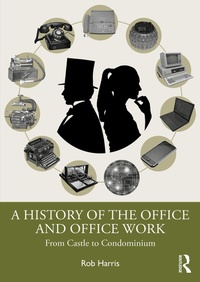
A History of the Office and Office Work
From Castle to Condominium
1st Edition
Published on 8. April 2025
412 pages
978-1-040-32334-2 (ISBN)
Description

This book brings together the office and office working as an economic construct, as a business function, as a building type and as a mode of work. It explores social and economic relations, and it traces the evolution of work and the environment and equipment needed to support it over the last 400 years. In so doing, it helps to fill a void in popular understanding of the office.
The role of the office has been examined over the past three years in ways that it has never been examined before. Whilst the existential crisis arising from COVID-19 has settled somewhat, there remain big questions over the future of office workers and office real estate. This book is a timely, well-researched and fascinating contribution to the debate.
Rob Harris explores how the nature of work has changed, and continues to change, placing the events surrounding COVID-19 into a longer-term perspective and asking what is the future of the office? Will it go through a radical reinvention? How will office work evolve in the future? Whither office buildings? The book emphasises the continuum of change and that today's events are simply the latest stage of change, rather than something entirely novel.
This book will be of interest to anyone with a stake in the built environment, whether as an investor, occupier, owner, manager or advisor. It is equally accessible to those with a non-technical background, including students on courses such as economic history, economics, geography, real estate and urban planning.
The role of the office has been examined over the past three years in ways that it has never been examined before. Whilst the existential crisis arising from COVID-19 has settled somewhat, there remain big questions over the future of office workers and office real estate. This book is a timely, well-researched and fascinating contribution to the debate.
Rob Harris explores how the nature of work has changed, and continues to change, placing the events surrounding COVID-19 into a longer-term perspective and asking what is the future of the office? Will it go through a radical reinvention? How will office work evolve in the future? Whither office buildings? The book emphasises the continuum of change and that today's events are simply the latest stage of change, rather than something entirely novel.
This book will be of interest to anyone with a stake in the built environment, whether as an investor, occupier, owner, manager or advisor. It is equally accessible to those with a non-technical background, including students on courses such as economic history, economics, geography, real estate and urban planning.
Reviews / Votes
"In taking us from 'castle' to 'condominium', Rob Harris takes us on a journey that might be seen as circular in nature. We start with private banks in grand residences and arrive in the era of home working assisted by Artificial Intelligence. In moving from 'market' to 'factory' to 'corporate' to 'digital' - the four office ages described in the book - we are given a rigorously researched expert view of not just how the office and office work has developed over time but how it might fare in the future."Jeremy Myerson, Professor Emeritus, Royal College of Art; Chairman, WORKTECH Academy
More details
Edition
1. Auflage
Language
English
Place of publication
London
United Kingdom
Publishing group
Taylor & Francis Ltd
Target group
College/higher education
Professional and scholarly
Illustrations
85 Halftones, black and white; 85 Illustrations, black and white
File size
103,52 MB
ISBN-13
978-1-040-32334-2 (9781040323342)
Copyright in bibliographic data and cover images is held by Nielsen Book Services Limited or by the publishers or by their respective licensors: all rights reserved.
Schweitzer Classification
Other editions
Additional editions
Book
04/2025
1st Edition
Routledge
€234.30
Shipment within 10-20 days
Book
04/2025
1st Edition
Routledge
€92.30
Shipment within 10-20 days

Book
04/2025
Routledge
Unfortunately, price unknown
Article exhausted; check different version
Person
Rob Harris is a consultant and analyst in the commercial real estate sector, where he has spent over three decades advising developers, investors, occupiers and public sector bodies. He established Ramidus Consulting Limited in 2003 as a specialist, independent built environment research and advisory business. Rob presents widely on a range of property market issues.
Content
Acknowledgements
List of figures
About the author
Foreword by Jeremy Myerson
Acknowledgements
Chapter 1 Perspectives on offices
Part I 1670-1770: building blocks of the office economy
Chapter 2 The basis of trading
Chapter 3 A new economy of mercantilist capitalism
Part II 1770-1870: bank house to office building
Chapter 4 Banking business
Chapter 5 Clerking: laborious and monotonous
Chapter 6 Offices take shape
Part III 1870-1945: the white collar factory
Chapter 7 A new organisation of society
Chapter 8 Gentleman all-rounder to office worker
Chapter 9 The machine age
Chapter 10 Cultural and rational filing cases
Part IV 1945-1990: the corporate office
Chapter 11 Blitz to Big Bang
Chapter 12 New environments for working
Chapter 13 Three centuries of change: from clerk to nomad
Part V 1990 onwards: the digital office and beyond
Chapter 14 The digital office
Chapter 15 The office in the network era
List of figures
About the author
Foreword by Jeremy Myerson
Acknowledgements
Chapter 1 Perspectives on offices
Part I 1670-1770: building blocks of the office economy
Chapter 2 The basis of trading
Chapter 3 A new economy of mercantilist capitalism
Part II 1770-1870: bank house to office building
Chapter 4 Banking business
Chapter 5 Clerking: laborious and monotonous
Chapter 6 Offices take shape
Part III 1870-1945: the white collar factory
Chapter 7 A new organisation of society
Chapter 8 Gentleman all-rounder to office worker
Chapter 9 The machine age
Chapter 10 Cultural and rational filing cases
Part IV 1945-1990: the corporate office
Chapter 11 Blitz to Big Bang
Chapter 12 New environments for working
Chapter 13 Three centuries of change: from clerk to nomad
Part V 1990 onwards: the digital office and beyond
Chapter 14 The digital office
Chapter 15 The office in the network era
