

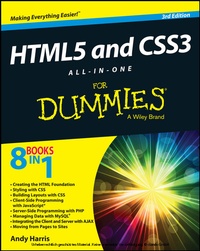
HTML5 and CSS3 All-in-One For Dummies
Description

A new edition of a bestseller covers the latest advances in web development!
HTML5 and CSS3 are essential tools for creating dynamic websites and boast updates and enhanced features that can make your websites even more effective and unique. This friendly, all-in-one guide covers everything you need to know about each of these technologies and their latest versions so that you can use them together. Building on the bestselling formats of the first two editions, this new edition teaches you the fundamentals of HTML5 and CSS3, and then presents ways for using them with JavaScript, MySQL, and Ajax to create websites that work.
- Covers using JavaScript, PHP, MySQL, and Ajax in the context of programming dynamic web pages with CSS3 and HTML5
- Includes self-contained minibooks that review HTML, CSS, design and layout, client-side JavaScript, Ajax and server-side, and putting it all together
- Examines new web development advancements including new technologies and changes to the standards
- Features a website that contains supporting materials including code and several valuable programs that are useful for web development
HTML5 and CSS3 All-in-One For Dummies, 3rd Edition serves as the perfect reference for both web development beginners and seasoned professionals looking to learn more about how to get the most out of the powerful combination of HTML5 and CSS3.
All prices
More details
Other editions
Additional editions
Person
Andy Harris taught himself programming because it was fun. Today he teaches computer science, game development, and web programming at the university level; is a technology consultant for the state of Indiana; has helped people with disabilities to form their own web development companies; and works with families who wish to teach computing at home.
Content
Introduction 1
Part I: Creating the HTML Foundation 7
Chapter 1: Sound HTML Foundations 9
Chapter 2: It's All About Validation 19
Chapter 3: Choosing Your Tools 33
Chapter 4: Managing Information with Lists and Tables 51
Chapter 5: Making Connections with Links 67
Chapter 6: Adding Images, Sound, and Video 77
Chapter 7: Creating Forms 105
Part II: Styling with CSS 129
Chapter 1: Coloring Your World 131
Chapter 2: Styling Text 149
Chapter 3: Selectors: Coding with Class and Style 175
Chapter 4: Borders and Backgrounds 197
Chapter 5: Levels of CSS 225
Chapter 6: CSS Special Effects 245
Part III: Building Layouts with CSS 263
Chapter 1: Fun with the Fabulous Float 265
Chapter 2: Building Floating Page Layouts 285
Chapter 3: Styling Lists and Menus 309
Chapter 4: Using Alternative Positioning 327
Part IV: Client-Side Programming with JavaScript 353
Chapter 1: Getting Started with JavaScript 355
Chapter 2: Talking to the Page 375
Chapter 3: Decisions and Debugging 399
Chapter 4: Functions, Arrays, and Objects 429
Chapter 5: Getting Valid Input 459
Chapter 6: Drawing on the Canvas 483
Chapter 7: Animation with the Canvas 511
Part V: Server-Side Programming with PHP 527
Chapter 1: Getting Started on the Server 529
Chapter 2: PHP and HTML Forms 549
Chapter 3: Using Control Structures 569
Chapter 4: Working with Arrays 587
Chapter 5: Using Functions and Session Variables 605
Chapter 6: Working with Files and Directories 617
Chapter 7: Exceptions and Objects 639
Part VI: Managing Data with MySQL 653
Chapter 1: Getting Started with Data 655
Chapter 2: Managing Data with MySQL 679
Chapter 3: Normalizing Your Data 705
Chapter 4: Putting Data Together with Joins 719
Chapter 5: Connecting PHP to a MySQL Database 741
Part VII: Integrating the Client and Server with AJAX 759
Chapter 1: AJAX Essentials 761
Chapter 2: Improving JavaScript and AJAX with jQuery 775
Chapter 3: Animating jQuery 795
Chapter 4: Using the jQuery User Interface Toolkit 819
Chapter 5: Improving Usability with jQuery 841
Chapter 6: Working with AJAX Data 859
Chapter 7: Going Mobile 883
Part VIII: Moving from Pages to Sites 909
Chapter 1: Managing Your Servers 911
Chapter 2: Planning Your Sites 933
Chapter 3: Introducing Content Management Systems 953
Chapter 4: Editing Graphics 977
Chapter 5: Taking Control of Content 995
Index 1015
Introduction
I love the Internet, and if you picked up this book, you probably do, too. The Internet is dynamic, chaotic, exciting, interesting, and useful, all at the same time. The web is pretty fun from a user's point of view, but that's only part of the story. Perhaps the best part of the Internet is how participatory it is. You can build your own content — free! It's really amazing. There's never been a form of communication like this before. Anyone with access to a minimal PC and a little bit of knowledge can create his or her own homestead in one of the most exciting platforms in the history of communication.
The real question is how to get there. A lot of web development books are really about how to use some sort of software you have to buy. That's okay, but it isn't necessary. Many software packages have evolved that purport to make web development easier — and some work pretty well — but regardless what software package you use, there's still a need to know what's really going on under the surface. That's where this book comes in.
About This Book
You'll find out exactly how the web works in this book. You'll figure out how to use various tools, but, more importantly, you'll create your piece of the web. You'll discover:
- How web pages are created: You'll figure out the basic structure of web pages. You'll understand the structure well because you build pages yourself. No mysteries here.
- How to separate content and style: You'll understand the foundation of modern thinking about the Internet — that style should be separate from content.
- How to use web standards: The web is pretty messy, but, finally, some standards have arisen from the confusion. You'll discover how these standards work and how you can use them.
- How to create great-looking web pages: Of course, you want a terrific-looking website. With this book, you'll find out how to use layout, style, color, and images.
- How to build modern layouts: Many web pages feature columns, menus, and other fancy features. You'll figure out how to build all these things.
- How to add interactivity: Adding forms to your pages, validating form data, and creating animations are all possible with the JavaScript language.
- How to write programs on the server: Today's web is powered by programs on web servers. You'll discover the powerful PHP language and figure out how to use it to create powerful and effective sites.
- How to harness the power of data: Every web developer eventually needs to interact with data. You'll read about how to create databases that work. You'll also discover how to connect databases to your web pages and how to create effective and useful interfaces.
- How AJAX is changing everything: The hottest web technology on the horizon is AJAX (Asynchronous JavaScript and XML). You'll figure out how to harness this way of working and use it to create even more powerful and interesting applications.
Foolish Assumptions
I don't have any foolish assumptions: I'm not assuming anything in this book. If you've never built a web page before, you're in the right hands. You don't need any experience, and you don't have to know anything about HTML, programming, or databases. I discuss everything you need.
If you're reasonably comfortable with a computer (you can navigate the web and use a word processor), you have all the skills you need.
If you've been around web development for a while, you'll still find this book handy.
If you've used HTML but not HTML5, see how things have changed and discover the powerful combination of HTML5 and CSS3.
You'll see how new HTML and CSS features can literally make your web pages sing and dance, with support for advanced tools like audio and video embedding, animation, and much more.
If you're already comfortable with HTML and CSS, you're ready to add JavaScript functionality for form validation and animation. If you've never used a programming language before, JavaScript is a really great place to start.
If you're starting to get serious about web development, you've probably already realized that you'll need to work with a server at some point. PHP is a really powerful, free, and easy language that's extremely prominent on the web landscape. You'll use this to have programs send e-mails, store and load information from files, and work with databases.
If you're messing with commercial development, you'll definitely need to know more about databases. I get e-mails every week from companies looking for people who can create a solid relational database and connect it to a website with PHP.
If you're curious about AJAX, you can read about what it is, how it works, and how to use it to add functionality to your site. You'll also read about a very powerful and easy AJAX library that can add tremendous functionality to your bag of tricks.
I wrote this book as the reference I wish I had. If you have only one web development book on your shelf, this should be the one. Wherever you are in your web development journey, you can find something interesting and new in this book.
Use Any Computer
One of the great things about web development is how accessible it can be. You don't need a high-end machine to build websites. Whatever you're using now will probably do fine. I tested most of the examples in this book with Windows 7, Ubuntu Linux, and a Macbook pro. I've tested on computers ranging from cutting-edge platforms to mobile devices to a $35 Raspberry Pi. Most of the software I use in the book is available free for all major platforms. Similar alternatives for all platforms are available in the few cases when this isn't true.
Don't Buy Any Software
Everything you need for web development is on the companion website. I've used only open-source software for this book. Following are the highlights:
- Komodo Edit: Komodo Edit is my current favorite editor. It's a solid free text editor well suited to the many text-editing tasks you'll run across in your programming travels. It also works exactly the same on every platform, so it doesn't really matter what computer or operating system you're running.
- XAMPP: When you're ready to move to the server, XAMPP is a complete server package that's easy to install and incredibly powerful. This includes the incredible Apache web server, the PHP programming language, the MySQL database manager, and tons of useful utilities.
- Useful tools: Every time I use a tool (such as a data mapper, a diagram tool, or an image editor) in this book, I make it available on the companion website.
There's no need to buy any expensive web development tools. Everything you need is here and no harder than the more expensive web editors.
How This Book Is Organized
Web development is about solving a series of connected but different problems. This book is organized into eight minibooks based on specific technologies. You can read them in any order you wish, but you'll find that the later books tend to rely on topics described in the earlier books. (For example, JavaScript doesn't make much sense without HTML because JavaScript is usually embedded in a web page written with HTML.) The following describes these eight minibooks:
- Book I: Creating the HTML Foundation — Web development incorporates a lot of languages and technologies, but HTML is the foundation. Here I show you HTML5, the latest incarnation of HTML, and describe how it's used to form the basic skeleton of your pages.
- Book II: Styling with CSS — In the old days, HTML had a few tags to spruce up your pages, but they weren't nearly powerful enough. Today, developers use Cascading Style Sheets (CSS) to add color and formatting to your pages as well as zing and pizazz. (I'm pretty sure those are formal computer programming words.)
- Book III: Building Layouts with CSS — Discover the best ways to set up layouts with floating elements, fixed positioning, and absolute positioning. Figure out how to build various multicolumn page layouts and how to create dynamic buttons and menus.
- Book IV: Client-Side Programming with JavaScript — Figure out essential programming skills with the easy and powerful JavaScript language — even if you've never programmed before. Manipulate data in web forms and use powerful regular expression technology to validate form entries. Also discover how to create animations with JavaScript with the powerful new <canvas> element.
- Book V: Server-Side Programming with PHP — Move your code to the server and take advantage of this powerful language. Figure out how to respond to web requests; work with conditions, functions, objects, and text files; and connect to databases.
- Book VI: Managing Data with MySQL — Most serious Web projects are eventually about data. Figure out how databases are created, how to set up a secure data server, the basics of data normalization, and how to create a reliable and trustworthy data back end for your site.
- Book VII:...
