

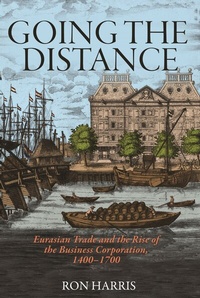
Going the Distance
Eurasian Trade and the Rise of the Business Corporation, 1400-1700
1st Edition
Published on 9. March 2020
488 pages
978-0-691-18580-4 (ISBN)
Description

A historical look at the early evolution of global trade and how this led to the creation and dominance of the European business corporation
Before the seventeenth century, trade across Eurasia was mostly conducted in short segments along the Silk Route and Indian Ocean. Business was organized in family firms, merchant networks, and state-owned enterprises, and dominated by Chinese, Indian, and Arabic traders. However, around 1600 the first two joint-stock corporations, the English and Dutch East India Companies, were established. Going the Distance tells the story of overland and maritime trade without Europeans, of European Cape Route trade without corporations, and of how new, large-scale, and impersonal organizations arose in Europe to control long-distance trade for more than three centuries.
Ron Harris shows that by 1700, the scene and methods for global trade had dramatically changed: Dutch and English merchants shepherded goods directly from China and India to northwestern Europe. To understand this transformation, Harris compares the organizational forms used in four major regions: China, India, the Middle East, and Western Europe. The English and Dutch were the last to leap into Eurasian trade, and they innovated in order to compete. They raised capital from passive investors through impersonal stock markets and their joint-stock corporations deployed more capital, ships, and agents to deliver goods from their origins to consumers.
Going the Distance explores the history behind a cornerstone of the modern economy, and how this organizational revolution contributed to the formation of global trade and the creation of the business corporation as a key factor in Europe's economic rise.
Before the seventeenth century, trade across Eurasia was mostly conducted in short segments along the Silk Route and Indian Ocean. Business was organized in family firms, merchant networks, and state-owned enterprises, and dominated by Chinese, Indian, and Arabic traders. However, around 1600 the first two joint-stock corporations, the English and Dutch East India Companies, were established. Going the Distance tells the story of overland and maritime trade without Europeans, of European Cape Route trade without corporations, and of how new, large-scale, and impersonal organizations arose in Europe to control long-distance trade for more than three centuries.
Ron Harris shows that by 1700, the scene and methods for global trade had dramatically changed: Dutch and English merchants shepherded goods directly from China and India to northwestern Europe. To understand this transformation, Harris compares the organizational forms used in four major regions: China, India, the Middle East, and Western Europe. The English and Dutch were the last to leap into Eurasian trade, and they innovated in order to compete. They raised capital from passive investors through impersonal stock markets and their joint-stock corporations deployed more capital, ships, and agents to deliver goods from their origins to consumers.
Going the Distance explores the history behind a cornerstone of the modern economy, and how this organizational revolution contributed to the formation of global trade and the creation of the business corporation as a key factor in Europe's economic rise.
More details
Language
English
Place of publication
Princeton, NJ
United States
Publishing group
De Gruyter
Target group
Professional and scholarly
Edition type
Digital original
Product notice
Reflowable
Illustrations
28 b/w illus. 20 tables. 14 maps.
ISBN-13
978-0-691-18580-4 (9780691185804)
Schweitzer Classification
Other editions
Additional editions
Book
02/2020
Princeton University Press
€55.71
Shipment within 10-20 days
Person
Ron Harris is professor of legal history and former dean of law at Tel Aviv University. He is the author of Industrializing English Law.
Content
- Cover
- Title Page
- Copyright Page
- CONTENTS
- Acknowledgments
- Note on the Use of City Names
- Introduction
- Part I. The Context: Geography, Historiography, Theory
- 1 Environment and Trade
- 2 Thoretical Frameworks for Analyzing the Development of Institutions in Interaction with Their Environment
- Part II. Organizational Building Blocks
- 3 Universal Building Blocks
- 4 Varying Organizational Building Blocks
- 5 The Commenda
- Part III. Long- Distance Trade Enterprises on the Eve of the Organizational Revolution
- 6 Family Firms in Three Regions
- 7 Merchant Networks
- 8 Trade by Rulers and States
- Part IV. The Corporation Transformed: The Era of Impersonal Cooperation
- 9 The origins of the Business Corporation
- 10 The Dutch East India Company
- 11 The English East India Company
- 12 Why Did the Corporation Only Evolve in Europe?
- Conclusion: Institutional Migration and the Corporation
- Notes
- Bibliography
- Index
