

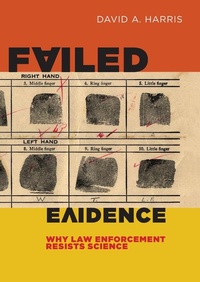
Failed Evidence
Why Law Enforcement Resists Science
Published on 3. September 2012
277 pages
978-0-8147-4466-6 (ISBN)
Description

With the popularity of crime dramas like CSI focusing on forensic science, and increasing numbers of police and prosecutors making wide-spread use of DNA, high-tech science seems to have become the handmaiden of law enforcement. But this is a myth,asserts law professor and nationally known expert on police profiling David A. Harris. In fact, most of law enforcement does not embrace science-it rejects it instead, resisting it vigorously. The question at the heart of this book is why.
>>>> Eyewitness identifications procedures using simultaneous lineups-showing the witness six persons together,as police have traditionally done-produces a significant number of incorrect identifications.
>>>> Interrogations that include threats of harsh penalties and untruths about the existence of evidence proving the suspect's guilt significantly increase the prospect of an innocent person confessing falsely.
>>>> Fingerprint matching does not use probability calculations based on collected and standardized data to generate conclusions, but rather human interpretation and judgment.Examiners generally claim a zero rate of error - an untenable claim in the face of publicly known errors by the best examiners in the U.S.
Failed Evidence explores the real reasons that police and prosecutors resist scientific change, and it lays out a concrete plan to bring law enforcement into the scientific present. Written in a crisp and engaging style, free of legal and scientific jargon, Failed Evidence will explain to police and prosecutors, political leaders and policy makers, as well as other experts and anyone else who cares about how law enforcement does its job, where we should go from here. Because only if we understand why law enforcement resists science will we be able to break through this resistance and convince police and prosecutors to rely on the best that science has to offer. Justice demands no less.
Visit the author's blog here.
>>>> Eyewitness identifications procedures using simultaneous lineups-showing the witness six persons together,as police have traditionally done-produces a significant number of incorrect identifications.
>>>> Interrogations that include threats of harsh penalties and untruths about the existence of evidence proving the suspect's guilt significantly increase the prospect of an innocent person confessing falsely.
>>>> Fingerprint matching does not use probability calculations based on collected and standardized data to generate conclusions, but rather human interpretation and judgment.Examiners generally claim a zero rate of error - an untenable claim in the face of publicly known errors by the best examiners in the U.S.
Failed Evidence explores the real reasons that police and prosecutors resist scientific change, and it lays out a concrete plan to bring law enforcement into the scientific present. Written in a crisp and engaging style, free of legal and scientific jargon, Failed Evidence will explain to police and prosecutors, political leaders and policy makers, as well as other experts and anyone else who cares about how law enforcement does its job, where we should go from here. Because only if we understand why law enforcement resists science will we be able to break through this resistance and convince police and prosecutors to rely on the best that science has to offer. Justice demands no less.
Visit the author's blog here.
Reviews / Votes
Failed Evidence is a masterful expose of both the flaws in our criminal justice system and the reasons many police and prosecutors are unwilling to correct them. If real change is to occur, would-be reformers need to ingest this book. Its prescriptions, all based on the latest scientific findings, would go a long way toward eliminating wrongful convictions and ensuring accurate verdicts. - Christopher Slobogin,Vanderbilt University Law School David Harris, the nation's leading expert on racial profiling, turns his attention in this timely book to exposing the flaws in three standard investigative techniques used to solve crimes: interrogations, eyewitness identifications, and forensic science. In clear, accessible language, he shows how these flaws can lead juries to convict innocent individuals. He also discusses why those in the best position to address these flaws are likely to resist reform. A must-read for anyone interested in a behind-the-scenes look at the criminal justice system. - Cynthia Lee,Charles Kennedy Poe Research Professor of Law, George Washington University Overall, the book serves as a vital resource for those seeking to overcome the system's reliance on failed evidence by identifying sources of the problem and suggesting both quick and long-term remedies. It will help ensure the adoption of evidence-based methods that can achieve more accurate results in the nation's criminal justice system. - Tony Bornstein (The Champion) Wrongful convictions are the worst error the American criminal justice system can make. And yet in the last two decades we have learned both that we regularly convict the innocent and that, as a result of empirical advances in the social sciences, we now know what reforms are necessary to substantially decrease the risk of wrongful conviction.David Harriss well-written and engaging book, Failed Evidence: Why Law Enforcement Resists Science, brilliantly synthesizes this research and its implications, astutely connecting the dots from the reasons why wrongful convictions occur to the solutions necessary to prevent them. If there is one book that I would recommend to policymakers, criminal defense attorneys and prosecutors, police or the members of the general public about the subject of wrongful conviction, it is Failed Evidence: Why Law Enforcement Resists Science.This first rate book is brimming with insight and intelligence. - Richard A. Leo,University of San Francisco Primarily intended for those in law enforcement, forensic science, and the legal fields, this book details potential pitfalls of the way investigative work is conducted and suggests new alternatives. (Library Journal) This book should be required reading for every potential juror. (Post-Gazette) For readers interesting in the phenomenon of unwarranted skepticism toward science, the book's chief value lies in Harris' detailed account of social and psychological factors that cause police and prosecutors to resist science-based reforms. (Science) Written in a crisp and engaging style, free of legal and scientific jargon. (UTNE)More details
Language
English
Place of publication
New York
United States
Target group
Professional and scholarly
Product notice
Reflowable
File size
2,48 MB
ISBN-13
978-0-8147-4466-6 (9780814744666)
Copyright in bibliographic data and cover images is held by Nielsen Book Services Limited or by the publishers or by their respective licensors: all rights reserved.
Schweitzer Classification
Other editions
Additional editions
Book
09/2012
New York University Press
€46.00
Shipment within 15-20 days
Person
David A. Harris is Distinguished Faculty Scholar and Professor of Law at the University of Pittsburgh. He is the author of Good Cops: The Case for Preventive Policing and Profiles in Injustice: Why Racial Profiling Cannot Work. He lives in Pittsburgh.
Content
1. Introduction: Science-Driven Policing, or Police Indifference to Science?2. Science and Traditional Police Investigative Methods: A Lot We Thought We Knew Was Wrong 3. In Their Own Words: Why Police and Prosecutors Say They Resist Science4. The Real Reasons for Resistance: Cognitive Barriers 5. The Real Reasons for Resistance: Institutional and Political Barriers6. What Must Be Done and How to Make It Happen7. Reasons for Hope: Examples of Real Change 8. Conclusion: From the Task to the Solution
