

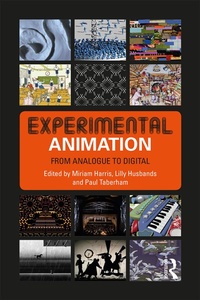
Experimental Animation
From Analogue to Digital
Published on 30. January 2019
294 pages
978-1-351-78801-4 (ISBN)
Description

Experimental Animation: From Analogue to Digital, focuses on both experimental animation's deep roots in the twentieth century, and its current position in the twenty-first century media landscape.
Each chapter incorporates a variety of theoretical lenses, including historical, materialist, phenomenological and scientific perspectives. Acknowledging that process is a fundamental operation underlining experimental practice, the book includes not only chapters by international academics, but also interviews with well-known experimental animation practitioners such as William Kentridge, Jodie Mack, Larry Cuba, Martha Colburn and Max Hattler. These interviews document both their creative process and thoughts about experimental animation's ontology to give readers insight into contemporary practice.
Global in its scope, the book features and discusses lesser known practitioners and unique case studies, offering both undergraduate and graduate students a collection of valuable contributions to film and animation studies.
Each chapter incorporates a variety of theoretical lenses, including historical, materialist, phenomenological and scientific perspectives. Acknowledging that process is a fundamental operation underlining experimental practice, the book includes not only chapters by international academics, but also interviews with well-known experimental animation practitioners such as William Kentridge, Jodie Mack, Larry Cuba, Martha Colburn and Max Hattler. These interviews document both their creative process and thoughts about experimental animation's ontology to give readers insight into contemporary practice.
Global in its scope, the book features and discusses lesser known practitioners and unique case studies, offering both undergraduate and graduate students a collection of valuable contributions to film and animation studies.
More details
Language
English
Place of publication
London
United Kingdom
Publishing group
Taylor & Francis Ltd
Target group
College/higher education
File size
3,06 MB
ISBN-13
978-1-351-78801-4 (9781351788014)
Copyright in bibliographic data and cover images is held by Nielsen Book Services Limited or by the publishers or by their respective licensors: all rights reserved.
Schweitzer Classification
Other editions
Additional editions
Book
02/2019
1st Edition
Routledge
€206.80
Shipment within 10-20 days
Book
02/2019
1st Edition
Routledge
€61.60
Shipment within 10-20 days
Persons
Miriam Harris is an experimental animator, scholar and Senior Lecturer at the Auckland University of Technology, New Zealand. She completed postgraduate study in Digital Animation and Visual Effects at Sheridan College, Toronto, and her experimental animated films have won awards at international film and animation festivals. Her essays have been published in the books Animated Worlds (2007), The Jewish Graphic Novel: Critical Approaches (2008) and 24 Czech and Polish Animators (2011). She is on the editorial board of the animation journal Animation Practice, Process, & Production, edited by Paul Wells.
Lilly Husbands is a Lecturer in Animation and Visual Culture at Middlesex University, United Kingdom. Her research is broadly concerned with the legacy and evolution of experimental animation in the context of contemporary multimedia practice. She has published numerous book chapters and articles on experimental animation in journals such as Moving Image Review & Art Journal (MIRAJ), Frames Cinema Journal and Alphaville: Journal of Film and Screen Media. She is an associate editor of Animation: An Interdisciplinary Journal.
Paul Taberham is a lecturer and scholar who has published on topics such as film cognition, evolutionary theories of art, avant-garde film and animation, film sound and aesthetics. He is the co-editor of Cognitive Media Theory (2014) and author of Lessons in Perception: The Avant-Garde Filmmaker as Practical Psychologist (2018). In addition, he has spoken internationally at conferences and published articles for several edited collections and journals including Projections: The Journal for Movies and Mind and Animation Journal. He is a fellow of The Society for Cognitive Studies of the Moving Image.
Lilly Husbands is a Lecturer in Animation and Visual Culture at Middlesex University, United Kingdom. Her research is broadly concerned with the legacy and evolution of experimental animation in the context of contemporary multimedia practice. She has published numerous book chapters and articles on experimental animation in journals such as Moving Image Review & Art Journal (MIRAJ), Frames Cinema Journal and Alphaville: Journal of Film and Screen Media. She is an associate editor of Animation: An Interdisciplinary Journal.
Paul Taberham is a lecturer and scholar who has published on topics such as film cognition, evolutionary theories of art, avant-garde film and animation, film sound and aesthetics. He is the co-editor of Cognitive Media Theory (2014) and author of Lessons in Perception: The Avant-Garde Filmmaker as Practical Psychologist (2018). In addition, he has spoken internationally at conferences and published articles for several edited collections and journals including Projections: The Journal for Movies and Mind and Animation Journal. He is a fellow of The Society for Cognitive Studies of the Moving Image.
Content
Foreword by Janeann Dill
Acknowledgements
List of Contributors
Introduction by Miriam Harris, Lilly Husbands and Paul Taberham
Definitions, Histories and Legacies
Paul Taberham - It is Alive if You Are: Defining Experimental Animation
Aimee Mollaghan - A Consideration of the Absolute in Visual Music Animation
Michael Betancourt - Experimental Animation and Motion Graphics
A1 Georges Schwizgebel
A2 Rose Bond
A3 William Kentridge
A4 Robert Sowa
From Analogue to Digital
Dan and Lienors Torre - Materiality, Experimental Process and Animated Identity
Tess Takahashi - "Meticulously, Recklessly, Worked Upon": Direct Animation, the Auratic and the Index
Miriam Harris - The Expressive Power of Experimental Digital Animation
Birgitta Hosea - Beyond a Digital Ecriture Feminine: Cyberfeminism and Experimental Computer Animation
B1 Jodie Mack
B2 Maya Yonesho
B3 Larry Cuba
B4 Max Hattler
Close Analysis of Individual Artists
Lilly Husbands - A Hermeneutic of Polyvalence: Deciphering Narrative in Lewis Klahr's The Pettifogger (2011)
Steve Reinke - How to be Human: The Animations of Jim Trainor
C1 Martha Colburn
C2 Masha Krasnova-Shabaeva
C3 Diego Akel
Science and the Cosmos
Janine Randerson - Animating the Cosmological Horizon: Between Art and Science
Aylish Wood - Where do Shapes Come From?
Sean Cubitt - NASA's Voyager Fly-by Animations
D1 Tianran Duan
D2 David Theobald
D3 Gregory Bennett
Acknowledgements
List of Contributors
Introduction by Miriam Harris, Lilly Husbands and Paul Taberham
Definitions, Histories and Legacies
Paul Taberham - It is Alive if You Are: Defining Experimental Animation
Aimee Mollaghan - A Consideration of the Absolute in Visual Music Animation
Michael Betancourt - Experimental Animation and Motion Graphics
A1 Georges Schwizgebel
A2 Rose Bond
A3 William Kentridge
A4 Robert Sowa
From Analogue to Digital
Dan and Lienors Torre - Materiality, Experimental Process and Animated Identity
Tess Takahashi - "Meticulously, Recklessly, Worked Upon": Direct Animation, the Auratic and the Index
Miriam Harris - The Expressive Power of Experimental Digital Animation
Birgitta Hosea - Beyond a Digital Ecriture Feminine: Cyberfeminism and Experimental Computer Animation
B1 Jodie Mack
B2 Maya Yonesho
B3 Larry Cuba
B4 Max Hattler
Close Analysis of Individual Artists
Lilly Husbands - A Hermeneutic of Polyvalence: Deciphering Narrative in Lewis Klahr's The Pettifogger (2011)
Steve Reinke - How to be Human: The Animations of Jim Trainor
C1 Martha Colburn
C2 Masha Krasnova-Shabaeva
C3 Diego Akel
Science and the Cosmos
Janine Randerson - Animating the Cosmological Horizon: Between Art and Science
Aylish Wood - Where do Shapes Come From?
Sean Cubitt - NASA's Voyager Fly-by Animations
D1 Tianran Duan
D2 David Theobald
D3 Gregory Bennett
